
Lead
NASA’s Perseverance rover has mapped a suite of finely laminated mudstones and associated mineral textures in Jezero Crater’s Neretva Vallis (Bright Angel formation) during surface operations in 2024–2025. Instruments including PIXL, SHERLOC, SuperCam, Mastcam‑Z, WATSON and RIMFAX identified authigenic Fe‑phosphate nodules, sulfide‑rich reaction cores and molecular signals consistent with organic carbon. A hand‑sampled core named Sapphire Canyon was collected from the Beaver Falls workspace (sol 1217) for future return. The assemblage records post‑depositional redox redistribution of Fe, P and S that the authors flag as “potential biosignatures” while noting strong abiotic alternatives.
Key takeaways
- Perseverance explored three Jezero terrains and focused on Neretva Vallis outcrops called Bright Angel and Masonic Temple; the Sapphire Canyon core was collected on sol 1217.
- Microscopic nodules (≈100–200 μm) enriched in Fe, P and Zn were found in mudstone facies; PIXL XRF and diffraction limits indicate crystallite sizes near or below 40–60 μm.
- SHERLOC Raman identified a G‑band near 1,600 cm−1—strongest at Apollo Temple—interpreted as a signature of macromolecular organic carbon in several targets (Walhalla Glades, Cheyava Falls, Apollo Temple).
- Reaction fronts with dark rims and lighter cores (“leopard spots”) range from ~200 μm to 1 mm and contain Fe‑phosphate rims and Fe–S‑rich cores consistent with greigite and related phases.
- Coarser olivine and Fe–Mg carbonate grains (0.5–2 mm) occur locally (Cheyava Falls, Steamboat Mountain), often within or adjacent to mudstone, and appear detrital rather than recrystallized.
- RIMFAX profiles show radar‑reflective layers with apparent dips up to ~30°; the Bright Angel formation lies stratigraphically above or contiguous with the Margin Unit.
- Spectral data (SuperCam, Mastcam‑Z) show weak hydration bands (~1.92 μm) and NIR/blue colour differences that track relative Fe3+ oxidation state across targets.
Background
Perseverance is part of the Mars 2020 program whose objectives include characterizing Jezero Crater’s geology, assessing past habitability and caching samples for potential return to Earth. The rover traversed the crater floor, Western Fan sediments and the olivine‑ and carbonate‑rich Margin Unit before investigating Neretva Vallis, the channel that fed the Western Fan. Bright Angel is a set of light‑toned, layered outcrops exposed on the northern and southern margins of Neretva Vallis and was prioritized because orbital imagery suggested metre‑scale layering and compositional contrasts.
Field observations on Mars combine remote, contact, and microscopic instruments: Mastcam‑Z and SuperCam provide context and spectral constraints; RIMFAX supplies subsurface stratigraphy; PIXL maps elemental chemistry and detects diffraction when possible; SHERLOC and WATSON deliver deep‑UV Raman and high‑resolution imaging for organics and fine textures. Together these datasets allow sedimentary interpretation and diagenetic reconstruction at submillimetre to outcrop scales.
Main event
In the Beaver Falls workspace (sol 1217) Perseverance studied layered blocks with alternating centimetre‑scale reddish/tan recessive beds and thinner, resistant light‑toned horizons. Instruments probed targets named Cheyava Falls (natural surface), Apollo Temple (abraded patch), and the Sapphire Canyon core (collected after in situ analysis). A darker, granular block—Steamboat Mountain—was investigated upslope as a possible transitional lithology to the Margin Unit.
Microscopy and PIXL mapping show the dominant facies is a fine‑grained mudstone (individual grains ≤30–110 μm inferred from WATSON and SHERLOC ACI resolution). Masonic Temple exposures include similar mudstones but also poorly sorted conglomerates with mm–cm intraclasts of the same mudstone, implying local variations in depositional energy.
SHERLOC Raman spectra recorded an approximately 1,600 cm−1 G band in three Bright Angel mudstone targets, with Apollo Temple the most intense. PIXL XRF indicates mudstones are enriched in SiO2, Al2O3 and FeO and depleted in MgO and MnO—consistent with chemically weathered, oxidized provenance—while SuperCam NIR spectra show shallow hydration bands and Ca‑sulfate spectral signatures consistent with bassanite.
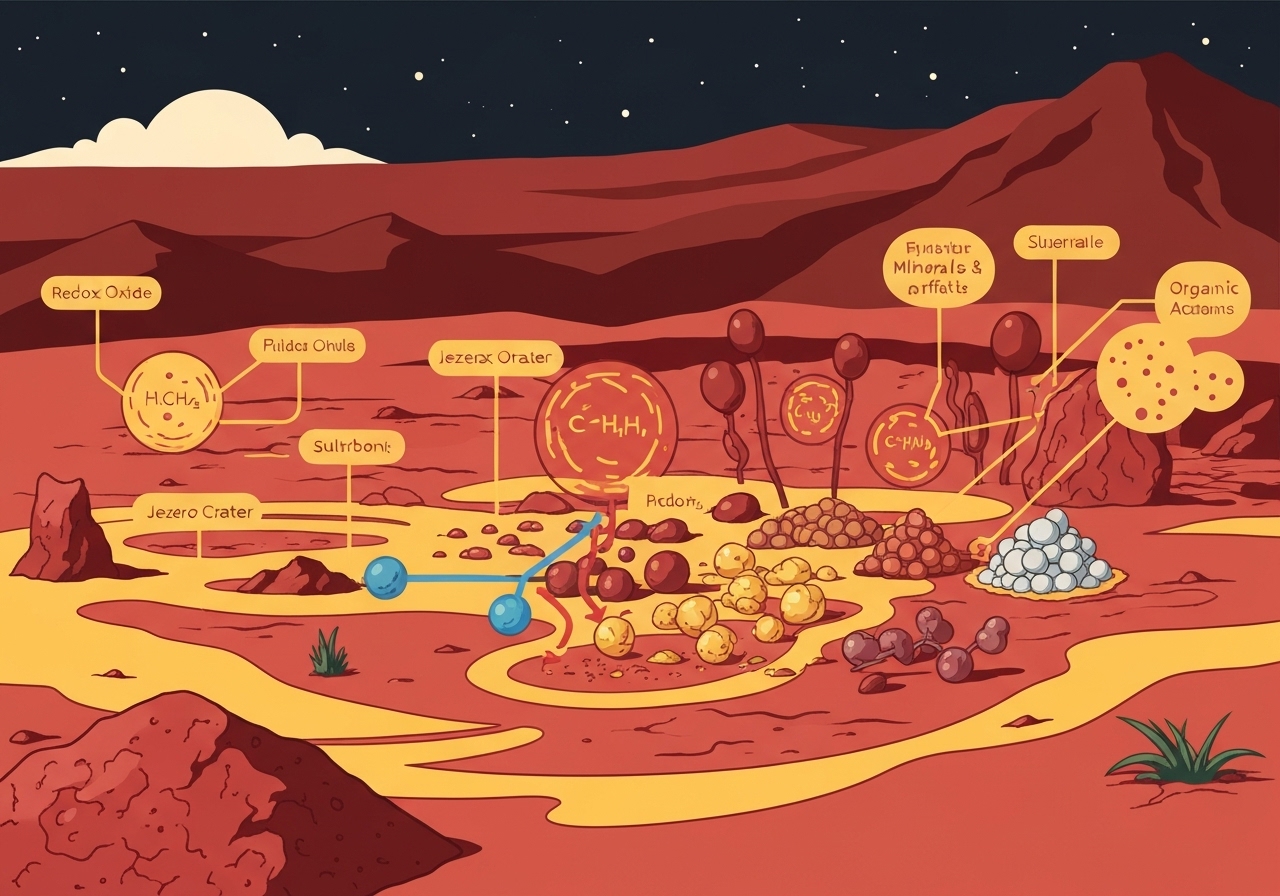
Within the mudstone, teams identified authigenic Fe‑phosphate masses and concentric reaction fronts: Fe‑phosphate nodules (100–200 μm) enriched in Fe, P and Zn, and multi‑coloured “leopard spots” with Fe‑phosphate rims and S‑, Fe‑, Ni‑ and Zn‑rich cores. XRF, colour imaging and scattering data point to greigite (Fe3S4) or related Fe‑sulfide phases in cores and possible vivianite (Fe3(PO4)2·8H2O) or its oxidized products in nodules and rims.
Analysis & implications
The assemblage documents post‑depositional redox reworking: an originally oxidized, Fe3+‑bearing mud matrix redistributed Fe and P into authigenic Fe‑phosphate phases and, locally, Fe‑sulfide phases. Two broad pathways can explain the observations. The abiotic pathway invokes inorganic reductants, magmatic sulfide input or low‑temperature chemical reactions that mobilize Fe2+ and S2−. The biological pathway invokes Fe‑ and sulfate‑reducing metabolisms that couple organic carbon oxidation to reduction of Fe and S, producing vivianite and greigite under low‑temperature, diagenetic conditions.
Several lines increase the plausibility of a biotic influence but do not prove it: (1) spatial association of macromolecular carbon (G‑band) with the highest inferred vivianite+greigite abundances (Apollo Temple); (2) concentric, in situ reaction fronts reminiscent of terrestrial reduction spots and reduction halos; and (3) Zn enrichment in nodules, which on Earth can result from sulfidation‑reoxidation cycles linked to microbial activity. Yet the authors emphasize that many abiotic mechanisms—organic catalysis of ferric oxide reduction, long‑range sulfide migration, or magmatic degassing—remain viable explanations under certain conditions.
For astrobiology, the key implication is that redox‑driven mineral fabrics plus organic signals constitute potential biosignatures that demand more data. Definitive attribution will require returned samples, isotopic measurements (Fe, S, C), higher‑resolution mineralogy, and laboratory analogue experiments to discriminate abiotic from microbially mediated pathways.
Comparison & data
| Parameter | Measured range / note |
|---|---|
| Authigenic nodule size | ≈100–200 μm |
| Reaction spot size | ≈200 μm – 1 mm |
| Olivine / carbonate grains | 0.5–2 mm (coarse sand to very coarse) |
| Imager resolutions | WATSON 17.9–36.3 μm/px; SHERLOC ACI ≈10 μm/px |
| PIXL diffraction limit | crystalline domain detection near 40–60 μm |
These measured values set constraints on how the phases formed: nodules and reaction rims are sub‑millimetre and likely authigenic rather than transported; coarse olivine grains are detrital; and the fine crystallinity (below PIXL’s diffraction threshold in many cases) argues for microcrystalline or poorly crystalline mineral forms such as bassanite or microcrystalline vivianite.
Reactions & quotes
The Nature article authors frame the discovery cautiously but clearly:
“The Bright Angel formation contains textures, chemical and mineral characteristics, and organic signatures that warrant consideration as ‘potential biosignatures’.”
Hurowitz et al., Nature (2025), peer‑reviewed team statement
NASA science project communications and independent specialists have emphasized the importance and limitations of in situ detection:
“Perseverance’s payload found compounds and textures that require sample return and laboratory isotopic work to discriminate abiotic from biotic origins.”
NASA / Mars 2020 science team (official guidance)
Laboratory specialists note the challenge of taphonomy and ambiguity:
“Vivianite and greigite can form via both microbial and abiotic diagenetic pathways; contextual geochemistry and isotopes are essential to build a case.”
Geochemistry / astrobiology expert commentary (paraphrased)
Unconfirmed
- Whether the Fe‑phosphate nodules and Fe–S cores formed principally by microbial metabolism or entirely by abiotic diagenetic reactions remains unresolved.
- The precise mineralogy of some Ca‑sulfate occurrences (bassanite versus gypsum versus anhydrite) is not uniformly indexed by PIXL diffraction and remains partially ambiguous.
- The source and timing of the reduced sulfur that produced sulfide phases (local abiotic reduction, magmatic/sulfide input at distance, or biologic sulfate reduction) are not yet constrained.
Bottom line
The Bright Angel formation in Jezero Crater presents a compact package of sedimentary mudstones, authigenic Fe‑phosphate nodules, sulfide‑bearing reaction cores and associated organic signals that together form a compelling, but not decisive, case for redox‑driven diagenesis. The distribution and chemistry of these features fit diagenetic scenarios that can be produced abiotically or by Fe‑ and sulfate‑reducing metabolisms; current in‑situ evidence cannot uniquely discriminate between them.
This discovery elevates the scientific value of the Sapphire Canyon sample and the Bright Angel suite for sample‑return priorities: returned materials will allow isotopic, mineralogical and molecular analyses that are decisive for biosignature evaluation. Meanwhile, targeted laboratory experiments, analogue field work, and additional rover observations (e.g., isotopic proxies if obtainable or more extensive mapping of nodules) are the near‑term path to reduce ambiguity.
Sources
- Hurowitz et al., Redox‑driven mineral and organic associations in Jezero Crater, Nature (2025) — peer‑reviewed article and primary source.
- Mars 2020 mission bundle (NASA Planetary Data System) — official mission data repository.
- PIXL instrument bundle (NASA PDS) — instrument data and calibrated XRF results (official data).