
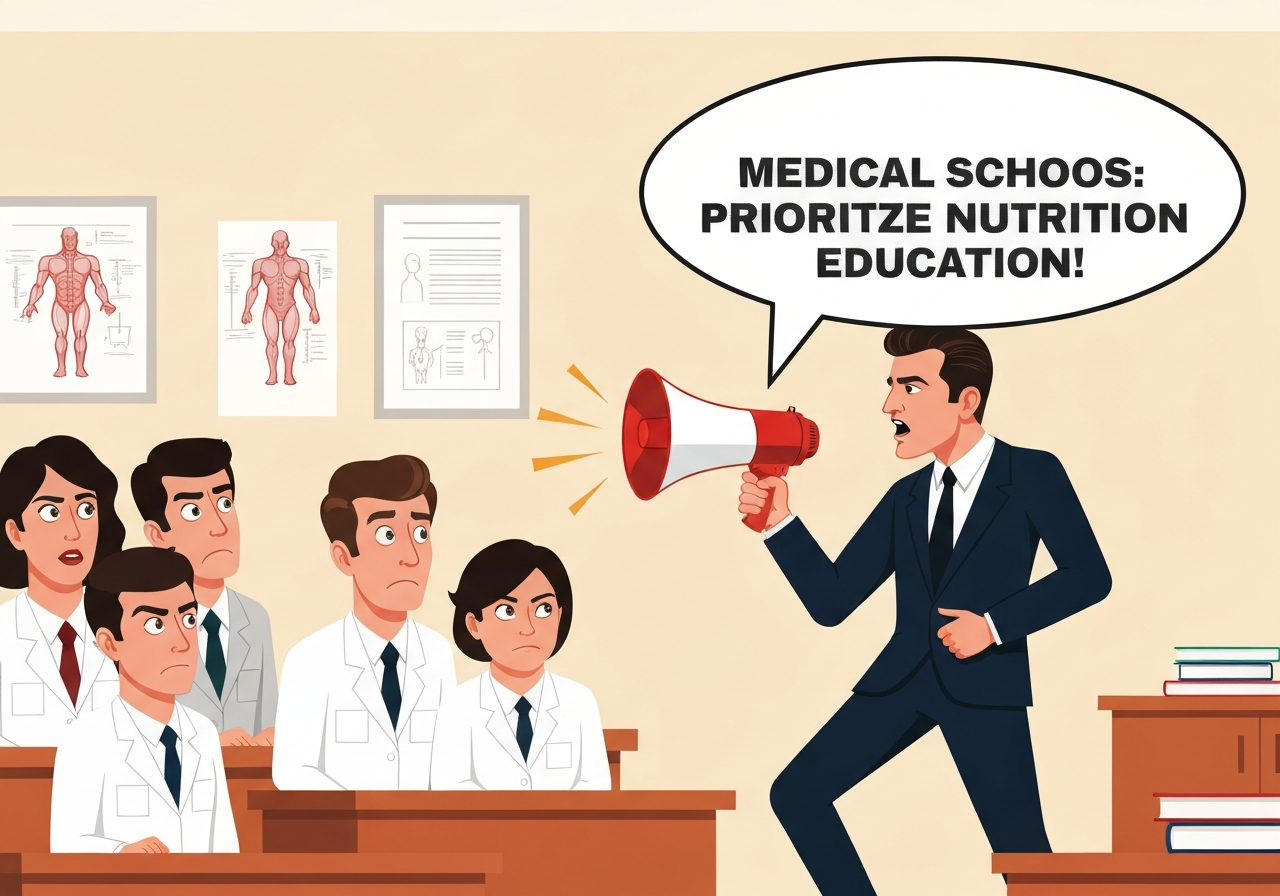
Health Secretary Robert F. Kennedy Jr. on Thursday launched a federal push asking U.S. medical schools to expand nutrition instruction, setting a 40-hour target and a three-part framework for compliance. The initiative asks institutions to review current nutrition training, designate a faculty lead for nutrition education and publish a plan explaining how they will reach the 40-hour goal. Senior Department of Health and Human Services officials said 52 medical schools have volunteered to participate; officials also signaled potential incentives and consequences for compliance or refusal. The move revives a long-running debate over how much nutrition doctors should learn and how that training should be integrated into clinical practice.
Key takeaways
- Fifty-two U.S. medical schools have agreed to join the new HHS initiative to expand nutrition teaching, according to senior HHS officials who briefed reporters.
- The initiative requests three steps from schools: review current nutrition instruction, appoint a faculty coordinator and publish a public plan to reach 40 hours of nutrition education per student.
- The administration framed the plan as a flexible framework rather than a mandated curriculum; officials said they offered suggested topics but did not provide full mandatory content.
- A 2015 survey of 133 U.S. medical schools found students received an average of 19 hours of nutrition education across four years, a commonly cited benchmark in the debate.
- Robert F. Kennedy Jr. has reportedly pressed schools for months, at times warning of funding consequences for noncompliance while promising public recognition for participating programs.
- Some experts support expanding nutrition training if it is evidence-based; others warn that upstream social and economic drivers of diet will limit what clinician education alone can accomplish.
Background
Concern about limited nutrition education in U.S. medical schools is longstanding. As early as the 1960s the American Medical Association flagged nutrition’s low profile in medical curricula; a 1969 White House conference similarly urged better training and funding for nutrition programs. Over subsequent decades clinicians and educators have repeatedly called for more clinical nutrition content, citing the rising burden of chronic diet‑related disease such as type 2 diabetes and cardiovascular disease.
Academic studies and surveys have consistently documented modest classroom time for nutrition topics. The often-cited 2015 survey of 133 medical schools found an average of roughly 19 hours during the four-year curriculum, a level many clinicians and dietitians argue is insufficient to prepare physicians for routine diet counseling or to triage complex nutrition issues. Medical schools face crowded curricula, competing certification requirements and constrained clinical placement time, all of which complicate adding new required hours.
Main event
On Thursday HHS officials outlined the administration’s three-step voluntary framework and said 52 schools had committed to participate. Officials described the approach as a loose blueprint schools could adapt; they stressed HHS was not dictating a single syllabus. According to officials, participating institutions will be asked to review existing training, name a faculty member to coordinate nutrition instruction and post a public plan showing steps to reach the 40-hour target.
The department’s push follows months in which Secretary Kennedy reportedly pressed universities directly and suggested a wide range of potential topics in a January letter, according to reporting by other outlets. HHS declined to share the full text of that letter during the briefing; officials said suggested topics were nonbinding and that they hoped to spur incremental institutional change rather than immediate mandates.
The initiative also ties public recognition and, by some accounts, potential financial pressure to institutional response. HHS officials said they would highlight participating programs; media reports have said Kennedy warned of funding reductions for schools that refuse to engage. Administration spokespeople framed the move as improving prevention-focused care by giving future physicians more grounding in diet-related risk factors.
Analysis & implications
Expanding nutrition education in medical schools could yield more clinicians who recognize and triage nutrition problems, but its practical impact depends on what is taught and how clinicians are supported in practice. If programs focus on evidence-based counseling, referral pathways and collaboration with registered dietitians, incremental gains in patient care are plausible. However, curricular expansion alone will not change the social determinants that shape dietary patterns—affordability, access, marketing and time constraints remain powerful drivers of what people eat.
The policy also raises questions about federal influence on medical curricula. The HHS plan is framed as voluntary, but public recognition and funding levers can shape institutional priorities. Medical schools already balance accreditation requirements, board-exam content and clinical training needs; adding hours requires trade-offs, new faculty or integration into existing courses rather than simply tacking on classroom time.
There is additional concern about content quality and selection. Several clinicians and educators told reporters they support more nutrition teaching only if the material is scientifically rigorous and clinically relevant. Skeptics worry that including unvetted or ideologically driven topics could undermine credibility and uptake among faculty and students.
Comparison & data
| Metric | Documented baseline | Administration target |
|---|---|---|
| Average nutrition hours per student (2015 survey) | ~19 hours (survey of 133 U.S. schools) | — |
| Administration goal | — | 40 hours per student |
| Medical schools committed (HHS) | — | 52 schools volunteered |
The 2015 survey benchmark—approximately 19 hours over four years—provides a quantitative basis for the administration’s 40‑hour target, which more than doubles that baseline. How schools measure and report the hours will shape whether the target reflects meaningful curricular depth or administrative accounting. The gap highlights both the scale of the proposed change and the logistical work schools face to recruit faculty, redesign courses and create assessment methods that ensure competency rather than mere contact hours.
Reactions & quotes
Nutrition scholars and clinicians offered qualified support for more training while urging rigorous standards and realistic goals. NYU emerita professor Marion Nestle emphasized the potential value but highlighted practical constraints in clinical practice and referral systems.
“It would be helpful if doctors had stronger nutrition training, but practical limits in primary care mean they mainly need to spot problems and know how to refer patients,”
Marion Nestle, NYU (professor emerita, nutrition and public health)
Some physicians welcomed expanded nutrition content but questioned the administration’s broader credibility given past statements on other health topics. A Harvard clinician said support hinges on scientific rigor and clear boundaries between accepted evidence and fringe ideas.
“I support expanding nutrition curricula if the material is scientifically rigorous; the real problem is broader economic and environmental drivers of diet,”
Dr. Adam Gaffney, Harvard Medical School (critical care physician)
HHS officials described the initiative as a practical step to improve preventive care; they emphasized voluntary participation and the goal of producing measurable plans that educators can adapt. Those departmental comments were offered in a press call with reporters and framed the approach as collaborative rather than prescriptive.
Unconfirmed
- The precise list of 71 topics reportedly suggested in a January letter from Secretary Kennedy, including items like composting and crop rotation, has not been independently verified by HHS spokespeople in the briefing and the full letter was not released for review.
- Reports that schools refusing to engage will face immediate funding cuts are not corroborated by a formal HHS policy document shared during the officials’ briefing; HHS described incentives and consequences in broad terms.
Bottom line
The administration’s push to increase nutrition training in medical schools surfaces a long-standing gap between current medical education and the nutritional contributors to chronic disease. The 40‑hour target is ambitious relative to the commonly cited 19-hour baseline and will require curricular redesign, faculty resources and validated assessment methods to translate hours into clinical competence.
Whether the initiative changes patient care will depend on content quality, integration with referral systems (especially access to registered dietitians) and broader policy actions addressing affordability and food environments. For readers, the most important near-term indicators to watch are the curricular plans schools post publicly, the specificity of learning objectives, and any follow-up measures HHS uses to verify substantive educational change.
Sources
- NBC News (news report on HHS announcement; original article provided)
- The New York Times (news reporting referenced by HHS briefing; reported details about Kennedy’s January letter)
- Journal of Biomedical Education / PubMed (academic index for the 2015 survey reporting ~19 average nutrition hours)
- American Medical Association (professional association; historical statements on nutrition in medical education)