
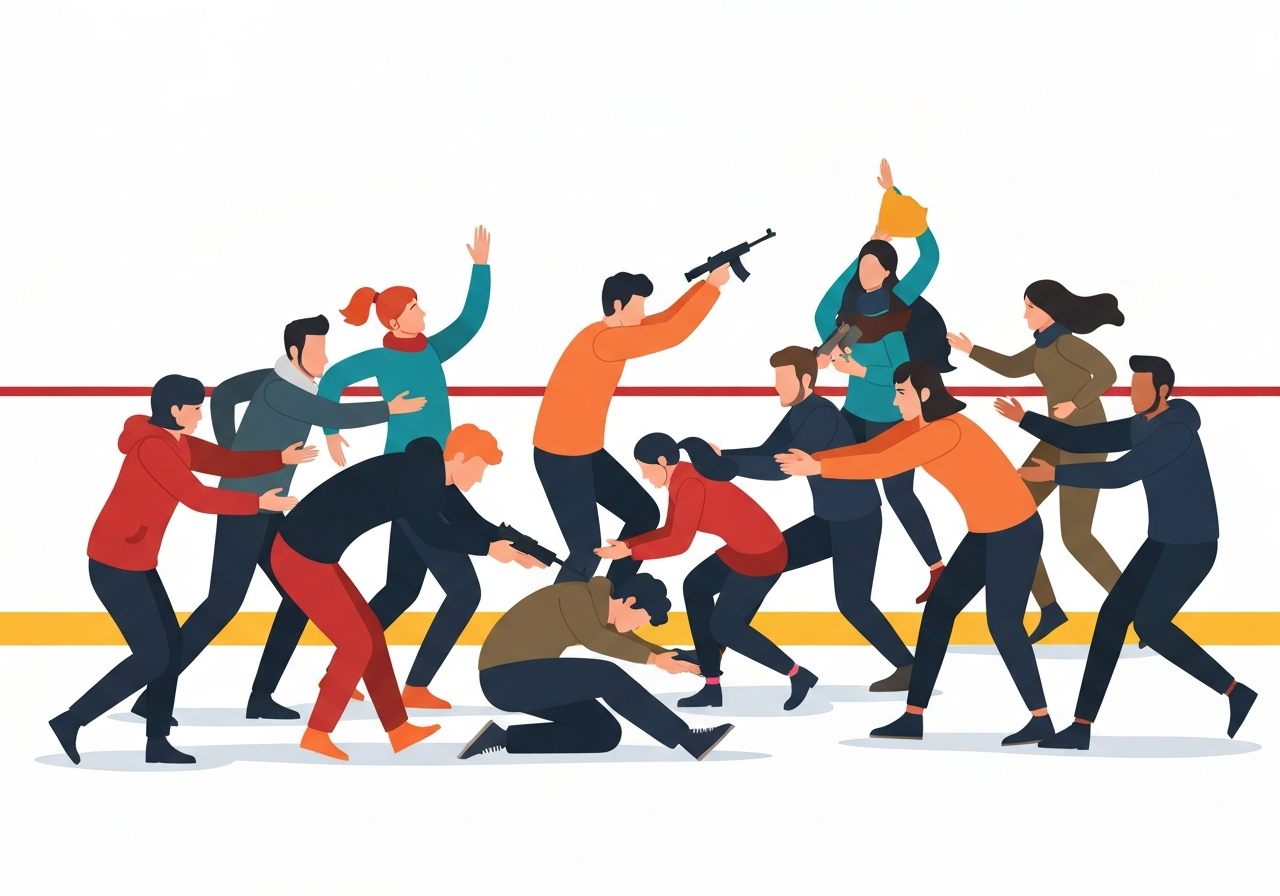
On Feb. 16, 2026, at the Dennis M. Lynch Arena in Pawtucket, bystanders intervened when a gunman opened fire during a youth hockey event. Michael Black, a retired printing-company owner, and at least two other men rushed the shooter after bullets rang out, seizing a weapon and pinning him to the floor. The attacker, identified by police as Robert Dorgan, later died from a self-inflicted gunshot; two people were killed and three others critically wounded. Officials say the swift actions of intervening civilians and first responders helped limit further fatalities.
Key Takeaways
- Timeline: The shooting occurred Monday, Feb. 16, 2026, at the Dennis M. Lynch Arena in Pawtucket, Rhode Island.
- Casualties: Two people were killed (Rhonda and Aidan Dorgan, 23) and three others remained in critical condition as of Feb. 18, 2026.
- Intervention: Michael Black, Robert Rattenni and Ryan Cordeiro are credited with subduing the shooter after bullets struck people in the bleachers.
- Shooter: Pawtucket police identified the attacker as Robert Dorgan (also known by aliases Roberta Esposito/Roberta Dorgano); he died from a self-inflicted gunshot after a scuffle.
- Immediate care: Retired firefighters/EMTs Chris Librizzi and Glenn Narodowy and nurse Maryann Rattenni provided on-site first aid to the wounded.
- Legal/context: Authorities have said questions about the shooter’s gender identity are not relevant to the criminal investigation; court records note a 2020 divorce that referenced gender identity.
- Response time: Police and federal agents arrived within minutes; bystander action is credited with preventing additional injuries.
Background
The Lynch Arena is a familiar venue to the Dorgan family: Aidan Dorgan, 23, played hockey there and family members regularly attended youth matches. According to court records, Robert Dorgan’s marital split in 2020 included references to gender identity, and Dorgan maintained online accounts where gender identity and far-right content appeared. Authorities have said those aspects are not central to the active criminal investigation into the shooting.
Youth sporting events and community arenas have been the site of multiple mass-violence incidents in recent years, prompting debate over security measures at local venues. Pawtucket police and federal agents are examining motive, timeline and any preparatory activity, while community leaders and families grapple with the loss and injuries sustained. Local emergency medical resources and retired first responders who happened to be present played a key role in the minutes after the attack.
Main Event
Spectators initially reported hearing sounds like popping before realizing the arena was being fired upon. Michael Black told his wife to run and then moved toward the shooter; video and witness accounts show him getting his left hand caught in the weapon’s chamber while trying to disarm the attacker. The shooter reportedly hoisted Black briefly before other bystanders intervened.
At least two additional men—identified by police as Robert Rattenni and Ryan Cordeiro—rushed to restrain the assailant, and video shows one applying a choke hold as the group immobilized him on the ice-rink floor. During the struggle the shooter produced a second firearm and ultimately died from a self-inflicted wound as he and Black made eye contact.
In the immediate aftermath, several bystanders and medically trained retirees provided life-saving care to the wounded between the bleachers. Responding officers and ATF agents taped off the scene and began a crime-scene investigation; a detective later told Black that one of the shooter’s daughters wanted to thank him for intervening. Black sustained an injured hand during the confrontation and was treated at a hospital before rejoining family members outside the taped perimeter.
Analysis & Implications
The incident underscores how ordinary citizens can alter the outcome of mass-violence events, but it also highlights the risks of untrained intervention. Medical and law-enforcement experts caution that while decisive action can save lives, it may also expose interveners to serious harm; Michael Black was injured while disabling the firearm. Policymakers and venue operators will likely revisit procedures for security presence, screening and emergency medical access at youth sports events.
Beyond venue security, the episode raises questions about early warning signs and pathways to violence. Investigators are examining the shooter’s background, social-media postings and recent behavior to establish motive, while community advocates call for expanded mental-health and de-escalation resources. Any links between ideology or identity and the motive remain a matter for investigators; public discussion should avoid speculative attribution until facts are confirmed.
The role of retired first responders and medically trained bystanders in this case also points to the value of widespread basic trauma training—stop-the-bleed, tourniquet use and rapid triage—at community sporting events. Municipalities may consider funding targeted training for volunteers, coaches and arena staff, alongside formal security upgrades, to reduce response times and improve survivability when attacks occur.
Comparison & Data
| Person | Status | Relation/Role |
|---|---|---|
| Rhonda Dorgan | Killed | Ex-wife of shooter |
| Aidan Dorgan, 23 | Killed | Shooter’s son |
| Linda Dorgan | Critical, injured | Grandparent |
| Gerald Dorgan | Critical, injured | Grandparent |
| Thomas Geruso | Critical, injured | Family friend |
| Robert Dorgan (shooter) | Died (self-inflicted) | Named by police |
The table summarizes the victims identified by law enforcement and media reporting. Officials have emphasized that the prompt medical attention from bystanders and retired EMTs likely improved the injured survivors’ chances of survival, while the rapid subduing of the shooter reduced the potential for a larger casualty count.
Reactions & Quotes
Police praised those who intervened for preventing additional casualties and speeding lifesaving care.
“A group of courageous citizens rushed to intervene and undoubtedly prevented further injury and increased the chances of survival for the injured.”
Pawtucket Police (official statement)
Pawtucket officials framed the response as a mix of civilian courage and professional emergency treatment that together limited the toll of the attack.
“The first thought was the safety of my wife…Get the gun and then subdue the shooter.”
Michael Black (witness and intervener)
Black described acting on instinct and focusing on neutralizing the weapon; he later received treatment for a hand injury and said he would continue his family plans despite the trauma.
Unconfirmed
- Definitive motive: Investigators have not released a confirmed motive linking the shooter’s background, ideology or identity to the attack.
- Targeting intent: It is not yet confirmed whether the shooter planned the attack specifically for that arena or merely encountered family members there.
- Online influence: Reported references on social accounts to ideology and identity are under review; any direct causal connection to the shooting remains unverified.
Bottom Line
The quick response by Michael Black and other bystanders, together with immediate first aid from nearby medically trained individuals, likely prevented more deaths at the Pawtucket rink on Feb. 16, 2026. Their actions exposed the trade-off between heroic intervention and personal risk, and prompted gratitude from survivors and law enforcement alike.
In the weeks ahead, investigators will seek to establish motive and a timeline; local leaders will face pressure to strengthen safety at community venues and to expand access to training that can improve outcomes when violence occurs. For families and the community, attention now turns to recovery, support services and measured policy discussion based on verified facts.
Sources
- Associated Press (news report)
- Pawtucket Police / City of Pawtucket (official local government site)