
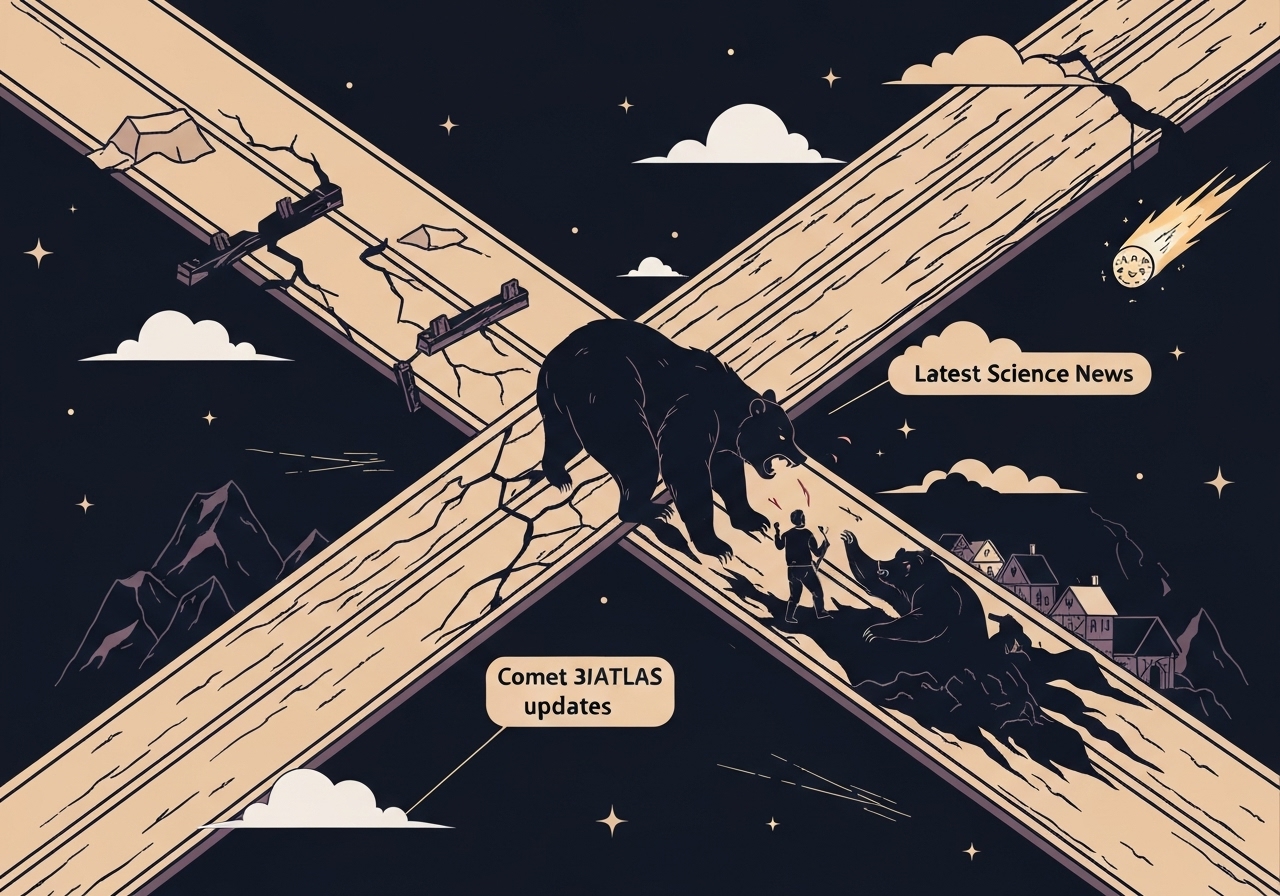
Today’s roundup brings fast-moving developments from archaeology, wildlife management and planetary science: a new digital atlas doubles estimates of the Roman road network, Japan has mobilized troops to assist with a record string of fatal bear attacks, and fresh images of interstellar Comet 3I/ATLAS — including shots from China’s Tianwen‑1 — continue to reshape scientists’ views of the visitor. Several other stories — a claimed quantum‑computing advance, climate tipping‑point warnings ahead of COP30, and stranded taikonauts aboard Tiangong after a suspected debris strike — add urgency and complexity to the week’s science headlines.
Key takeaways
- Researchers mapped roughly 186,000 miles (300,000 km) of Roman roads, about twice prior estimates, by incorporating smaller, unnamed routes into a new digital atlas (Itiner‑e).
- Japan has recorded at least 12 fatal bear attacks in 2025; the Self‑Defense Forces will assist with trapping and logistics but say soldiers will not shoot animals (reported Nov. 6, 2025; NPR).
- Interstellar Comet 3I/ATLAS (≈7 miles / 11 km across, traveling ~130,000 mph / 210,000 km/h) was imaged by China’s Tianwen‑1 on Oct. 3, 2025, and has also been tracked by Hubble and other observatories.
- Quantinuum announced Helios, a 98‑qubit (barium‑ion) processor, and reported Fermi‑Hubbard simulations aimed at clues for room‑temperature superconductivity; independent validation remains pending.
- The U.N. Environment Programme finds global temperatures are likely to exceed 1.5 °C before 2035, sharpening focus on tipping points ahead of COP30 in Brazil (starting Nov. 10, 2025).
- Three Chinese astronauts (Wang Jie, Chen Zhongrui, Chen Dong) were forced to delay return from Tiangong after their reentry capsule was struck by suspected debris; investigations are ongoing.
- A second comet, C/2025 K1 (ATLAS), survived perihelion and displays an unusually golden appearance that may reflect a low gas‑to‑dust ratio.
Background
Interest in long‑range transport networks has resurged as archaeologists deploy digital mapping and remote‑sensing to recover previously invisible infrastructure. The Itiner‑e project combined historical sources, local surveys and geospatial analysis to expose tens of thousands of miles of minor roads that knit the Roman world together, extending the empire’s logistical reach far beyond the main highways studied for decades.
Human–wildlife conflict is also rising in several regions. In Japan this year, a confluence of ecological and demographic trends — disrupted food supplies for bears linked to warmer winters and an aging rural population with fewer active hunters — has driven more animals into inhabited areas in late 2025. Authorities have escalated responses from local trapping to military logistical support, reflecting the scale and frequency of encounters.
Meanwhile, the astronomy community has been captivated by 3I/ATLAS, only the third confirmed interstellar comet observed in our solar system. Rapid brightening, color changes in the coma and high relative velocity have made it a priority target; spacecraft and Earth‑based assets have been redirected to capture high‑resolution imagery and spectroscopy as it transits the inner system.
Main event
The new Roman road atlas expands the known network to nearly 186,000 miles (300,000 km) at the empire’s height around A.D. 150, according to researchers who emphasized the role of smaller connector routes. These lesser‑studied tracks appear to have been crucial for local trade, troop movement and administrative ties between regional centers and imperial hubs. The project’s authors say the map alters quantitative estimates of connectivity and travel time across provinces, with implications for models of economic integration and military logistics in antiquity.
In Japan, officials reported at least 12 fatal bear attacks in 2025, the most since national records began in 2006. The Self‑Defense Forces will support trapping, transport and logistics, while local authorities expand monitoring and non‑lethal deterrence efforts. Researchers link the surge partly to climate‑driven shifts in forage availability and to demographic changes that have reduced the number of experienced hunters and guardians in rural communities. Some municipalities are experimenting with robotic deterrents — so‑called “monster wolf” devices — and community response plans to reduce confrontations before hibernation season.
Astronomers released new images of Comet 3I/ATLAS taken by China’s Tianwen‑1 Mars orbiter on Oct. 3, 2025; combined with Hubble and other observations, the dataset is helping teams chart the comet’s morphology and changing color phases. 3I/ATLAS measures roughly 7 miles (11 km) across and is moving at about 130,000 mph (210,000 km/h) relative to the Sun. Scientists are using multispectral imaging and time‑series photometry to probe dust–gas ratios, particle sizes and activity drivers as the object experiences intense solar irradiation.
At least three additional items commanded attention this week. Quantinuum unveiled Helios, a 98‑qubit barium‑ion quantum processor, and said its teams used the device to simulate aspects of the Fermi‑Hubbard model relevant to superconductivity research; independent reproduction of those results will be a key next step. The U.N. released a UNEP assessment warning the world is likely to surpass 1.5 °C of warming before 2035, pressing negotiators ahead of COP30. And China’s Shenzhou‑20 crew — Wang Jie, Chen Zhongrui and Chen Dong — remained aboard Tiangong after a suspected piece of orbital debris struck their return capsule hours before an intended departure, delaying their homecoming while investigators examine telemetry and hull integrity.
Analysis & implications
The expanded Roman road map rewrites assumptions about imperial cohesion and local agency. Doubling the estimated network shifts models for how goods, information and troops flowed and suggests regional economies were more tightly knit than earlier maps implied. For historians and modelers, the new dataset invites recalibration of travel‑time estimates, fuel costs for draft animals, and the spatial footprint of Roman administration. It also underscores the power of integrating small‑scale archaeological traces with large‑scale geospatial methods.
Japan’s spike in bear fatalities highlights a wider pattern linking ecological stressors and aging rural populations in high‑income countries. Warmer winters can reduce mast yields and alter hibernation timing, pushing omnivores into settlements. The use of the military for logistics — explicitly non‑lethal in this instance — underlines how wildlife crises can become public‑safety and civil contingency issues rather than purely conservation problems. Long‑term solutions will require habitat management, community preparedness, and policies that bolster rural workforce resilience.
Images of 3I/ATLAS from multiple platforms demonstrate how rapidly coordinated observations can transform understanding of transient interstellar visitors. Each dataset — from Tianwen‑1’s distant flyby geometry to Hubble’s high‑resolution views — contributes complementary constraints on composition and activity. If teams can combine spectroscopy, dust‑particle analysis and dynamical modeling, they may reconstruct aspects of the comet’s origin and histories of its parent system, offering rare empirical clues about planetesimal formation beyond our solar system.
Quantinuum’s Helios announcement is notable but provisional: quantum simulation claims must clear replication and benchmarking hurdles before the results can meaningfully inform materials discovery. Similarly, UNEP’s projection of exceeding 1.5 °C before 2035 elevates the political stakes at COP30; negotiators face pressure to convert emissions pledges into measurable, near‑term action. Finally, the suspected debris strike on Shenzhou‑20 is a reminder that growing orbital traffic increases collision risk, and that space‑safety protocols and debris‑mitigation remain urgent international priorities.
| Topic | Key stat | Why it matters |
|---|---|---|
| Roman roads | ~186,000 miles / 300,000 km | Revises connectivity and economic models for the Roman Empire |
| Comet 3I/ATLAS | ~7 miles / 11 km; 130,000 mph / 210,000 km/h | Interstellar composition clues; rare visit |
| Japan bear deaths (2025) | ≥12 fatalities | Human–wildlife conflict, climate and demographic linkages |
| Helios (Quantinuum) | 98 qubits (barium ion) | Quantum simulation attempts for superconductivity models |
The short table above clarifies scale and stakes for readers tracking multiple, unrelated developments; each figure provides a quantitative anchor that helps translate news into research or policy priorities.
Reactions & quotes
“Soldiers will assist with trapping and logistics; they will not shoot bears,” officials said as Japan expanded its response to the uptick in attacks.
Japanese Self‑Defense Forces (official statement)
“We used Helios to simulate parts of the Fermi‑Hubbard model in search of superconductivity signatures,” a company spokesperson said, stressing the need for peer review and independent benchmarks.
Quantinuum (company statement)
“Telemetry indicates an impact on the Shenzhou‑20 return capsule; engineers are assessing structural and systems integrity before authorizing reentry,” an agency update said.
China Manned Space Agency (official update)
Unconfirmed
- The full extent of structural damage to the Shenzhou‑20 return capsule remains under investigation and has not been publicly quantified.
- The precise causes of C/2025 K1’s golden hue are not yet established; spectral analysis suggests a low gas‑to‑dust ratio but is inconclusive.
- Quantinuum’s superconductivity‑related simulation results require independent replication and peer review before they can be treated as validated scientific findings.
Bottom line
This batch of stories underlines how science increasingly links local and global scales: archaeological mapping reshapes centuries‑old narratives about connectivity; wildlife incidents expose the social consequences of ecological change; and astronomical encounters and quantum claims push frontiers while demanding cautious validation. Policymakers and researchers should treat spectacular headlines as starting points for sustained inquiry rather than endpoints.
Watch next: peer‑reviewed papers and validation studies for the Roman‑road dataset and Quantinuum’s simulations; final assessments of the Shenzhou‑20 capsule and related orbital‑debris telemetry; and COP30 commitments that respond to UNEP’s 1.5 °C projection. These follow‑ups will determine whether this week’s developments produce durable shifts in scholarship, public policy or technology deployment.
Sources
- Live Science live blog (news blog)
- Space.com (space journalism) — coverage of Tianwen‑1 observations
- NPR (broadcast journalism) — reporting on Japan bear attacks
- Reuters (news agency) — background on robotic deterrents and wildlife tactics
- Itiner‑e (research/digital humanities) — Roman road atlas and interactive map
- Quantinuum (company press release) — Helios announcement and simulation claims
- UNEP (intergovernmental organization) — climate assessment on 1.5 °C timing
- Nature Astronomy (academic journal) — JWST eclipse mapping of WASP‑18b