
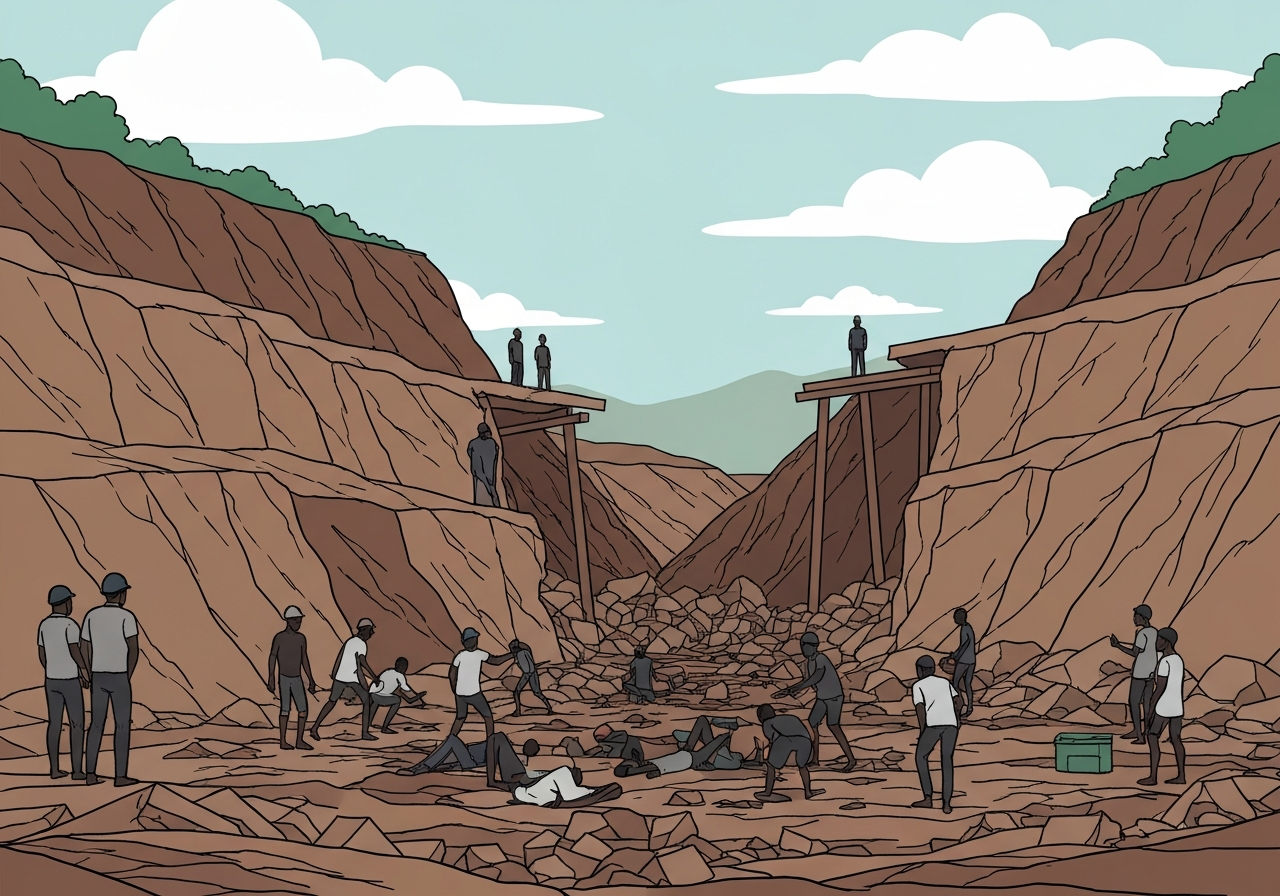
Lead: More than 200 people died when a landslide collapsed part of the Rubaya coltan mine in North Kivu province on Wednesday, January 28, 2026, local officials and spokespeople said. The mine, a major source of coltan used to make tantalum for electronics, has been under the control of the M23 rebel group since 2024. Initial rescue operations recovered some survivors with serious injuries, while the confirmed death toll was reported at least 227 by an adviser to the provincial governor. The site’s strategic importance and the contested control of resources have intensified scrutiny of safety and governance in the region.
Key Takeaways
- At least 227 people were reported dead after the Rubaya mine landslide; authorities initially described “more than 200” victims including miners, children and market vendors.
- Rubaya supplies roughly 15% of the world’s coltan, which is processed into tantalum used in phones, computers, aerospace components and turbines.
- The collapse occurred on Wednesday, January 28, 2026, in an area controlled by the M23 rebel group since 2024.
- Local diggers at Rubaya work manually for a few dollars per day; many informal miners and traders were on site at the time of the collapse.
- The UN has accused M23 of looting Rubaya’s mineral wealth to finance its insurgency; Rwanda denies backing the rebels.
- Rescue teams recovered survivors with critical injuries, and search efforts continued as authorities attempted to clarify the full casualty count.
Background
Rubaya, in North Kivu province of the Democratic Republic of Congo, is one of the world’s most important coltan sites. Coltan is refined into tantalum, a heat-resistant metal that is integral to modern electronics and industrial applications, and Rubaya’s deposits are estimated to account for about 15% of global coltan output.
For years Rubaya has hosted a mix of artisanal diggers, small-scale operators and armed groups vying for control of lucrative mineral flows. Since 2024 the M23 rebel movement has maintained control over the site, altering local governance, access and security arrangements and drawing international scrutiny over how mineral revenues are used.
Artisanal miners typically work with hand tools in precarious pits and tunnels for very low pay. Those conditions, combined with weak regulation and the presence of armed actors, create chronic safety hazards that have led to recurrent collapses and fatalities across eastern DRC’s mining areas.
Main Event
The landslide struck Rubaya on Wednesday, January 28, 2026, according to regional spokespeople who relayed the toll to international news agencies. Local eyewitnesses described a sudden collapse of a working slope where miners and market vendors had gathered, burying dozens beneath rubble and mud.
Lumumba Kambere Muyisa, a spokesperson linked to the rebel-appointed provincial governor, told reporters that “more than 200” people were victims of the landslide and that some survivors were pulled out with severe injuries. An adviser to the governor, speaking anonymously, later reported a confirmed death toll of at least 227.
Rescue efforts involved local teams hurriedly digging to reach victims; accounts indicate some people were pulled alive but critically wounded. Medical facilities in the area reported receiving multiple trauma patients, straining limited local health capacity.
The site’s control by M23 since 2024 shaped both access for responders and the flow of information; officials outside the rebel administration said access and independent verification were constrained in the immediate aftermath.
Analysis & Implications
The collapse highlights the intersection of humanitarian risk and resource conflict in eastern DRC. Rubaya’s global economic importance for coltan places a spotlight on how revenues are governed and whether extraction practices meet even minimal safety and labor standards. When extraction occurs under armed-group control, oversight and enforcement mechanisms are greatly weakened.
Economically, disruption at Rubaya could ripple through supply chains that depend on tantalum, but immediate effects on global electronics manufacturing are likely to be limited because producers rely on diversified sources. Politically, the disaster intensifies scrutiny of M23’s conduct and the broader regional dynamics involving allegations of external support, which Kigali denies.
For local communities, the human toll is severe and long-term: families lose breadwinners, and informal economies centered on artisanal mining face further destabilization. Without rapid humanitarian assistance and structural reforms to mining governance, the cycle of unsafe labor, exploitation and periodic disasters is likely to continue.
Comparison & Data
| Indicator | Reported Figure |
|---|---|
| Estimated share of world coltan from Rubaya | ~15% |
| Initial confirmed deaths reported by adviser | At least 227 |
| Period of M23 control | Since 2024 |
The table shows the most-cited quantitative details from reporting: Rubaya’s outsized contribution to coltan supplies, the provisional confirmed death count, and the timeframe of rebel control. These figures help explain why the collapse has both local humanitarian consequences and wider geopolitical resonance.
Reactions & Quotes
Official statements have been limited and mediated by the region’s complex control dynamics. Media outlets quoted a provincial spokesperson, and UN agencies have repeatedly raised concerns about resource exploitation in the area.
“More than 200 people were victims of this landslide, including miners, children and market women,”
Lumumba Kambere Muyisa, spokesperson for rebel-appointed provincial governor (as reported to news agencies)
“Rescue teams have pulled people from the debris, but the scale of the incident overwhelms local capacities,”
Anonymous adviser to the governor (provided a provisional death count of at least 227)
“The exploitation of mineral resources in conflict-affected zones has long funded armed actors and deepened insecurity,”
United Nations sources cited in reporting
Unconfirmed
- Exact final casualty figure: authorities have reported at least 227 confirmed dead but wider counts remain provisional as search-and-rescue continued and verification was constrained by on-site control.
- Precise causes beyond slope failure (e.g., whether recent heavy rains, illegal excavation techniques or deliberate disturbance contributed) have not been independently verified.
Bottom Line
The Rubaya collapse is both a humanitarian tragedy and a symptom of deeper governance failures where high-value minerals intersect with armed group control. Immediate priorities are search-and-rescue, medical care for survivors and transparent casualty verification.
In the medium term, the incident underscores the urgency of measures to improve mine safety, ensure accountable management of mineral revenues and reduce the power of armed actors over resource-rich territories. International actors, supply-chain companies and regional governments will face renewed pressure to address these structural risks.
Sources
- The Guardian (international newspaper reporting on the collapse and statements from local spokespeople)
- Reuters (international news agency — original field reporting and relay of provincial spokesperson comments)