
Lead
George Russell topped the final practice (FP3) for the 2026 Australian Grand Prix at Albert Park on Friday, setting a 1:19.053 to finish fastest in a disrupted hour. The session started at 12:50 local time after a brief delay for barrier repairs and saw multiple interruptions, including a stop for Carlos Sainz and a late heavy crash for Mercedes’ Kimi Antonelli at Turn 2. Antonelli walked away and reported he was okay, but his car suffered significant damage that raised questions about repairs ahead of qualifying. Teams used mixed tyre programmes during the session as they prepared for the first qualifying run at 16:00 local time.
Key Takeaways
- George Russell set the fastest lap of FP3 with a 1:19.053, finishing 0.616s clear of Lewis Hamilton in second.
- Charles Leclerc ended FP3 third, 0.774s off Russell, after topping the timesheets mid-session with a 1:20.271.
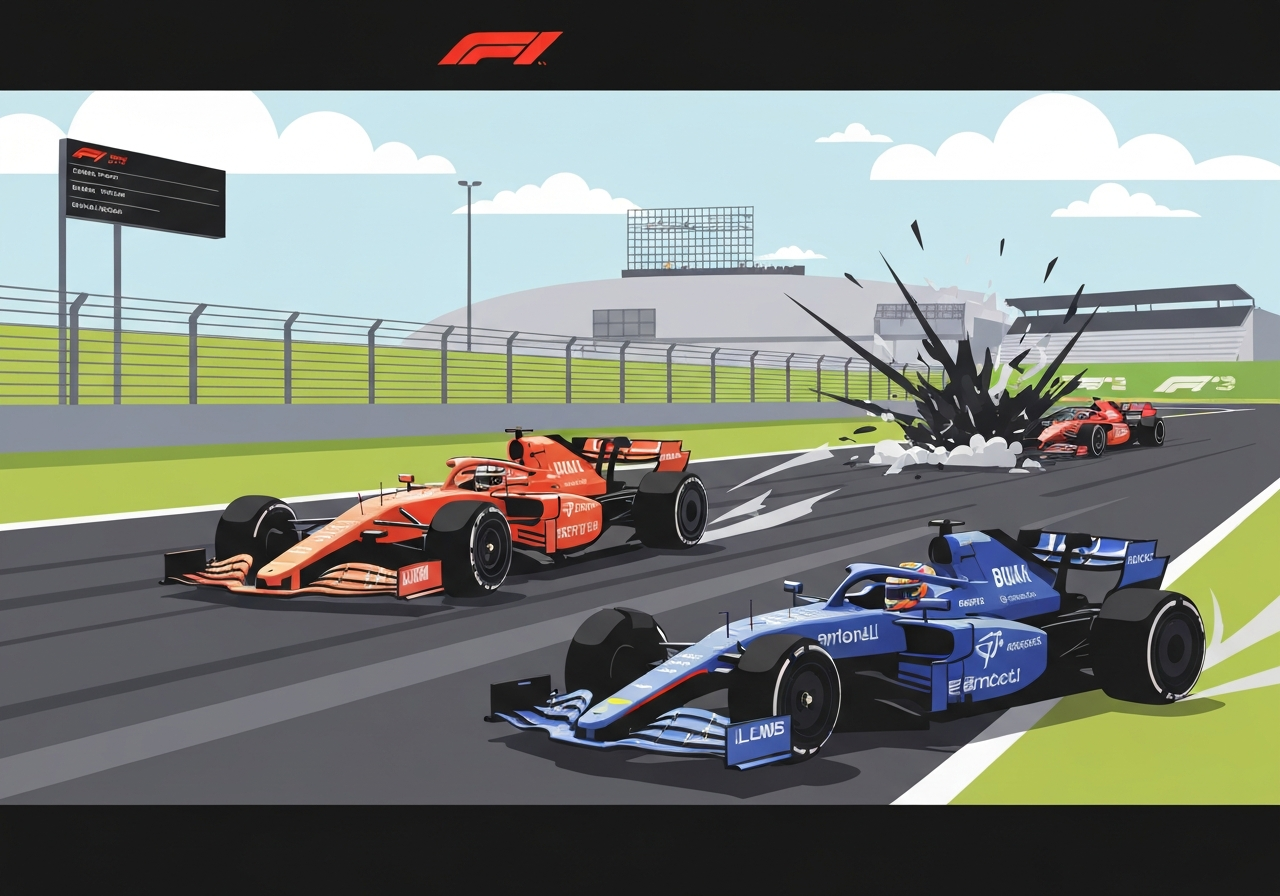
- Kimi Antonelli suffered a heavy crash at Turn 2 late in the hour; he exited the W17 and reported being okay, but the car sustained major damage and was seventh in the final classification.
- Carlos Sainz stopped near pit entry earlier, prompting yellow flags, a Virtual Safety Car and then a brief red flag while his Williams was recovered; Sainz could not return and finished 21st.
- Lance Stroll did not run in FP3 because Aston Martin cited a suspected internal combustion engine (ICE) issue that delayed a rebuild.
- Oscar Piastri, Isack Hadjar and Max Verstappen produced competitive laps, with Piastri fourth and the Red Bulls inside the top six.
- Rookie Arvid Lindblad continued strong form in 11th for Racing Bulls; Gabriel Bortoleto and Ollie Bearman completed the top 10.
Background
FP3 at Albert Park traditionally serves as teams’ final chance to confirm qualifying trims and tyre allocation strategies before the short evening qualifying session. The 2026 calendar places the Australian round early in the season, so teams are still refining balance, aero setup and power-unit modes after pre-season changes and the opening rounds. Tyre choices this weekend—soft and mixed compounds during FP3—reflect teams balancing single-lap speed with long-run data ahead of Q1.
Albert Park’s tight kerbs and low-grip sections increase the risk of late-session incidents when cars switch to soft tyres for fast laps. That risk was visible in FP3: an F3 incident earlier in the day required fence repairs and delayed the start by a few minutes, while on-track stoppages interrupted teams’ planned programmes. For Aston Martin and some other squads, power-unit reliability concerns added another layer of uncertainty coming into qualifying.
Main Event
The session began at 12:50 local time after barrier repairs following an earlier F3 collision, with Alpine’s Franco Colapinto among the first cars out alongside Lewis Hamilton and Fernando Alonso. Early running featured mixed tyre usage as teams divided work between long runs and quick laps; several drivers remained in the garages while circuits repaired and marshals completed checks. The field then experienced an early interruption when Carlos Sainz stopped near pit entry in his Williams, triggering yellow flags and a Virtual Safety Car before the FW48 was recovered and the session was briefly red-flagged.
Once action resumed with 38 minutes remaining, most teams put significant mileage on the board. Lance Stroll did not appear following Aston Martin’s confirmation of a suspected ICE problem that required attention and prevented him from taking part in FP3. As the session progressed, lap times fell: Charles Leclerc led the timing screens mid-session with a 1:20.271, displacing Mercedes’ Antonelli by 0.053s at that stage, while Hamilton sat close behind.
Soft-tyre runs in the closing quarter produced the quickest times of the hour. Oscar Piastri and others briefly topped the leaderboard before Russell produced the session’s benchmark 1:19.053 with under four minutes left, moving him clear of the pack by 0.774s over Leclerc. Hamilton recovered to second, 0.616s adrift. Antonelli’s late crash at Turn 2—after taking too much kerb and losing rear grip—brought out red flags as marshals recovered the W17 and cleared debris. He reported he was unhurt but the car required substantial recovery.
When FP3 resumed for a short sprint to the finish, teams scrambled to get final flying laps done in the pit-lane queue. The final classification left Russell first, Hamilton second, Leclerc third, Piastri fourth and the Red Bulls of Isack Hadjar and Max Verstappen inside the top six. Antonelli completed the hour in seventh amid uncertainty about his car’s repairability before qualifying. Sainz remained 21st after his earlier stoppage, while Bottas and Pérez were 19th and 20th respectively.
Analysis & Implications
Mercedes’ pace in FP3 suggests their W17 has competitive one-lap speed at Albert Park, particularly under a soft-tyre programme. Russell’s 1:19.053 was materially faster than the others, indicating a strong qualifying window if they can translate practice trim to a low-fuel, high-grip run. However, practice times are only one input—fuel loads, engine modes and tactical tyre use will be clarified during qualifying at 16:00 local time.
Antonelli’s crash complicates Mercedes’ preparations. Even though the driver reported he was okay, the extent of structural and suspension damage could force a heavy rebuild that disrupts setup continuity and component allocation. If the team elects to replace major parts under parc fermé or component parc rules, that could carry penalties or limit set-up options for the rest of the weekend, depending on FIA determinations and spare-part availability.
Aston Martin’s inability to run Stroll adds an extra reliability question to the grid’s narrative. A suspected ICE issue that prevents a driver from taking any running in FP3 leaves the team with little data on race runs and tyre deg. That will push Aston Martin to rely more on simulation data and practice notes from Fernando Alonso, who managed 18 laps in the session, to confirm their race pace and qualifying approach.
Rookie performances and midfield density are noteworthy. Arvid Lindblad’s 11th and other strong runs from non-factory teams signal tighter midfield competition that could influence tyre strategy and Q2/Q3 margins. Teams facing repair or reliability challenges may prioritize race setup over qualifying in parc fermé scenarios to salvage points on Sunday.
Comparison & Data
| Pos | Driver | Time | Gap |
|---|---|---|---|
| 1 | George Russell | 1:19.053 | – |
| 2 | Lewis Hamilton | — | +0.616s |
| 3 | Charles Leclerc | — | +0.774s |
| 4 | Oscar Piastri | — | +1.034s |
| 5 | Isack Hadjar | — | +1.084s |
The table above captures the top five timings and gaps from FP3. Russell’s margin over Hamilton (0.616s) is unusually large for an Albert Park practice session and may reflect targeted low-fuel runs or a particularly effective soft-tyre window. Teams will compare these short-run numbers with long-run stint data gathered earlier in FP3 to calibrate tyre degradation curves ahead of qualifying.
Reactions & Quotes
“I’m okay,”
Kimi Antonelli (reported on team radio)
Antonelli’s brief radio message confirmed he was unhurt after the Turn 2 impact. Teams often use the driver’s immediate status to inform recovery procedures and medical checks before making technical assessments.
“Session stopped while the vehicle was recovered,”
Race Control (FIA)
Race Control’s intervention to red-flag the session allowed marshals to clear debris and recover Antonelli’s car. That stoppage compressed the remaining running time and contributed to the hectic end-of-session pit-lane queue as teams made final soft-tyre attempts.
Unconfirmed
- Whether Antonelli’s W17 can be fully repaired in time for Qualifying remains unconfirmed and depends on the scale of structural damage and spare-part availability.
- The precise technical cause of Carlos Sainz’s stoppage near pit entry has not been officially disclosed beyond the car coming to a halt and being recovered.
- The root cause of Lance Stroll’s suspected ICE issue has been described as a suspected problem by Aston Martin; a formal diagnosis has not yet been published.
Bottom Line
George Russell’s FP3 benchmark gives Mercedes momentum heading into the Australian Grand Prix qualifying session, but the session’s interruptions and Antonelli’s late crash inject uncertainty into the grid’s immediate outlook. Teams will have to balance the raw one-lap speed shown by the leaders with tyre life and race-pace considerations when finalising setups for qualifying and Sunday’s race.
Key items to monitor are Mercedes’ repair timeline for Antonelli’s car, Aston Martin’s diagnosis of Stroll’s ICE issue, and how closely other teams can match Mercedes’ soft-tyre pace over a single flying lap. With qualifying scheduled for 16:00 local time, the paddock will be working through repairs and data analysis to present their best packages for the short, decisive session.