
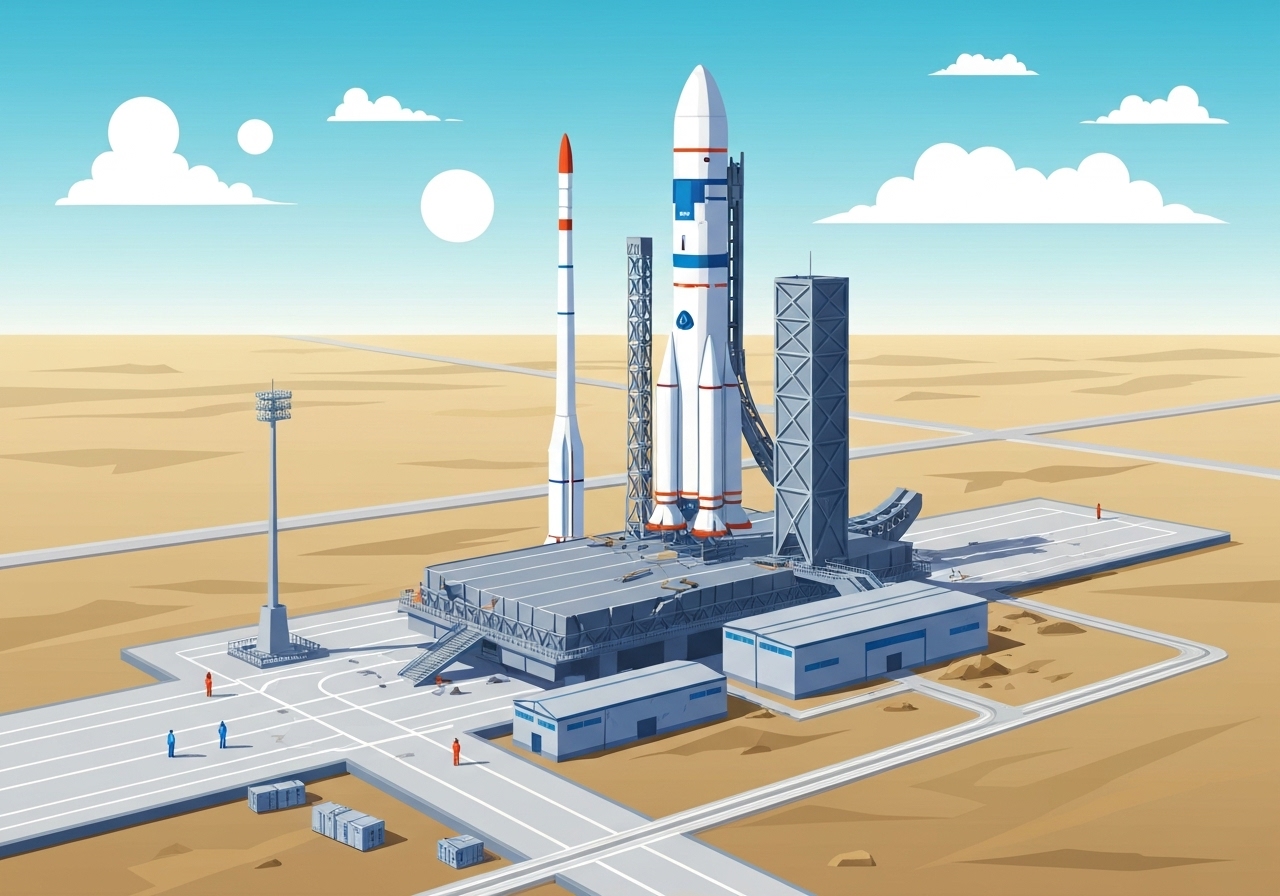
On Nov. 27, 2025, Roscosmos confirmed that a maintenance cabin at Baikonur Cosmodrome’s Site 31/6 was damaged during the Soyuz MS-28 crew launch to the International Space Station. The Soyuz MS-28 mission lifted off on a Soyuz 2.1a rocket and delivered cosmonauts and a NASA astronaut safely to orbit; the platform in the pad’s flame trench reported a collapse after ignition. Officials say the affected component, service platform 8U0216, is used in final prelaunch processing and is being assessed for repair, with spare parts reportedly available. The three crewmembers, Sergey Kud-Sverchkov, Sergey Mikaev and NASA astronaut Chris Williams, arrived aboard the station and are expected to remain for about eight months.
Key takeaways
- The incident occurred on during the Soyuz MS-28 launch from Baikonur Site 31/6; the crew reached the ISS safely.
- Roscosmos reported collapse of a maintenance cabin or service platform in the flame trench, identified as unit 8U0216, essential for pad operations.
- Site 31/6 has been Russia’s exclusive pad for human and cargo launches to the ISS since Site 1 was retired in 2020; Site 31/6 was first used in Jan. 1961 and has supported more than 400 launches.
- Analysts estimate repairs to the service platform could take up to two years, and Roscosmos said spare parts are available and restoration will proceed in the near term.
- It remains unclear whether other Russian pads can support crewed launches; a Progress resupply flight was scheduled for December and its status is under review.
- The Soyuz MS-28 crew will continue their mission aboard the ISS, with no immediate operational disruption to their presence on station.
Background
Baikonur Cosmodrome has been central to Soviet and Russian human spaceflight for decades. Site 1, known as Gagarin’s Start, hosted Yuri Gagarin’s historic 1961 flight and was long the primary human-launch complex; limited funding led to Site 1’s retirement for crewed missions in 2020. Since then, Site 31/6 has carried the full burden of Russian crewed and cargo missions to the International Space Station, making it a linchpin in crew rotation and resupply logistics.
The pad infrastructure includes service platforms and maintenance cabins located around the rocket and within the flame trench to support final checks and crew access. Damage to those elements directly affects prelaunch processing, vehicle integration and ground support throughput. For decades the two Baikonur pads provided operational redundancy; with one effectively out of commission for crew launches, schedule resilience is reduced. The mothballed Site 1 retains some hardware, but reactivating or cannibalizing components would require assessment and possibly significant refurbishment.
Main event
During the Soyuz MS-28 liftoff, observers and telemetry indicate that a structural component in the flame trench area failed, described by Roscosmos as a collapse of the maintenance cabin or service platform. The three-person crew launched atop a Soyuz 2.1a and reached the station without incident, confirming that the vehicle’s ascent performance and onboard systems were nominal. Roscosmos issued a statement that damage is being evaluated and that necessary spare parts are on hand for restoration, while work to return the complex to service is planned in the near future.
Independent analyst Anatoly Zak warned that duplicate hardware might be borrowed from the mothballed Site 1 or from similar facilities elsewhere, and he offered an early repair timeline estimate. His preliminary assessment suggested repairs to the service platform 8U0216 could take up to two years, a timeframe that would extend the period during which Site 31/6 is the only pad available for crewed launches. Roscosmos has not published a firm schedule or an estimated return-to-service date beyond saying the damage will be fixed soon.
Operators are evaluating whether upcoming missions, including a Progress resupply flight scheduled for December, can proceed from Site 31/6 or must be deferred or reassigned. Technical teams are inspecting supporting systems such as fueling lines, flame trench integrity and ground handling equipment to determine the full extent of impact. The immediate priority has been preserving crew safety and maintaining ISS operations while ground repairs and contingency planning move forward.
Analysis & implications
The loss of redundancy at Baikonur poses immediate and medium-term operational risks for Russia’s ISS logistics. With Site 31/6 currently the only pad active for human and cargo missions, any further failures or extended repair work could create a bottleneck in launch cadence, complicating crew rotations and resupply windows. If repair of platform 8U0216 stretches toward the analyst estimate of two years, Roscosmos would need to reprioritize launches and possibly negotiate timing changes with ISS partners.
Financial and industrial factors are central to the issue. Site 1 was retired for crewed launches in 2020 because upgrades were unaffordable at the time, leaving Roscosmos dependent on a single active complex for a critical national capability. Reclaiming parts from a mothballed facility could be faster than fabricating new components, but that approach risks creating secondary failures and requires careful structural and systems verification. International partners monitoring the situation will weigh mission planning adjustments against the costs and risks of shifting launch profiles.
In the longer term, the incident highlights the strategic vulnerability of relying on aging Cold War-era infrastructure for contemporary human spaceflight. Modernization or diversified basing would reduce single-point failures, but both require sustained investment and lead times. For ISS program managers and Roscosmos leadership, choices now will affect crew scheduling, commercial-cargo interfaces and potential contingency reserves for any future anomalies.
Comparison & data
| Site | First used | Role | Known launches | Status |
|---|---|---|---|---|
| Site 1, Gagarin’s Start | 1961 (historic human launch) | Primary human launches historically | Hundreds (historic) | Retired for crewed flights in 2020 |
| Site 31/6 | Jan. 1961 | Exclusive Russian crew and cargo launches to ISS since 2020 | More than 400 launches | Damage to service platform 8U0216 under assessment |
The table summarizes the two Baikonur pads most relevant to Russian human spaceflight. Site 1 remains historically significant but was removed from active crew duty in 2020; Site 31/6 now carries the operational load. The >400 launches figure for Site 31/6 underscores the pad’s long service life and the cumulative wear that can complicate rapid repair and renewal efforts. Comparing role and status clarifies why the current damage has outsized operational importance.
Reactions & quotes
Roscosmos provided a brief official update about the condition of the complex and plans to repair damage, framing the issue as technical and manageable. The agency emphasized assessment and repair readiness while assuring that crewmembers are safe aboard the station; the statement is a primary source for immediate operational facts.
The condition of the launch complex is currently being assessed. All the necessary spare parts are available for restoration, and the damage will be repaired in the near future.
Roscosmos, official statement
Independent analysts flagged longer timelines and logistical hurdles for returning the pad to full capability, noting the potential need to borrow hardware from a mothballed site. Their perspective underscores that an official intent to repair does not equate to a short repair duration.
There is some possibility that duplicate hardware could be borrowed from the mothballed Site 1… According to preliminary estimates, repairs of the service platform, known as 8U0216, could take up to two years.
Anatoly Zak, RussianSpaceWeb analysis
Unconfirmed
- Whether the full repair of platform 8U0216 will indeed take as long as two years remains unverified and depends on inspection outcomes.
- It is not yet confirmed that hardware can be safely repurposed from the mothballed Site 1 without substantial refurbishment.
- Any direct impact on the December Progress resupply mission schedule has not been publicly confirmed at the time of reporting.
Bottom line
The Nov. 27, 2025 Soyuz MS-28 launch successfully delivered three crewmembers to the ISS but exposed a vulnerability at Baikonur: damage to the service platform at Site 31/6. Roscosmos reports assessment and spare parts availability and intends to repair the pad, while independent analysts caution that repairs could be prolonged, potentially affecting Russia’s launch cadence and contingency planning.
Near-term priorities are crew safety, preserving ISS operations and completing a thorough damage assessment to determine repair scope and timelines. For ISS partners and Roscosmos, transparent updates and coordinated scheduling will be essential to manage missions while the pad is restored and to reduce the programmatic risk of relying on a single active crewed launch complex.
Sources
- Space.com (media report summarizing the incident and statements)
- Roscosmos (official agency statement)
- RussianSpaceWeb (analysis by Anatoly Zak, independent space history and technical commentary)