
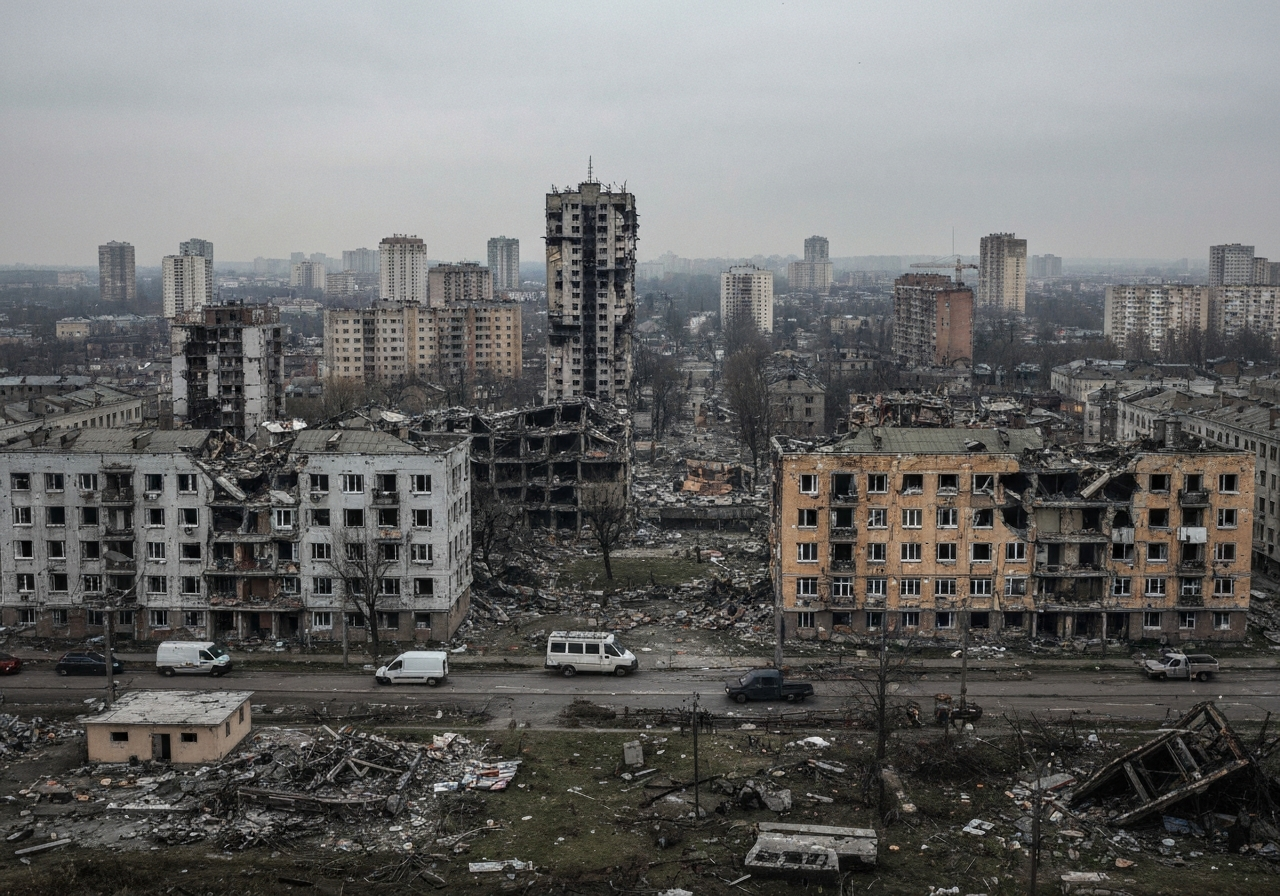
Lead: Four years after Russia launched a full-scale invasion of Ukraine on Feb. 24, 2022, the fighting remains Europe’s largest conflict since World War II, with heavy tolls on soldiers and civilians and far-reaching effects on regional security. The war enters its fifth year on Feb. 24, 2026, with no clear end in sight even as U.S.-brokered talks between delegations from Moscow and Kyiv take place. Key disputes — notably the status of territory Moscow controls and guarantees for Ukraine’s postwar security — have stalled negotiations. Meanwhile, independent and institutional estimates show large battlefield losses, widespread civilian harm and major population displacement.
Key takeaways
- Estimated combined military casualties for both sides reach an upper bound of about 1.8 million, according to a December 2025 CSIS report, with Russia’s share estimated at roughly 1.2 million casualties including up to 325,000 troop deaths.
- CSIS places Ukrainian military casualties between 500,000 and 600,000, including up to 140,000 deaths; Ukrainian President Volodymyr Zelenskyy has publicly said about 55,000 Ukrainian troops have died.
- The U.N. Human Rights Monitoring Mission documents 14,999 civilian deaths and more than 40,600 civilian injuries since Feb. 24, 2022, while reporting at least 763 child fatalities; civilian casualties rose sharply in 2025.
- Ukraine currently faces Russian control of about 19.4% of its territory; Moscow’s frontline gains over the past year amounted to about 0.79% of Ukrainian land, per the Institute for the Study of War.
- Humanitarian and financial assistance to Ukraine fell about 5% in 2025 versus the 2022–2024 annual average, while tracked foreign military aid dropped about 13% in 2025 overall; European states increased arms transfers by 67% to partly offset shortfalls.
- Roughly 5.9 million Ukrainians have left the country (about 5.3 million to Europe); an additional ~3.7 million are internally displaced from their prewar homes.
- The World Health Organization has recorded 2,881 Russian attacks that affected medical care, including at least 2,347 strikes on health-care facilities and related infrastructure since the full-scale invasion.
Background
Russia’s Feb. 24, 2022 invasion marked a dramatic escalation of hostilities that had persisted in the Donbas and Crimea since 2014. The assault shattered the immediate post–Cold War security assumptions in Europe and triggered the largest displacement of people on the continent in decades. Western states imposed extensive sanctions on Moscow and have supplied Kyiv with varying degrees of military, financial and humanitarian aid, reshaping alliance politics and defense commitments across NATO and EU members.
From the outset, battlefield dynamics have been costly for both militaries. Moscow initially reported limited losses publicly and has not provided consistent casualty figures since early 2023; Western think tanks and Ukrainian officials have produced independent tallies that diverge substantially from official Russian data. Diplomatic efforts intermittently resumed, most recently with U.S.-facilitated meetings between Russian and Ukrainian delegations, but those contacts have not closed the deep gaps on territorial outcomes or security guarantees that would underpin a lasting settlement.
Main event
Over the four-year period the frontlines have shifted but large-scale territorial change has been limited relative to the human cost. Think-tank calculations put territory under Russian control at about 19.4% of Ukraine, including Crimea and areas seized since 2014; in the last year Moscow gained roughly 0.79 percentage points more territory, underscoring slow, attritional fighting. Both sides have continued to mount offensives, counterattacks and strikes, with heavy use of artillery, drones and aerial munitions shaping outcomes on key sectors of the front.
Civilian infrastructure has borne repeated blows. The World Health Organization reported nearly three thousand attacks that impeded medical care, and separate U.N. tallies show tens of thousands of civilian casualties and thousands of destroyed or damaged public-service sites. Energy and water systems have been targeted or degraded during winter months, producing recurring outages that amplify civilian suffering beyond the immediate strike damage.
Diplomatic developments have been intermittent. During 2025 and into early 2026, the U.S. helped convene delegations from Moscow and Kyiv in exploratory exchanges aimed at stopping the war. Those talks have focused on sequencing — ceasefire terms, withdrawal and security guarantees — but core differences, notably over who controls occupied areas and guarantees for Ukraine’s future sovereignty, remain unresolved, limiting prospects for a near-term settlement.
Analysis & implications
The human cost is the clearest immediate implication: cumulative military casualties in the hundreds of thousands per side and nearly 15,000 documented civilian deaths create long-term demographic and social consequences for Ukraine and for Russian communities that have provided recruits. High battlefield attrition strains recruitment, logistics and the domestic political compact in both countries, with implications for military sustainability and political leadership at home.
Strategically, the conflict has hardened security postures across Europe. NATO members have accelerated force posture adjustments, defense spending and joint planning while European states that increased military aid in 2025 partly offset declines from other donors. These shifts deepen Europe’s security integration but also sustain a prolonged proxy dimension to the fighting, tying Western defense policies to Kyiv’s battlefield endurance.
Economically and humanitarianly, displaced populations — about 5.9 million abroad and 3.7 million internally — will require years of reconstruction, social services and reintegration support. Reduced humanitarian and financial flows (a 5% drop reported for 2025) complicate recovery planning and risk leaving large needs unmet amid continuing conflict. The damage to health infrastructure and repeated attacks on services create secondary public-health crises that will increase long-term costs for Ukraine and international partners.
Comparison & data
| Metric | Figure / Period |
|---|---|
| Estimated combined military casualties (upper bound) | 1.8 million (Feb 2022–Dec 2025, CSIS) |
| Estimated Russian military casualties | 1.2 million (incl. up to 325,000 deaths) |
| Estimated Ukrainian military casualties | 500,000–600,000 (incl. up to 140,000 deaths) |
| U.N. civilian deaths | 14,999 (since Feb 24, 2022) |
| People who left Ukraine | 5.9 million (≈5.3 million to Europe) |
| Territory under Russian control | 19.4% of Ukraine (ISW) |
| Attacks affecting medical care | 2,881 (WHO) |
The table aggregates institutional estimates to give a snapshot of scale and impact. Methodologies differ: think tanks rely on open-source battlefield tracking and intelligence estimates, U.N. monitors compile verified civilian casualty reports that emphasize confirmed cases, and humanitarian agencies log attacks on services with on-the-ground reporting. Those methodological differences explain why headline numbers vary but together they depict a conflict that is both high-cost and diffuse in its effects.
Reactions & quotes
Officials, analysts and affected communities have responded in predictable but consequential ways: Kyiv continues to press for sustained Western support and security guarantees; Moscow frames its objectives in security and territorial terms; allies weigh assistance against political and budgetary limits. Public reaction across Europe and within Ukraine remains concentrated on humanitarian relief and reconstruction needs.
“About 55,000 Ukrainian troops have died,”
Volodymyr Zelenskyy, President of Ukraine (public statement)
This statement from President Zelenskyy, given earlier in February 2026, reflects Kyiv’s official toll and underscores the gap between Ukrainian counts and external estimates. Kyiv’s figures are politically and emotionally salient for domestic audiences and allies, even as independent verification of exact numbers remains difficult.
“This period has seen the largest number of troop deaths for any major power in any conflict since World War II,”
Center for Strategic and International Studies (CSIS) report summary
CSIS framed its casualty estimate to highlight the unprecedented scale of military losses in modern European warfare. Analysts caution, however, that CSIS’s tallies rely on open-source reconstructions and should be read alongside other institutional assessments.
“Attacks on health care and medical infrastructure have continued, with a near 20% rise last year,”
World Health Organization (WHO) report
The WHO’s figures on strikes affecting medical care emphasize the conflict’s knock-on impacts on public health and emergency response capacity. Health agencies warn that repeated disruption will compound indirect mortality and morbidity beyond battlefield deaths.
Unconfirmed
- Exact, verified totals of military deaths for either side remain unresolved because neither Moscow nor Kyiv provides comprehensive, independently verifiable casualty rolls.
- Details of any negotiated territorial swaps, potential timelines for withdrawal or binding security guarantees discussed in talks brokered in 2026 have not been publicly confirmed.
- Some local reports of unit-level casualties and equipment losses circulated online remain unverified and differ from institutional tallies.
Bottom line
Four years into the full-scale invasion, the Russia–Ukraine war is a protracted, high-cost conflict that has reshaped European security, inflicted deep human suffering and produced enduring reconstruction and reconciliation challenges. Institutional estimates consistently point to very large military casualties, substantial civilian harm and mass displacement that will require sustained international effort to address.
Short of a political breakthrough that resolves the status of occupied territory and delivers enforceable security guarantees for Ukraine, the most likely near-term outcome is continued attritional fighting with episodic shifts in momentum. Policymakers and aid planners should prepare for prolonged humanitarian and reconstruction demands even as diplomatic channels continue to seek pathways to reduce violence and protect civilians.
Sources
- Associated Press — News report summarizing institutional estimates and developments.
- Center for Strategic and International Studies (CSIS) — Think tank casualty estimate (report summary/analysis).
- Institute for the Study of War (ISW) — Frontline and territorial control analysis (think tank).
- United Nations Human Rights Monitoring Mission — Civilian casualty figures and human-rights monitoring (international organization).
- World Health Organization (WHO) — Reporting on attacks affecting medical care and health infrastructure (UN agency).
- Kiel Institute — Tracking of foreign aid and assistance flows to Ukraine (research institute).