
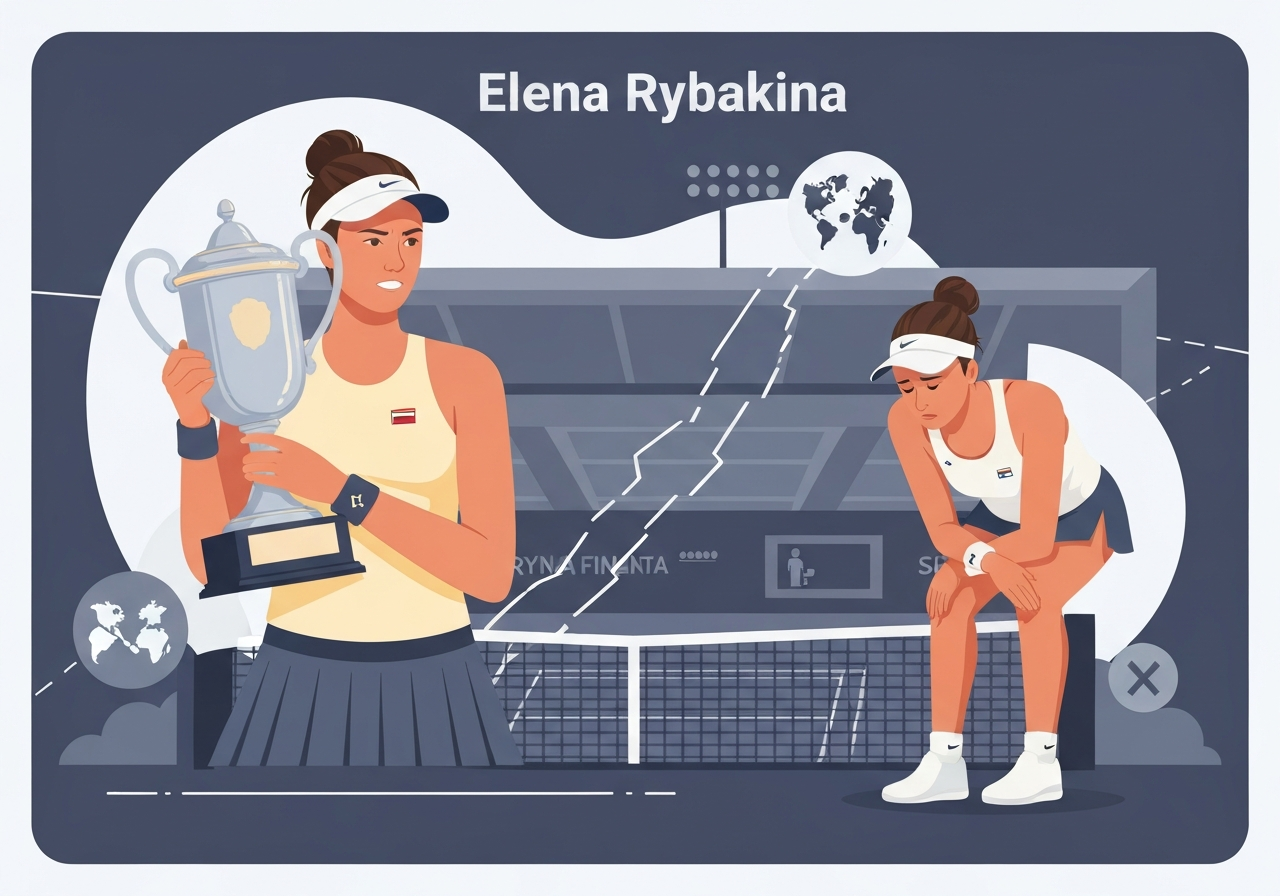
Lead: Elena Rybakina beat world No.1 Aryna Sabalenka 6-4, 4-6, 6-4 to win the 2026 Australian Open at Rod Laver Arena, sealing the match with an ace. The Kazakh claimed her second Grand Slam title, reversing the result of the 2023 Melbourne final against Sabalenka. Sabalenka, who has now lost successive Australian Open finals, said she will take time away from tennis to process the defeat. Off-court, the tournament week also featured a separate dispute: French player Ugo Humbert may face disciplinary action from his federation for missing Davis Cup duty.
Key takeaways
- Final score: Elena Rybakina def. Aryna Sabalenka 6-4, 4-6, 6-4; match decided by a late Rybakina ace.
- Rybakina wins her second major title (first was Wimbledon 2022) and finished the match by winning six of the last seven games.
- Sabalenka remains world No.1 but is now 4–4 in Grand Slam finals and has lost the Australian Open final in back-to-back years.
- Sabalenka acknowledged tactical regrets—singling out serve aggression—and said she will take a short break from tennis before regrouping.
- Separately, Ugo Humbert is facing possible sanction from the French Tennis Federation after skipping Davis Cup; the FFT leadership is reportedly considering disciplinary measures.
- Men’s draw developments: Novak Djokovic skipped a training day after a late-night five-set semi; he will face Carlos Alcaraz in the men’s final.
- Doubles note: Neal Skupski and Christian Harrison won the Australian Open men’s doubles title, beating local wildcards 7-6(7), 6-4.
Background
The match marked a renewed chapter in a recent rivalry: Sabalenka beat Rybakina in the 2023 Australian Open final, but Rybakina has since regrouped and reached the 2026 final seeded No.5. Both players entered the match with strong runs at Melbourne Park; neither had dropped a set earlier in this edition. Rybakina’s power and serve have been a foundation since her 2022 Wimbledon triumph, while Sabalenka’s aggressive baseline game and serve have underpinned her ascent to world No.1.
Beyond the court, national and federation issues have peppered the fortnight. The French federation publicly expressed disappointment after Ugo Humbert prioritized his physical recovery over Davis Cup duty; federation officials told L’Equipe they may consider sanctions. On the men’s side, marathon semi-finals raised questions about recovery and scheduling as Novak Djokovic and Carlos Alcaraz prepare for a high-profile final.
Main event
The final opened with Rybakina grabbing an early break and carrying that momentum to take the first set 6-4; she saved two break points in the eighth game and used her serve to escape pressure. Sabalenka responded in the second set, raising intensity and running an eight-point streak at one stage to level the match 1–1 with a 6-4 set win.
The decider swung on a sequence of short, high-pressure games. Sabalenka led early in the final set but lost a crucial service game that shifted momentum; Rybakina then won six of the last seven games. The match ended when Rybakina served an ace on match point, prompting an emotional celebration and a winner’s speech thanking her team, Kazakhstan’s supporters and the tournament staff.
Post-match, Sabalenka spoke candidly about immediate disappointment and tactical hindsight. She said she needed a short break to process the loss and reflected that, in hindsight, she might have pushed more aggressively on serve at pivotal moments. Rybakina praised Sabalenka’s run and expressed hope they will meet in more finals going forward.
Analysis & implications
Rybakina’s win reasserts her as a major title contender and highlights the depth at the top of the women’s tour. A second Grand Slam validates her ability to close big matches against top-ranked opponents and suggests she can sustain top-level results across surfaces. For Sabalenka, the defeat is a psychological and tactical test: she keeps the world No.1 ranking but must address the fine margins—serve placement, second-serve consistency and decision-making under pressure—that decided this final.
Rankings and momentum matter: Rybakina’s victory will boost her seeding and confidence heading into the hard-court season, while Sabalenka must balance recovery with reflection to avoid a longer slump. The match also underlines how Grand Slam finals often hinge on a handful of service games rather than extended baseline exchanges; converting break points and limiting unforced errors in critical games made the difference.
The event’s broader calendar questions persist. Long semi-finals in the men’s draw raised recovery issues ahead of finals day; Djokovic’s choice to rest rather than practice illustrates how elite players manage immediate fitness versus preparation. Separately, the Humbert situation underscores tension between individual scheduling and national team obligations—a dynamic federations and players will continue to negotiate.
Comparison & data
| Player | Grand Slam finals (W–L) | Australian Open finals (W–L) |
|---|---|---|
| Elena Rybakina | 2–1 (titles: 2022 Wimbledon, 2026 AO) | 1–1 (2023 L, 2026 W) |
| Aryna Sabalenka | 4–4 | 2–3 (lost finals in consecutive years) |
This table places the result in perspective: Rybakina’s second major arrives three-and-a-half years after Wimbledon 2022, while Sabalenka’s finals record now reads as a balanced but streaky set of outcomes. The match statistics (aces, break points saved/converted) again pointed to serve performance as the decisive factor.
Reactions & quotes
“Right now I don’t want to think about tennis,”
Aryna Sabalenka, post-match press conference
Context: Sabalenka spoke openly about needing time to process the loss, while affirming long-term ambition and promising to return to competition with renewed focus.
“Hard to find the words now, but congratulations to Aryna — I hope we play many more finals together,”
Elena Rybakina, winner’s remarks
Context: Rybakina thanked her support team, Kazakhstan’s fans and the tournament organizers, framing the victory as a team effort after a difficult build-up.
“Definitely not going to train tomorrow. Just going to use every hour I possibly can to recover,”
Novak Djokovic (on skipping practice before the men’s final)
Context: Djokovic opted for rest after a late-night semi-final, highlighting recovery priorities ahead of the men’s final with Carlos Alcaraz.
Unconfirmed
- Reports that Novak Djokovic demanded 10% of Australian Open ticket sales remain unverified by official organizers; the claim has been reported in outlets but not corroborated by Tennis Australia.
- Allegations that Carlos Alcaraz abused medical timeout rules during his semi-final (to gain a competitive advantage) are contested and include opinion from pundits; there has been no formal disciplinary ruling published.
Bottom line
Elena Rybakina’s victory is a reminder that Grand Slam outcomes can shift quickly at the top level: a single run of pressure points and service holds was enough to tilt the match. Sabalenka leaves Melbourne still holding the world No.1 ranking, but she must convert final-day experience into tactical adjustments if she is to add more majors to her résumé.
Off-court stories from this fortnight — federation disputes over player availability and debates about medical timeouts and recovery windows — may have lasting effects on scheduling, national team policy and how players balance personal welfare with obligations. As the tour moves on, the next weeks will reveal whether Melbourne was a turning point for Rybakina’s momentum or a temporary peak in an otherwise open field.
Sources
- Daily Express live coverage (news outlet) — primary match reporting and press-conference excerpts.
- Australian Open / Tennis Australia (official) — tournament results and official match information.
- WTA (governing body) — player profiles and statistics.
- L’Equipe (news outlet) — report on French Tennis Federation comments regarding Ugo Humbert.