
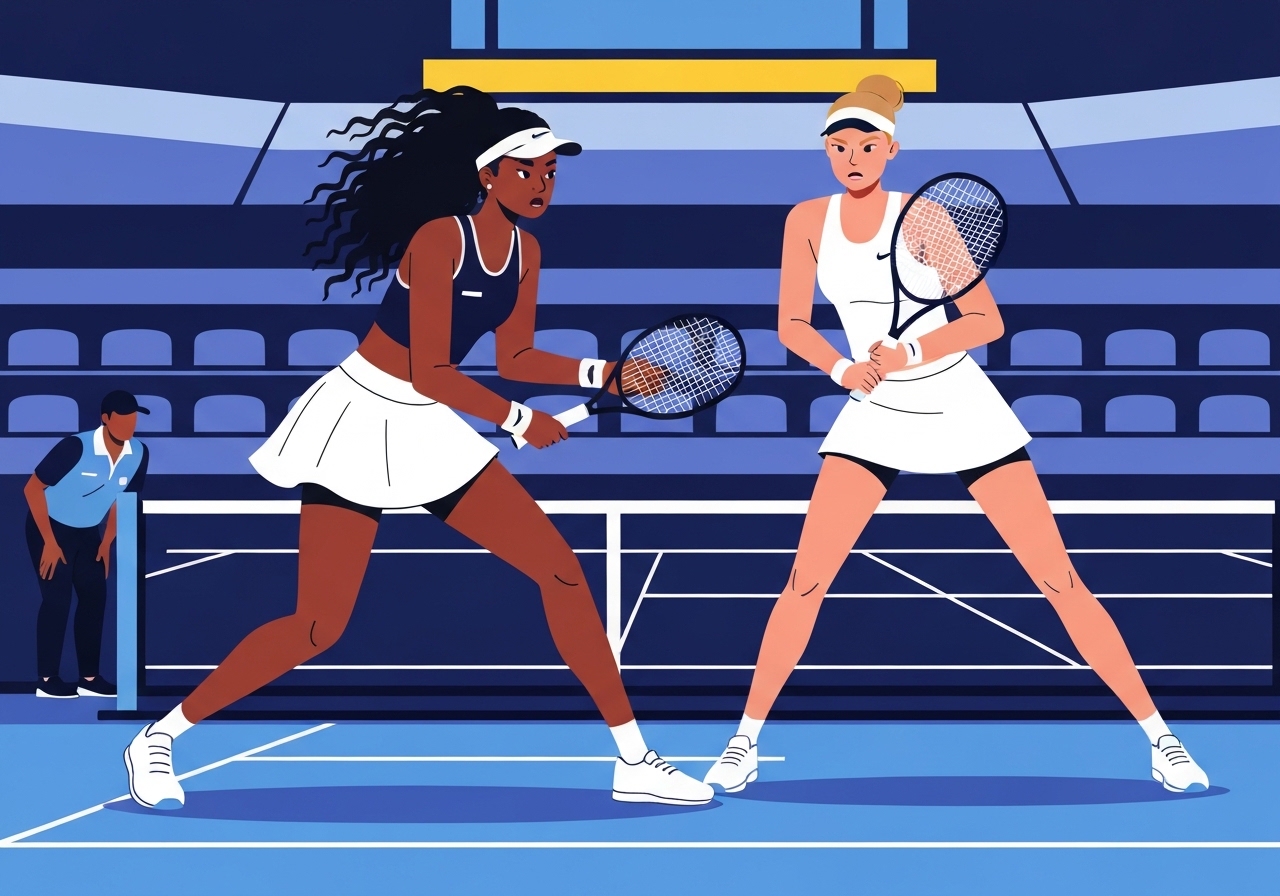
World number one Aryna Sabalenka will face Elena Rybakina in the 2026 Australian Open final in Melbourne after comfortable semi-final wins on Thursday. Sabalenka defeated Elina Svitolina 6-2, 6-3 despite a contested hindrance call in the first set, while Rybakina beat Jessica Pegula 6-3, 7-6 (9-7). Both finalists enter Saturday’s showpiece unbeaten in sets at this tournament, with Sabalenka on an 11-match winning run and Rybakina carrying exceptional serving form. The match sets up a high-stakes rematch: Rybakina seeks revenge for her 2023 final defeat to Sabalenka.
Key takeaways
- Aryna Sabalenka beat Elina Svitolina 6-2, 6-3 to reach her fourth consecutive Australian Open final; she has not dropped a set at Melbourne Park this year.
- Elena Rybakina defeated Jessica Pegula 6-3, 7-6 (9-7) to advance, saving match points in a tense second-set tiebreak.
- Sabalenka leads the tournament in total winners with 172 and is on an 11-match winning streak across events.
- Rybakina has served 41 aces so far in Melbourne and has lost only once in her last 20 matches.
- Head-to-head on hard courts favors Rybakina 6-5, while Rybakina also has the superior recent win total—37 wins since the end of Wimbledon last year.
- Sabalenka’s semi-final featured a hindrance ruling against her for alleged grunting; the point was awarded to Svitolina after an on-court review.
- Svitolina entered the semi-final as the tournament’s 12th seed after beating two top-10 players but was outmatched by Sabalenka’s power and serving consistency.
Background
The Australian Open has become a stage for powerful baseline tennis and big-serving contenders, and this year’s women’s draw has reinforced that trend. Aryna Sabalenka, a two-time Australian Open champion and the world number one, has been a dominant presence in Melbourne over recent years; this marks her fourth consecutive final appearance at the tournament. Elena Rybakina, seeded fifth and a former Wimbledon champion, has rebuilt her momentum since 2023 and arrives in Melbourne with a rich vein of form—only one loss in her past 20 matches.
Both players embody contrasting strengths: Sabalenka’s aggressive baseline game produces high winner counts but has sometimes been paired with emotional volatility, while Rybakina’s flat, powerful serve creates quick points and many aces. The rivalry has particular history on hard courts, where Rybakina holds a narrow 6-5 edge, adding a tactical subplot to the final. For the tournament organizers and fans, a rematch of the 2023 final carries narrative weight and commercial appeal.
Main event
Sabalenka controlled much of her semi-final against Ukraine’s 12th seed Elina Svitolina, producing 29 winners to 15 unforced errors and conceding just 11 points on her serve. The match included a turning moment in the fourth game of the opener when umpire Louise Azemar Engzell penalised Sabalenka for a hindrance reportedly linked to her grunt; the point was awarded to Svitolina after the umpire reviewed the rally. Sabalenka challenged the decision with a video review but the call stood.
Rather than losing composure, Sabalenka responded by breaking Svitolina and winning four of the next five games to claim the first set. Early in the second set a poor service game gave Svitolina a short-lived break, but Sabalenka immediately recovered, breaking back and then serving out the match with a forehand winner. Her on-court reset and aggressive response under pressure were decisive.
Rybakina’s semi-final was a tighter contest. She wrapped up the first set with a confident forehand and opened the second with an early break, but Pegula rallied, recovered a lost service game and forced a dramatic finish. Pegula saved three match points on her serve and later pushed the second set to a tiebreak, where Rybakina held her nerve to win 9-7 in the breaker. The Kazakh’s serving—41 aces to date in Melbourne—proved a critical advantage.
Analysis & implications
The final pits Sabalenka’s relentless aggression and high-volume winner production against Rybakina’s serve-dominated approach; tactically the match should hinge on return games and how each player handles pressure points. Sabalenka’s tournament-leading 172 winners reflect both her offensive potency and the risk she accepts to generate short points—a strategy that works when her serve is dominant and her first-strike hitting lands. If her serve falters or leads to higher unforced error counts, Rybakina’s ability to hold serve consistently could tilt the balance.
Rybakina’s recent consistency—37 wins since Wimbledon and only one defeat among her last 20 matches—indicates mental resilience and form across surfaces. Her ace count and serve percentages allow her to escape tighter rallies; the key for Sabalenka will be to neutralise the serve with aggressive, well-placed returns and to seize the few break opportunities that arise. On big points, Sabalenka’s recent improvement in maintaining focus after emotional incidents will be tested once more.
Beyond the match itself, a Sabalenka victory would cement her status as the dominant force in women’s tennis and extend her Grand Slam tally; a Rybakina win would mark a major title reclamation and underline the potency of power-serving athletes on hard courts. The result has ranking, endorsement and legacy implications for both players and may influence tactical preparation across the tour for how to confront heavy-hitting opponents.
Comparison & data
| Player | Semi-final score | Winners (match) | Unforced errors (match) | Key stat (tournament) |
|---|---|---|---|---|
| Aryna Sabalenka | 6-2, 6-3 vs Svitolina | 29 | 15 | 172 winners (tournament), 11-match streak |
| Elena Rybakina | 6-3, 7-6 (9-7) vs Pegula | — | — | 41 aces (tournament), 37 wins since Wimbledon |
The table summarises match-level and tournament-level indicators that shaped the semi-finals. Sabalenka’s match stats highlight attacking dominance and near-imperious serving (just 11 points lost on serve in the semi). Rybakina’s tournament aces and season-long win total demonstrate the serve’s outsized role in her results; she frequently converts fewer baseline rallies into decisive points by shortening exchanges with service power.
Reactions & quotes
“That’s actually never happened to me. I think it was the wrong call, but whatever. It actually benefitted my game. I was more aggressive.”
Aryna Sabalenka
“She did not make the normal sound”
Umpire Louise Azemar Engzell (on-court ruling)
“I was not brave enough”
Aryna Sabalenka (reflecting on the 2025 final loss to Madison Keys)
Unconfirmed
- Any formal protest or disciplinary follow-up by tournament officials regarding the hindrance call had not been announced at the time of reporting.
- Whether the hindrance ruling will prompt a review of on-court audio or replay procedures at future events is not confirmed.
- Predictions that the 2026 final outcome will materially change either player’s endorsement landscape are speculative and not verified.
Bottom line
The Sabalenka–Rybakina final in Melbourne is a classic contrast of styles: Sabalenka’s offensive breadth versus Rybakina’s serving precision. Both players arrive with strong forms—Sabalenka’s streak and winner totals, Rybakina’s ace production and match wins—meaning the match will likely be decided on a few pivotal return games and tie-break moments. For observers of the women’s tour, the final will underscore whether baseline aggression or serving dominance currently holds the strategic upper hand on hard courts.
Saturday’s match will also be a test of temperament. Sabalenka’s ability to stay composed after controversial moments and Rybakina’s capacity to convert tight opportunities are the human factors that could swing the final. Fans and analysts should watch early return games and break-point conversion rates as the clearest predictors of the winner.
Sources
- BBC Sport — media report and match coverage (press).
- Australian Open — official tournament site and match centre (official).
- WTA — player profiles and statistics (official tour).