
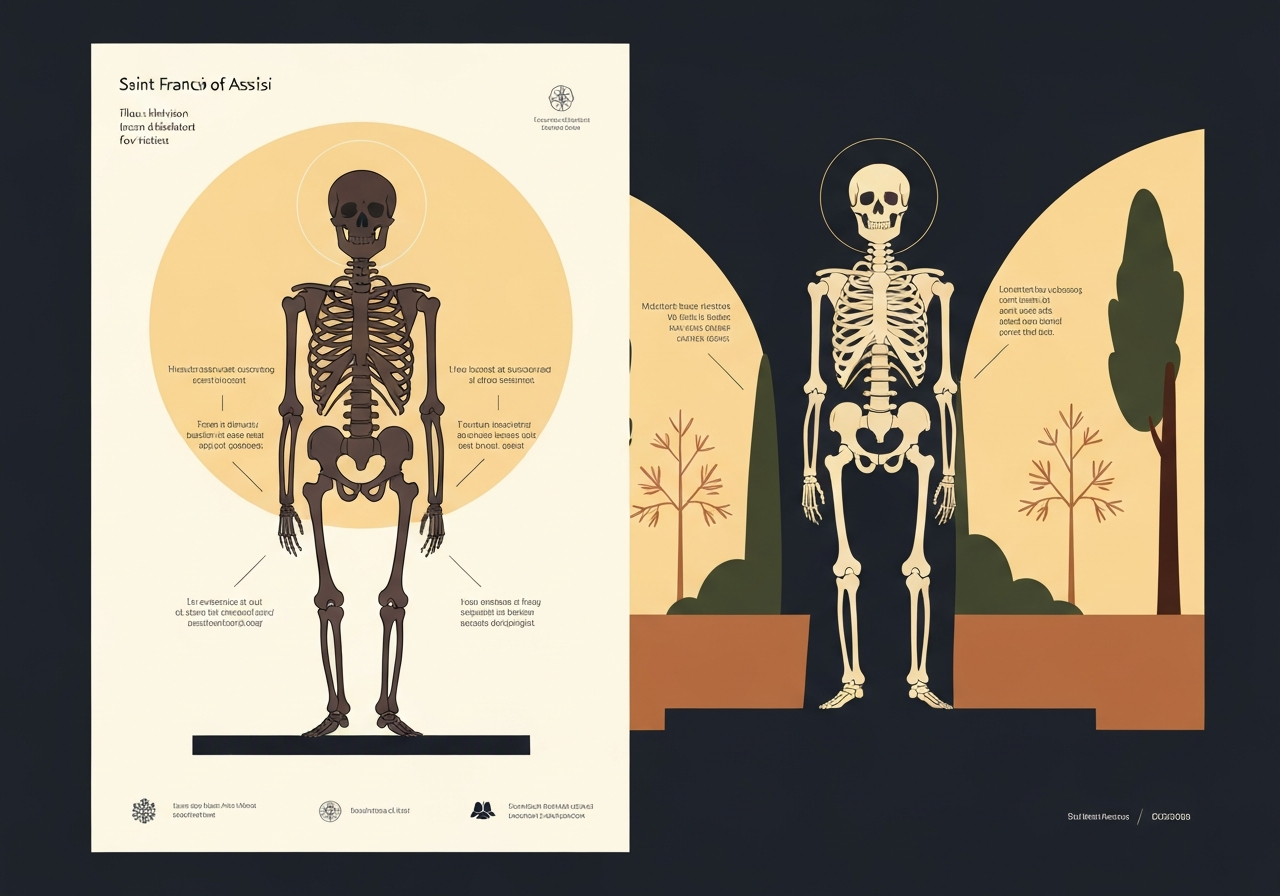
On 22 February 2026 the skeletal remains of Saint Francis of Assisi were placed on full public view in the Basilica of Saint Francis of Assisi in Italy, beginning a monthlong exhibition that runs until 22 March 2026. The relics lie inside a sealed, nitrogen filled reliquary engraved Corpus Sancti Francisci and are protected by a secondary bulletproof case and 24 hour surveillance. Church officials say the display is intended as a contemplative opportunity for pilgrims and casual visitors alike and is expected to draw hundreds of thousands to the hilltown of Assisi. Reservations already approach 400,000 and local authorities have prepared for a major surge in visitors during the 800th anniversary commemorations.
Key Takeaways
- Dates and location: The display opened on 22 February 2026 and will remain in the Basilica of Saint Francis of Assisi until 22 March 2026.
- Preservation measures: The bones are inside a nitrogen filled case with a bulletproof outer glass enclosure and continuous video monitoring.
- Visitor demand: Nearly 400,000 reservations were reported before the opening, with a strong majority from Italy and additional visitors from Brazil, North America and Africa.
- Expected footfall: The basilica normally hosts about 1,000 weekday visitors and 4,000 at weekends, but officials estimate up to 15,000 on weekdays and 19,000 on weekends during the exhibition month.
- Historical context: Saint Francis died on 3 October 1226 and the basilica that houses his remains was completed in 1230; his tomb was rediscovered after secretive excavations in 1818.
- Previous public viewings: Apart from scientific inspections and short exhumations, the bones were displayed publicly only once before, in 1978 for a single, limited-audience day.
- Cultural observance: A public holiday will be reinstated on 4 October 2026 as part of the 800th anniversary commemorations of Saint Francis’s death.
Background
Francis of Assisi renounced a family inheritance and founded the Franciscan order in the early 13th century, becoming one of Italy’s most venerated saints and a patron of the country. The Basilica of Saint Francis, begun soon after his death and completed in 1230, was built over his burial site and has been a focal point for pilgrimage and Franciscan spirituality ever since. The practice of venerating relics has deep roots in Christian history, with remains and objects of saints viewed as channels for devotion across denominations. Scientific study and conservation of human remains in ecclesiastical settings have increased in recent decades, prompting collaborations between religious custodians and preservation specialists. The rediscovery of Francis’s tomb in 1818 followed clandestine excavations, and public access to the physical remains has otherwise been strictly limited.
Relic displays often raise logistical and ethical questions for heritage managers and religious communities balancing access with conservation. In Assisi, the custodian friars and local authorities have coordinated security, crowd management and messaging to ensure that the exhibition is both safe and reverent. The Franciscan leadership frames the showing as compatible with long-standing devotional practices while inviting people of varied beliefs to reflect on Francis’s life. That framing sits alongside technical measures intended to prevent deterioration, drawing on modern museum and conservation standards to protect the bones during public exposure.
Main Event
On the first day the transparent nitrogen sealed reliquary was removed from a metal coffer inside the saint’s stone tomb in the basilica crypt and placed under a second, fortified glass enclosure in the main church. The outer case is anti-burglary and bulletproof, and the basilica has activated round the clock camera monitoring to deter theft and vandalism. Access is managed through timed reservations and security screening to control crowd flow and minimize risk to the relics and to visitors.
Giulio Cesareo, director of communications for the Franciscan convent, described the physical state of the remains as showing signs of having been ‘consumed’ by a life of radical poverty, and said the friars hope the display will be meaningful to both believers and non-believers. Marco Moroni, guardian of the convent, reported that almost 400,000 people had already reserved visits and confirmed that the majority of bookings were domestic while substantial numbers have come from Brazil, North America and African countries.
The basilica will keep interior lighting subdued and has said it will not stage theatrical illumination for the event. Conservation briefings provided to the public state that the sealed nitrogen environment and controlled light levels are intended to maintain the relics in the same microclimate they experienced in the tomb. Friars led prayers at the site and officials emphasised the intention to combine devotional practice with professional stewardship for the duration of the showing.
Analysis & Implications
The exhibition is likely to produce a significant short term economic uplift for Assisi and the wider Umbria region, with hotels, restaurants and transport seeing sharp increases in demand across the month. Local infrastructure will be tested: higher visitor numbers can strain lodging capacity, public transport, and waste management, requiring city authorities to stretch resources and deploy temporary controls. The reinstatement of a public holiday on 4 October 2026 signals institutional recognition of the anniversary’s cultural importance and may further concentrate travel and pilgrimage flows that autumn.
From a heritage management perspective, the use of a sealed, nitrogen filled case is consistent with contemporary conservation practice for fragile organic remains, yet the event also raises longer term questions. Conservators will monitor the bones after the exhibition to detect any unforeseen effects of public display despite the sealed environment, and the friars’ choice to allow extended viewing may set a precedent for how other major relics are handled. Transparency about monitoring results will be important to build public trust in both the religious custodians and conservation professionals.
Religiously and socially, the display underscores how medieval saints remain central to contemporary identity and memory in Italy and beyond. It may also prompt renewed discussion about relic veneration in plural societies, including how such acts of devotion intersect with tourism and secular interest. Diplomatically, the international turnout reflects Francis’s global appeal, but organizers will need to manage crowd safety and cross-border travel considerations as the commemoration year continues.
Comparison & Data
| Metric | Typical level | Expected during exhibition |
|---|---|---|
| Weekday visitors to basilica | ~1,000 | up to 15,000 |
| Weekend visitors to basilica | ~4,000 | up to 19,000 |
| Advance reservations | — | almost 400,000 |
The numbers above come from Franciscan convent statements and reflect projections for the monthlong event rather than confirmed totals. Even with timed entry, sustained daily peaks could produce congestion at transport hubs and local services, requiring contingency plans and possibly temporary restrictions on ancillary events.
Reactions & Quotes
Officials and visitors offered a mix of devotional reflection and practical caution on opening day.
a meaningful experience for believers and non believers alike
Giulio Cesareo, Franciscan communications director
Cesareo and other friars framed the display as rooted in a long Christian tradition of relic veneration, while emphasising reverence over spectacle.
the damaged and consumed state of the bones shows he gave himself completely to his life’s work
Giulio Cesareo, Franciscan communications director
On logistics, the convent guardian highlighted the large international interest behind the advance bookings.
almost 400,000 people have reserved visits from many parts of the world
Marco Moroni, guardian of the Franciscan convent
Unconfirmed
- The precise final attendance figure for the month is not yet known and may differ from current reservation totals.
- Long term effects on the bones beyond immediate post-display monitoring remain to be established and will depend on follow up conservation assessments.
- Detailed breakdowns of visitor nationality by exact numbers are provisional and have been summarised by convent officials rather than published in full.
Bottom Line
The Assisi exhibition combines centuries-old devotional practice with contemporary conservation and crowd management, bringing an uncommon level of public access to one of Italy’s most important relics. Short term benefits for local tourism and global attention are clear, while custodians and conservation experts will need to publish monitoring results to address preservation concerns and set standards for similar future events.
Observers should watch for official conservation reports after 22 March 2026 and for logistical adjustments as the wider 800th anniversary programme unfolds, including the reinstated public holiday on 4 October 2026. How the church balances reverence, access and scientific transparency in the weeks and months ahead will shape public confidence in custodial decisions for other major relics.
Sources
- The Guardian — news report summarising opening day coverage and convent statements