
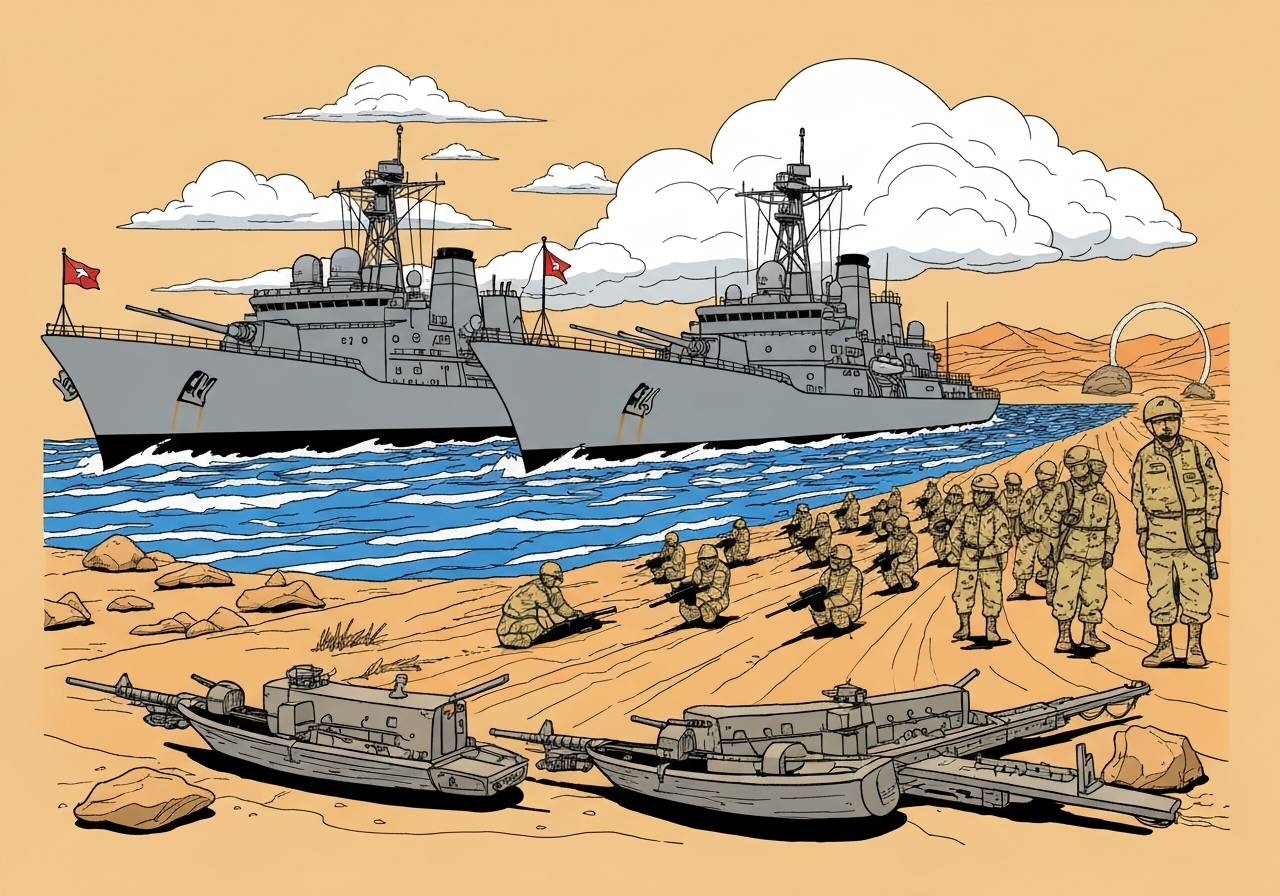
U.S. Navy amphibious forces from San Diego departed this week for the Middle East as part of a stepped-up American military posture in the region. On Thursday, March 19, 2026, an amphibious ready group centered on the 844-foot USS Boxer left San Diego carrying elements of Camp Pendleton’s 11th Marine Expeditionary Unit — up to 2,500 Marines — to bolster U.S. forces amid the war with Iran that began Feb. 28, 2026. Boxer is sailing with the amphibious warships USS Portland and USS Comstock and is described by officials and outlets as a “mini-carrier” because of its embarked air assets, including F-35B jets. The move follows the recent departure of the USS Tripoli group, which sailed about a week earlier with a similar Marine contingent.
Key Takeaways
- Departure date: The Boxer amphibious ready group left San Diego on Thursday, March 19, 2026, with Portland and Comstock accompanying the flagship.
- Personnel and units: The ships are carrying elements of Camp Pendleton’s 11th Marine Expeditionary Unit (11th MEU), up to 2,500 Marines trained for rapid air-and-ground amphibious operations.
- Platform details: USS Boxer is an 844-foot amphibious assault ship that can operate F-35B short-takeoff/vertical-landing aircraft; Boxer’s last major deployment ran July 16–Nov. 24, 2024, interrupted by mechanical repairs.
- Operational context: The Pentagon said ready groups are being sent because ground forces might be required to supplement U.S. missile and drone strikes in the conflict that began on Feb. 28, 2026.
- Regional aim and options: U.S. officials have discussed reopening the Strait of Hormuz for global shipping; one proposed option mentioned publicly is securing Kharg Island, Iran’s primary oil export terminal.
- Related naval activity: It is not yet clear whether Boxer’s group will operate near the San Diego-based USS Abraham Lincoln carrier strike group, which is in the Arabian Sea and recently completed key pre-deployment training.
Background
The U.S. military has increased deployments to the Middle East since open hostilities between the United States and Iran began on Feb. 28, 2026. Early phases of the conflict have relied heavily on missile and drone exchanges; Washington now signals a need to have ground and amphibious options available should strikes and maritime operations require augmentation. Amphibious ready groups and Marine Expeditionary Units offer flexible, sea-based surge capacity and the ability to put forces ashore quickly if commanders determine a landing operation is necessary.
Camp Pendleton’s 11th MEU is a rotating, forward-deployable combined-arms force that trains for rapid response, crisis intervention and amphibious assaults. Historically, MEUs based in Southern California were among units that landed Marines during the 2003 Iraq War; their doctrine emphasizes air-ground integration and ship-to-shore maneuver. The Boxer and similar amphibious assault ships host helicopters, tiltrotors and short-takeoff jets, giving commanders options from strike to humanitarian assistance.
Main Event
On Thursday, March 19, 2026, the Boxer amphibious ready group sailed from San Diego with the Portland and Comstock. Embarked elements of the 11th MEU include infantry, logistics and aviation detachments trained for ship-to-shore assault and stabilization missions. The departure came roughly a week after the USS Tripoli left San Diego with two other ships and another contingent of about 2,500 Marines, reflecting a pattern of sequential rotational surges.
Officials characterize Boxer as a hub for air assets — routinely labeled a “mini-carrier” because it can operate F-35B jets alongside helicopters and MV-22 Ospreys. The deployment follows Boxer’s last large-scale mission from July 16 to Nov. 24, 2024, which was cut short by mechanical issues that required repairs in San Diego. The ship is now back in service and operationally ready for this mission.
The Pentagon has framed these naval movements as precautionary and responsive: planners want maritime and ground options available as U.S. forces continue missile and drone strikes against Iranian targets. Public discussion in Washington has included potential operations to ensure the Strait of Hormuz remains open for international shipping, and Kharg Island has been specifically mentioned in that strategic conversation.
Analysis & Implications
The deployment of amphibious ready groups with an embarked MEU raises the operational threshold in the region because it places a highly mobile ground force within reach of multiple littoral targets. A MEU can conduct a range of missions — from evacuations and limited raids to larger amphibious assaults — making it a versatile tool for commanders who seek options short of full-scale ground invasion. For policymakers, the presence of ready groups signals to allies, adversaries and commercial shipping that the U.S. is preparing for contingencies beyond air and sea strikes.
Economically, guaranteeing the free flow of oil through the Strait of Hormuz is a central U.S. objective; operations to secure maritime chokepoints would have immediate global market implications. A move to seize or temporarily control Kharg Island would be a high-risk operation with major escalation potential, given its importance to Iran’s oil exports. Military planners must weigh asset protection, logistics and sustainment for any sustained shore-based occupation of such facilities.
Politically, sending additional Marines and amphibious assets projects deterrence but also risks entangling U.S. forces in a broader, protracted land campaign if mission aims expand. Domestically, reactions are likely to vary: some veterans and policymakers will view the deployment as necessary preventive posture, while others will see it as an escalation with unclear end-states. Internationally, partners and neutral shipping interests will watch whether these movements restore safe passage in the Strait or provoke retaliatory actions.
Comparison & Data
| Unit / Group | Departure | Approx. Marines | Key ships |
|---|---|---|---|
| Boxer amphibious ready group | March 19, 2026 | Up to 2,500 (elements of 11th MEU) | USS Boxer, USS Portland, USS Comstock |
| Tripoli amphibious group | ~March 12, 2026 | About 2,500 Marines | USS Tripoli + two escorts |
| Abraham Lincoln strike group | Operating in Arabian Sea (March 2026) | Carrier strike complement | USS Abraham Lincoln (carrier) |
The table clarifies recent U.S. naval activity from San Diego-area units in March 2026: two sequential amphibious group departures, each carrying roughly 2,500 Marines, and a carrier strike group operating in the Arabian Sea. These deployments emphasize maritime mobility and the U.S. practice of positioning expeditionary forces to preserve a range of response options.
Reactions & Quotes
“It’s relatively safe, but you need a lot of help, in the sense of you need ships, you need volume.”
President Donald Trump — as reported by San Diego Union-Tribune
“The Boxer is often described as a ‘mini-carrier’ because of its ability to operate a mix of aircraft, including F-35B jets, from a sea-based deck.”
Associated Press / Reuters coverage
“The Pentagon is dispatching ready groups because ground forces might be needed to supplement the missile and drone attacks”
Pentagon commentary reported by wire services
Local veterans and community groups in San Diego expressed mixed views: some emphasized the need to protect shipping lanes and deter escalation, while others cautioned against enlarging U.S. ground commitments. Military analysts reached by wire services noted that amphibious readiness groups and MEUs are standard instruments for projecting flexible power but warned that their presence can complicate diplomatic efforts if perceived as preparations for occupation.
Unconfirmed
- Whether USS Boxer’s current deployment includes a full complement of F-35B aircraft aboard is not publicly confirmed.
- There is no official confirmation that the Boxer group will operate in proximity to the USS Abraham Lincoln carrier strike group.
- Plans to seize or occupy Kharg Island remain speculative; no operational order for such an action has been publicly released.
Bottom Line
The March 19, 2026, departure of the Boxer amphibious ready group with elements of Camp Pendleton’s 11th MEU adds a sea-based, rapid-response capability to U.S. forces already engaged in strikes since Feb. 28. That capability gives commanders options for limited ground operations, emergency evacuations or demonstrations of force without immediately committing large long-term land forces.
However, the presence of amphibious forces also raises escalation risks if planners move from deterrence to seizure operations of critical facilities such as Kharg Island. Observers should watch for clarifying Pentagon guidance on mission scope, whether air assets like F-35Bs embark, and any coordination with allied naval forces that could alter the operation’s political and military calculus.
Sources
- San Diego Union-Tribune (local news report)
- Reuters (international wire reporting)
- Associated Press (wire service)