
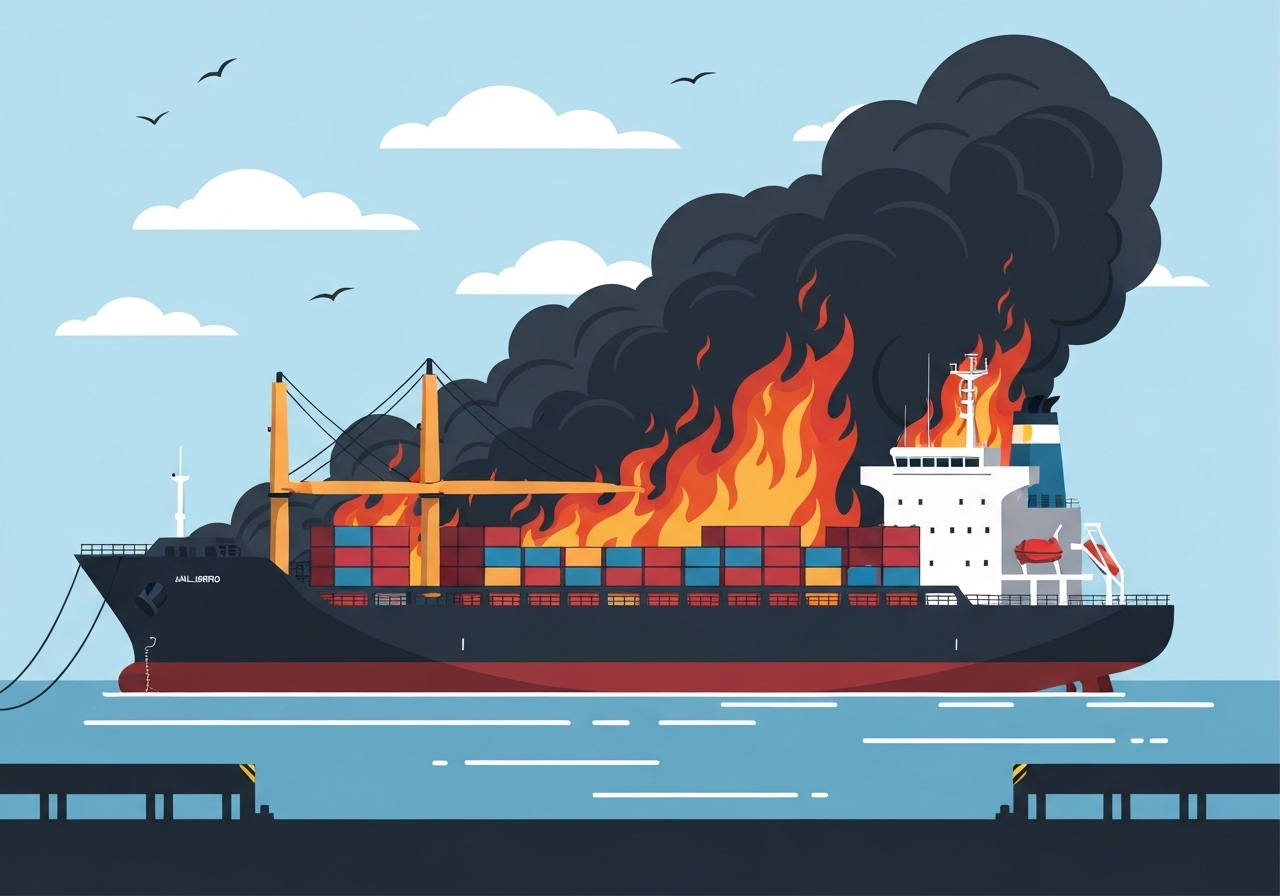
Lead: Firefighters and marine responders battled a large electrical fire on the 1,100-foot container ship 1 Henry Hudson at the Port of Los Angeles on Friday evening, Nov. 21, 2025. The blaze, first reported below deck at 6:38 p.m., prompted a major emergency declaration as hazardous materials inside several containers complicated suppression efforts. An explosion just before 8 p.m. disrupted power to lights and cranes, and marine units cooled the hull while hazardous‑materials teams monitored air quality. All 23 crew members were evacuated and accounted for by 8:30 p.m., and no injuries were reported.
Key Takeaways
- Incident timeline: an electrical fire was reported at 6:38 p.m.; an explosion occurred just before 8:00 p.m.; all 23 crew were rescued by 8:30 p.m.
- Scale of response: 186 firefighters were assigned to the vessel and specialists in hazardous materials and marine firefighting were deployed.
- Vessel details: the ship, named 1 Henry Hudson, is about 1,100 feet long and had arrived at the Port of L.A. on Wednesday after sailing from Tokyo.
- Hazard control: hazardous materials were reported in multiple containers; all firefighters operated in protective suits and with oxygen masks while air quality teams monitored conditions.
- Access and safety: the U.S. Coast Guard set a one‑nautical‑mile safety perimeter; the Vincent Thomas Bridge was closed at 10:30 p.m. with detours advised.
- Suppression tactics: crews used marine cooling for the hull, refrained from below‑deck entry early in the response, and used drones for thermal imaging.
Background
The Port of Los Angeles is the busiest container port in the United States and handles a large share of transpacific cargo, including hazardous shipments that require specialized handling. Fire incidents on container vessels pose unique risks because cargo manifests can include flammable or toxic materials packed in sealed containers, complicating detection and suppression. Local emergency services maintain joint protocols for maritime fires, combining LAFD hazardous‑materials teams, Coast Guard incident command, and marine firefighting assets from the port authority. In recent years, ports worldwide have emphasized joint training and thermal imaging surveillance to detect and manage below‑deck fires before they spread to cargo stacks.
Container ships of this class typically carry multinational crews and complex stowage plans; manifests are essential to identify hazardous consignments but may not be immediately accessible during a fast‑moving emergency. The involvement of 186 firefighters and specialized hazmat teams reflects the Port of L.A.’s contingency posture for high‑risk maritime incidents. Local and state officials are routinely briefed during such events — here, Los Angeles city and California state offices were informed as crews worked to secure the scene. The port authority, the U.S. Coast Guard, and traffic agencies coordinate to protect waterfront operations and surface transportation routes during prolonged responses.
Main Event
According to fire officials, the below‑deck electrical fire aboard the 1 Henry Hudson was first reported at 6:38 p.m. Responders made an initial assessment and established an incident command, prioritizing crew rescue and establishing a perimeter. An explosion under way just prior to 8:00 p.m. affected the vessel’s electrical systems and shore cranes, prompting command to restrict firefighters from below‑deck entry while hazardous‑materials teams evaluated air quality.
Marine units worked to cool the ship’s exterior to reduce heat transfer and make lateral ventilation and eventual below‑deck access safer for crews. Drones equipped with thermal imaging provided overhead heat maps of the superstructure and sub‑levels to guide suppression efforts and identify hot spots. At one point earlier in the evening, six crew members were reported unaccounted for, but by 8:30 p.m. LAFD confirmed all 23 crew had been located and safely removed from the vessel.
Large quantities of water were used in firefighting and, while that raised concerns about stability and ballast, incident commanders reported the ship did not appear to be sinking during the early response. A one‑nautical‑mile safety zone was enforced by the U.S. Coast Guard to protect other port traffic, and the California Highway Patrol ordered the Vincent Thomas Bridge closed at 10:30 p.m. to limit surface access near terminals. Containment progress was initially slow due to persistent heat and the presence of hazardous cargo within affected containers.
Analysis & Implications
Maritime electrical fires are often difficult to locate and control because cable runs and machinery spaces are enclosed and interconnected; below‑deck blazes can spread through ventilation and cable ducts if not rapidly isolated. The combination of electrical ignition and containers carrying hazardous materials increases both the operational complexity and the risk profile for firefighting crews, necessitating full personal protective equipment and atmospheric monitoring. The decision to withhold below‑deck entry early reflects standard risk management: minimizing firefighter exposure until reliable air sampling and hot‑spot mapping are available.
The scale of the response — 186 firefighters plus hazmat, marine, and Coast Guard assets — underscores the potential downstream effects on port operations. Extended terminal closures or detours, such as the Vincent Thomas Bridge shutdown, can ripple through supply chains, delaying trucked cargo movement and increasing congestion at alternate entry points. Given Los Angeles’ role in U.S. goods movement, a prolonged incident could exacerbate scheduling backlogs for carriers and lead to demurrage or rerouting costs for shippers.
From a regulatory and insurance perspective, investigators will focus on root causes: electrical system integrity, maintenance records, cargo declaration accuracy, and stowage practices for hazardous materials. If investigations reveal lapses in manifest declaration or safety protocols, ship operators and cargo owners could face fines and longer‑term operational restrictions. Conversely, robust documentation and adherence to International Maritime Organization codes may mitigate legal and commercial exposure for the vessel’s operator and flag state.
Comparison & Data
| Metric | This Incident (1 Henry Hudson) | Typical Large Container Ship |
|---|---|---|
| Length | 1,100 ft | 800–1,200 ft |
| Crew | 23 | 20–30 |
| Firefighting personnel assigned | 186 | Varies by incident, 50–200+ |
| Safety perimeter | 1 nautical mile | 0.5–2 nm depending on hazards |
The table places the vessel and response in context: the ship’s length and crew size are within expected ranges for large container ships, while the high number of firefighters reflects the added hazard of containerized dangerous goods. Using drones for thermal imaging is now common practice during complex marine fires, improving situational awareness without increasing human exposure. The Vincent Thomas Bridge closure illustrates local transport impacts that often accompany major waterfront incidents.
Reactions & Quotes
Local officials issued public updates as responders worked through the night, emphasizing that crew safety was secured and that hazardous‑materials protocols were in effect.
“All crew members were accounted for and removed from harm’s way; hazardous‑materials teams remain on scene to assess air quality.”
Los Angeles Fire Department (official statement)
The mayor’s office and the governor’s staff were briefed, reflecting the event’s potential regional significance and the need for coordinated support.
“We are monitoring the situation closely and coordinating with local partners to support response efforts.”
Mayor Karen Bass (city statement)
The U.S. Coast Guard confirmed maritime restrictions intended to protect other vessels and first responders.
“A safety perimeter has been established to protect port traffic and emergency operations while crews suppress the fire.”
U.S. Coast Guard (on‑scene command)
Unconfirmed
- The precise cause of the electrical ignition has not been publicly confirmed and remains under investigation.
- Specific identities and quantities of hazardous materials in affected containers have not been released by authorities.
- The full extent of structural or cargo damage and any potential long‑term port operational impact remain unclear pending formal assessments.
Bottom Line
The November 21, 2025 fire aboard the 1 Henry Hudson in San Pedro illustrates how electrical incidents on large container ships can escalate quickly when hazardous cargo is involved. Rapid evacuations and a large, coordinated response secured all 23 crew members without reported injuries, but containment proved slow due to persistent heat and hazardous materials concerns. Short‑term consequences include surface traffic disruptions, a one‑nautical‑mile maritime exclusion zone, and the Vincent Thomas Bridge closure; longer‑term implications depend on investigative findings about cause and manifest accuracy.
Investigators will now examine shipboard electrical systems, cargo documentation, and response timelines to determine root causes and any regulatory or commercial fallout. For local communities and supply‑chain stakeholders, the episode underscores the value of joint training, transparent cargo declarations, and investment in remote sensing and marine firefighting capabilities to reduce risks in future port incidents.
Sources
- Los Angeles Times — News organization report summarizing timeline and official statements (media).
- Los Angeles Fire Department — Official agency for firefighting and hazardous‑materials response (official).
- U.S. Coast Guard — Federal maritime safety and on‑scene coordination (official).
- Vessel Finder — Ship tracking and voyage information indicating arrival from Tokyo (ship‑tracking service).
- Port of Los Angeles — Port authority and terminal operations (official).