
Lead
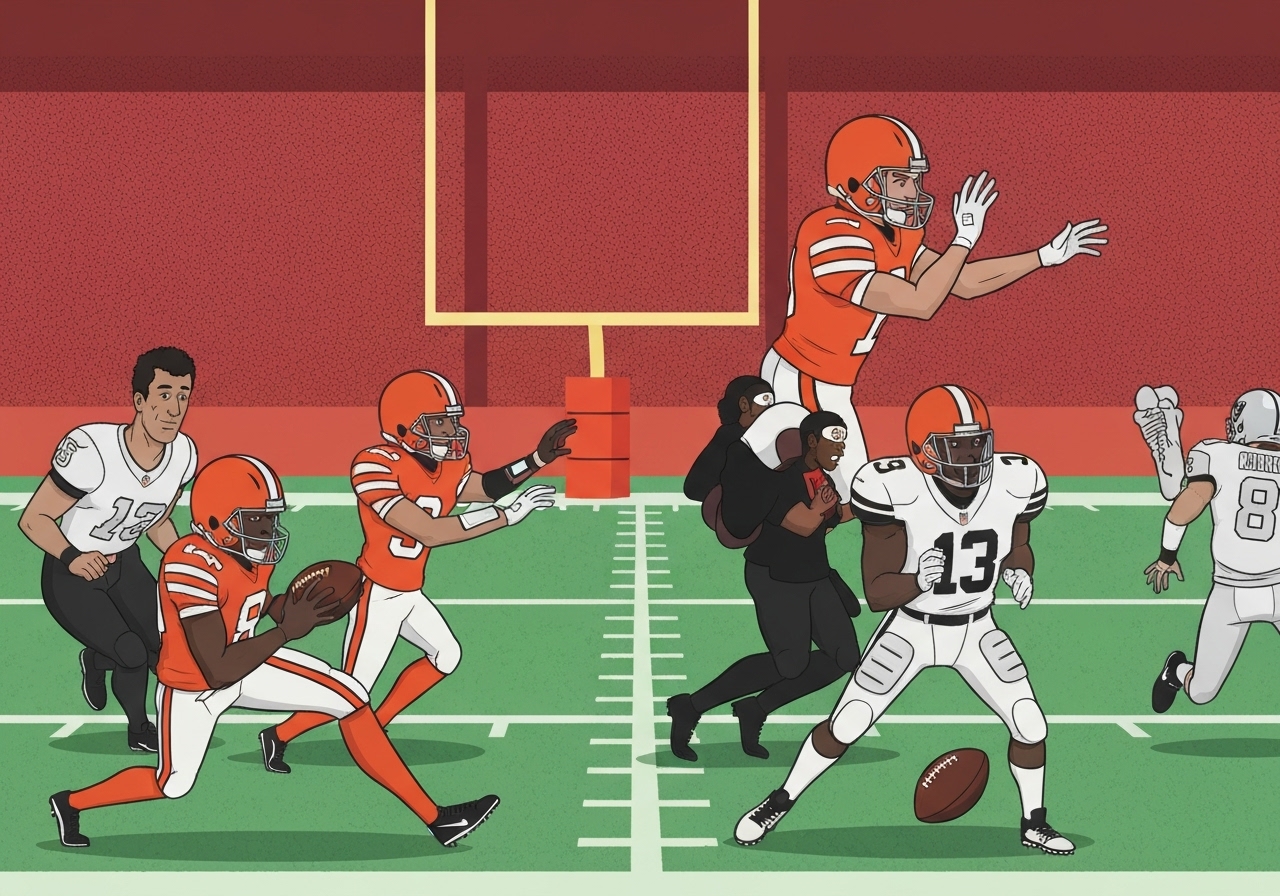
Shedeur Sanders made his first career start Sunday and, playing in view of his father Deion Sanders, took a 14-3 lead into halftime as the Cleveland Browns held the Las Vegas Raiders to just 101 total yards. Cleveland’s defense generated five sacks and a turnover that helped build the margin, while special teams set up the opening score. Sanders completed 7 of 11 passes for 127 yards and threw one interception but was supported by a stout front and a timely return. The Raiders’ lone points came on a 41-yard Daniel Carlson field goal after a pair of promising drives stalled.
Key Takeaways
- The Browns led 14-3 at halftime, gaining 132 total yards to the Raiders’ 101.
- Cleveland recorded five sacks in the half; Maliek Collins had two and Myles Garrett added one (Garrett leads the NFL in sacks).
- Shedeur Sanders was 7-of-11 for 127 yards with one interception through two quarters.
- Gage Larvadain returned an A.J. Cole punt 44 yards; Cole was penalized 14 yards for tripping and the Browns scored shortly after.
- Quinshon Judkins scored twice on runs of 8 and 2 yards after key Browns plays of 17 yards to Harold Fannin and 52 yards to Isaiah Bond.
- Raiders QB Geno Smith was 13-of-20 for 110 yards; Daniel Carlson made a 41-yard field goal and missed a 48-yard attempt.
- Jerry Jeudy fumbled at the end of a 39-yard reception; Elandon Roberts recovered for Las Vegas.
Background
The Browns entered the game with an emphasis on defensive pressure as a route to quick scores, leaning on veterans like Myles Garrett and Maliek Collins to disrupt opposing passing games. Shedeur Sanders, a rookie making his first NFL start, did so under the heightened attention that comes with being the son of Pro Football Hall of Famer Deion Sanders. Cleveland’s early-season game plans have mixed conservative play-calling with opportunistic special teams, a combination intended to protect inexperienced quarterbacks while generating short fields.
The Raiders have struggled offensively in recent weeks, and their early possessions reflected communication and protection issues against consistent pressure. Geno Smith, a veteran presence under center for Las Vegas, has attempted to balance quick-completion looks with designed runs for backs like Ashton Jeanty, who had 10 carries in the half. Special-teams miscues and turnovers have been a recurring problem for both clubs this season, magnifying the impact of each mistake in close contests.
Main Event
Cleveland’s scoring sequence began after a 44-yard punt return by Gage Larvadain that ended when A.J. Cole tripped the returner; officials assessed a 14-yard tripping penalty on Cole to place the ball at the Raiders’ 27. Two plays later, Quinshon Judkins finished the possession with an 8-yard touchdown run. That sequence illustrated how a single special-teams play and an officiating call can alter field position and scoring opportunities.
The Browns’ second touchdown came after Sanders orchestrated a pair of big plays: a 17-yard completion to Harold Fannin and a 52-yard pass to Isaiah Bond that flipped field position and set up Judkins’ 2-yard scoring run. Sanders’ passing numbers were limited but efficient in producing yardage on those two plays, helping convert explosive opportunities into points rather than empty drives.
Defensively, Cleveland’s unit dominated the line of scrimmage, limiting Las Vegas to 101 total yards in the half and recording five sacks. Maliek Collins accounted for two of those sacks, while Myles Garrett added another, underscoring the Browns’ pass-rush depth. The Raiders’ lone sustained scoring drive stalled inside the red zone and resulted in a 41-yard Daniel Carlson field goal; Carlson also missed a 48-yard attempt later in the half.
Notable individual plays included Jerry Jeudy’s 39-yard catch that ended with a fumble recovered by Elandon Roberts for the Raiders, and Isaiah Bond’s 58 yards on two receptions that provided Cleveland with its largest passing gains in the period. The Browns’ 132 yards in the half came with balanced contributions from special teams, defense, and situational passing.
Analysis & Implications
The half illustrated two contrasting trajectories: Cleveland generating game-changing plays on defense and special teams, and Las Vegas failing to sustain drives under pressure. Five sacks in one half is a disruptive rate that usually forces a team to alter protection schemes and quicken its release times. For Geno Smith and the Raiders, the immediate task is to improve pass protection and get playmakers into space against a defense that is currently winning individual matchups.
For Shedeur Sanders, the stat line of 7-of-11 for 127 yards with an interception is a mixed but not uncommon profile for a rookie starter relying on a complementary game plan. The Browns limited his dropbacks and maximized high-reward targets (the 52-yard Bond catch), which reduced exposure while still producing points. How Cleveland balances longer-developing pass designs versus quick, high-percentage throws will shape Sanders’ efficiency in the second half and beyond.
Special teams again proved decisive: a 44-yard return plus a tripping penalty directly created the first touchdown opportunity. That sequence highlights how marginal gains in the kicking and return game can shift expected points on a drive. Teams that win the field-position battle often need fewer offensive yards to score, a principle on display in this half where Cleveland had 132 yards but two touchdowns.
Looking forward, the Raiders face a mid-game schematic challenge. They must neutralize the Browns’ edge rush and generate separation for their receivers against a defense that has demonstrated pass-rush depth. If Las Vegas cannot protect and produce yards after catch, the result is likely to be more third-and-long situations and a continued reliance on Daniel Carlson for scoring from longer distances.
Comparison & Data
| Stat | Browns (1H) | Raiders (1H) |
|---|---|---|
| Total yards | 132 | 101 |
| Passing (yards) | 127 | 110 |
| Sacks | 5 | 0 |
| Turnovers | 0 | 1 (fumble) |
| Points | 14 | 3 |
The table above compresses the first-half differential: Cleveland’s defensive pressure converted into sacks and short fields, while Las Vegas had modest passing yardage but no sacks to offset the Browns’ gains. The Browns’ scoring efficiency (two touchdowns from limited total yards) underscores situational advantages provided by special teams and pass-rush-created field position.
Reactions & Quotes
“A dominant first half by the Browns’ defense set the tone and provided short fields for the offense.”
NBC Sports (game report)
“Special teams’ field-flipping play directly led to Cleveland’s opening touchdown, a clear momentum swing.”
Game analysis (broadcast)
“Sanders produced two explosive completions that turned field position into points despite a limited number of throws.”
Post-halftime analytics summary
Unconfirmed
- Whether Shedeur Sanders will remain the starter beyond this game has not been confirmed by the Browns’ organization.
- Reports of any injury status affecting either team’s depth charts for the second half are not yet officially disclosed.
- The precise tactical adjustments the Raiders will implement at halftime—personnel or protection schemes—have not been publicly detailed.
Bottom Line
At halftime the Browns lead 14-3 thanks to a combination of defensive pressure, a pivotal special-teams play, and two short touchdown runs by Quinshon Judkins. Shedeur Sanders’ first start has been supported by teammates more than defined by his own volume of passes; two big completions produced points, but the interception and limited attempts reflect a conservative, protective approach.
The Raiders must answer with improved pass protection and quicker decision-making from Geno Smith to prevent the Browns’ pass rush from dictating the remainder of the game. If Cleveland sustains its pressure and special-teams performance, they will likely maintain control; conversely, a successful halftime adjustment by Las Vegas could tighten the contest quickly.