
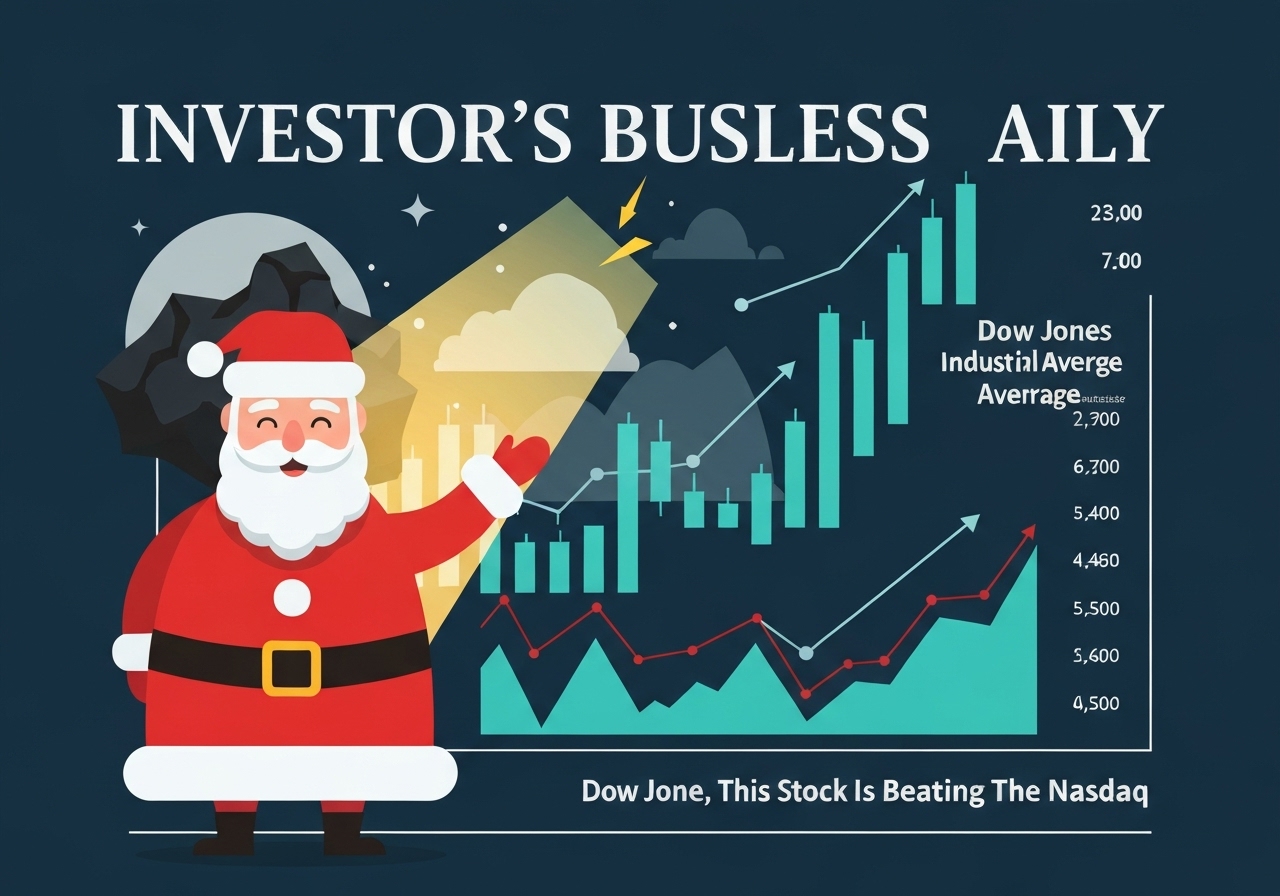
In a shortened pre-Christmas session on Wednesday, U.S. equity markets broadly rose as traders wrapped trading early for the holiday and indexes recorded gains across both the Nasdaq and the New York Stock Exchange. The 3-1/2-hour trading window saw positive breadth, with advancing issues outnumbering decliners and winners driving the tape higher. Market historians note the pattern as part of the long-observed “Santa Claus” seasonal effect first documented by Yale Hirsch decades ago. One notable outcome of the session was a major Dow component outperforming the Nasdaq composite during the late-day move.
Key Takeaways
- Trading on Wednesday was shortened to a 3.5-hour session ahead of the Christmas holiday, compressing volume into the early day and afternoon.
- Both the Nasdaq and the New York Stock Exchange closed higher on the session, reflecting broad gains rather than narrow leadership.
- Market breadth was positive: advancers outpaced decliners across major exchanges, indicating broad participation.
- One large-cap Dow component outperformed the Nasdaq composite during the session’s rally, standing out among blue-chip names.
- The move follows a seasonal pattern often referenced as the “Santa Claus rally,” a phenomenon noted in market lore and historical studies.
- Shortened holiday hours and thinner year-end liquidity likely amplified intraday price moves and sector rotations.
Background
The idea of a year-end lift in equities—commonly called the “Santa Claus rally”—was popularized by market historian Yale Hirsch and has been cited in investor commentary for decades. It refers to a stretch of generally positive returns in the final trading days of December and the first two trading days of January. Analysts and portfolio managers attribute the pattern to a mix of window-dressing by funds, tax-related flows, holiday optimism, and lower trading volumes that can exaggerate price moves.
Holiday-shortened sessions, such as the 3.5-hour trading day on this particular Wednesday, routinely change intraday dynamics: thinner liquidity can intensify price reactions to news or to concentrated buy/sell orders. Historically the effect varies year to year—some years produce clear gains across indices, while others see sector-specific strength with mixed breadth. Market participants ranging from retail traders to institutional funds monitor these days for both tactical entries and portfolio rebalancing.
Main Event
The session opened with modest buying interest and built into the afternoon as traders adjusted positions ahead of the holiday close. Both major exchanges recorded more advancing issues than decliners, a technical sign of broad participation rather than a market driven by a few large winners. Volume profiles were lighter than a typical full session, consistent with shortened holiday trading.
Sector leadership was mixed but notable: several large-cap industrial and consumer-oriented names contributed to the Dow’s relative strength, helping at least one Dow component to outpace the Nasdaq composite for the day. Technology issues on the Nasdaq also posted gains, but the breadth signal suggests the rally was not confined to one index or sector. Late-session buying pushed intraday highs into place for many names before the market closed early.
Market commentators linked the move to both seasonal factors and tactical flows—some participants cited window-dressing and end-of-year allocation adjustments as drivers, while others pointed to benign macro headlines that reduced near-term risk aversion. No single headline dominated the tape; rather, a collection of modestly positive developments and thin liquidity amplified the upside. Traders noted that in such compressed sessions price swings can appear sharper than they would in a full trading day.
Analysis & Implications
From a technical and tactical standpoint, a holiday-driven lift can reset investor sentiment into the new year, but it does not in itself resolve longer-term fundamental questions. A one-day or short stretch of gains often reflects positioning and crowd psychology more than changes in corporate earnings or macro fundamentals. Investors should be cautious about extrapolating a brief Santa-period uptrend into a durable trend without corroborating economic or earnings data.
For portfolio managers, the observed breadth is meaningful: when advances outnumber declines across exchanges, it suggests participation that could support follow-through if underlying catalysts align. Yet thinner holiday liquidity raises the risk of false signals—moves can reverse quickly once normal volumes return. Risk managers therefore often treat year-end rallies as opportunities to rebalance rather than as confirmation of a new regime.
On the market-structure side, the outperformance of a Dow component relative to the Nasdaq highlights the difference between price-weighted and market-cap-weighted index dynamics and the possibility of rotation between value-oriented blue-chips and growth-heavy Nasdaq names. If rotation persists into the new year, it could influence sector allocations and earnings-season positioning. Policymakers’ signals on interest rates and economic data releases early next year will be central to whether gains stick.
Comparison & Data
| Exchange | Session Result | Session Length |
|---|---|---|
| Nasdaq | Closed higher (broad gains) | 3.5 hours (holiday-shortened) |
| New York Stock Exchange | Closed higher (broad gains) | 3.5 hours (holiday-shortened) |
The table above summarizes the session outcome and the shortened trading window. Shortened sessions typically compress daily volume, which can increase intraday volatility. Comparing this session to a normal full day shows the same directional gains but a different risk profile due to lighter participation. Investors should interpret statistical signals from these days with the holiday context in mind.
Reactions & Quotes
Market analysts and reporters highlighted the breadth and the holiday timing when characterizing the session. Commentary emphasized that the positive advance-decline balance was the notable technical factor of the day, rather than a single dominating news item.
“Breadth was positive on the holiday-shortened session, with advancers outnumbering decliners across major exchanges,”
Investors Business Daily (market wrap)
Other observers framed the move within the seasonal context, noting that year-end flows and lighter liquidity can produce outsized-looking moves that require follow-through to become meaningful.
“Year-end positioning and thinner volumes commonly amplify moves during the holiday period, which can make single-session outperformance less durable without follow-up days of strength,”
Market commentary (seasonal analysis)
Unconfirmed
- The specific magnitude by which winners outpaced losers in the early tape was not published in the initial summary and remains unquantified here.
- The precise identity and intraday drivers for the Dow component that outperformed the Nasdaq were not confirmed in available summaries and require direct trade-level data for verification.
- Attributing the session’s gains solely to seasonal “Santa” effects is tentative; multiple factors likely combined and causation is not definitively established.
Bottom Line
The holiday-shortened session produced broad gains across the Nasdaq and NYSE, with positive breadth and at least one Dow stock outpacing the Nasdaq. While the move is consistent with the well-known seasonal pattern called the Santa Claus rally, thinner liquidity and end-of-year positioning mean the signal should be treated with caution. Investors and managers often use such sessions to rebalance or to make tactical adjustments rather than to assume a new directional trend without additional confirmation.
Looking ahead, follow-through in normal-volume sessions and early-January economic and corporate data will determine whether the late-December strength persists. For now, the market closed the week on a constructive note, but prudent investors will watch for confirmation rather than rely on a single holiday-session advance.