
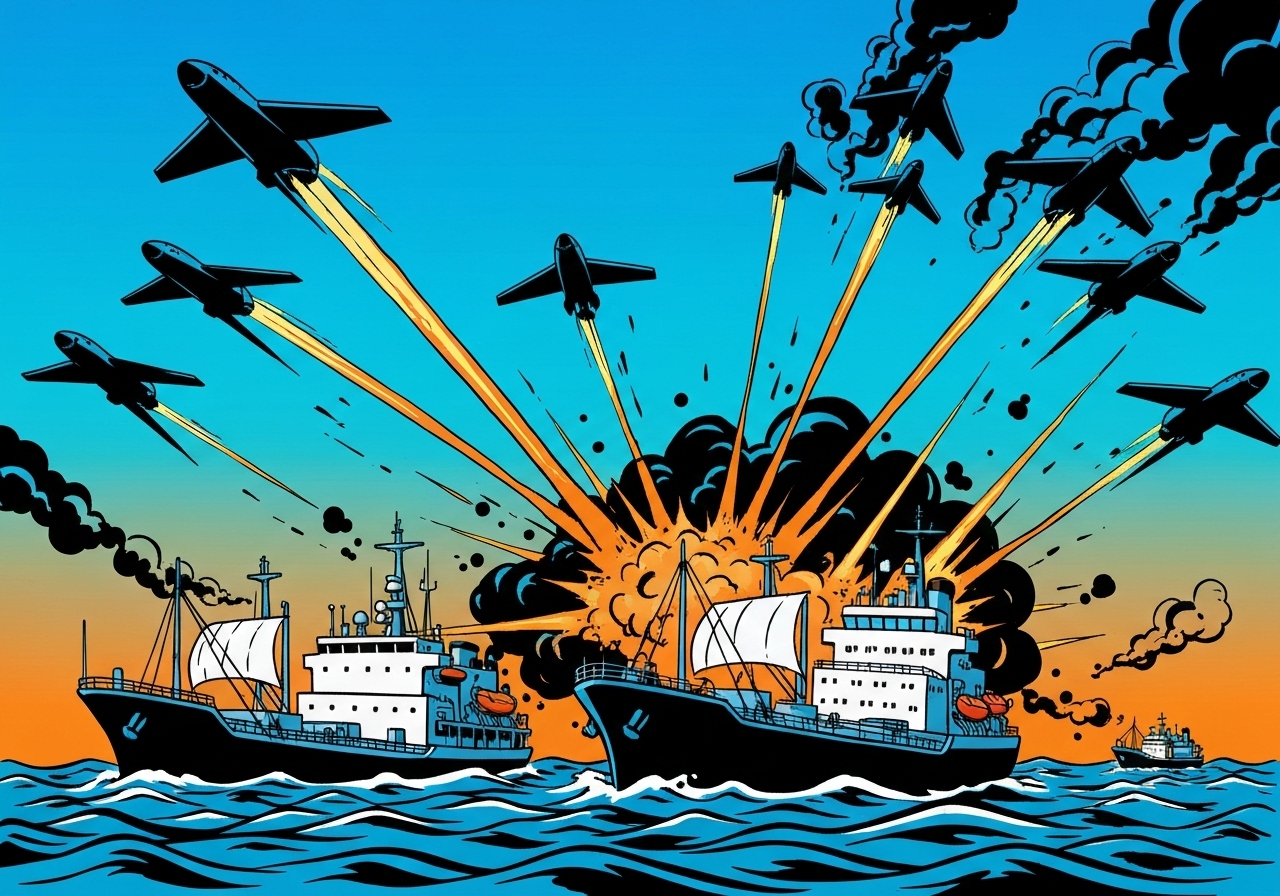
Lead: On December 30, 2025, aircraft and/or naval assets from the Saudi-led coalition struck vessels identified as belonging to the UAE-backed Southern Transitional Council (STC) in southern Yemen, authorities and local sources reported. The action came shortly after an evacuation notice urged all civilians in Mukalla to leave the area until further notice ahead of military operations. The strikes were reported near coastal areas of southern Yemen and follow intensifying tensions between the coalition, the internationally recognized government, and southern separatists. Initial reports have not produced independently verified casualty totals.
Key Takeaways
- The strike occurred on December 30, 2025, targeting ships linked to the Southern Transitional Council (STC) in southern Yemen.
- An evacuation warning for civilians in Mukalla was issued shortly before the strikes, advising residents to evacuate “until further notice” ahead of operations.
- The STC is broadly described in reporting as UAE-backed; the targeted vessels were characterized in sources as linked to the STC rather than to Houthi forces.
- A billboard photo of Aidarous al-Zabidi, head of the STC, was documented in Aden on December 9, 2025, underscoring the council’s visible political presence in the south.
- No independently verified figures for deaths or injuries have been published in the immediate aftermath; humanitarian access and reporting remain constrained.
- The incident adds to a pattern of episodic clashes and strikes involving coalition forces, the STC, and other Yemeni actors since 2015.
Background
Yemen’s conflict has fragmented into multiple fronts since 2014–2015, with the Houthi movement controlling large parts of the north and a patchwork of actors vying for influence in the south. The Saudi-led coalition intervened in 2015 in support of the internationally recognized government, while the UAE has cultivated close ties with southern actors, notably the Southern Transitional Council (STC), which seeks greater autonomy or independence for southern Yemen.
The STC was formed in 2017 and has, at times, operated both as a political force and an armed actor in southern governorates including Aden and Hadramawt. While ostensibly allied to counter the Houthis, the STC and forces loyal to the Hadi government have clashed, complicating the coalition’s intra-coalition dynamics. Maritime and coastal control in the south is strategically important for supply lines, ports and access to the Red Sea and Gulf of Aden shipping lanes.
Main Event
Local officials and media reported that a coalition strike on December 30 targeted vessels identified as belonging to or operating under the Southern Transitional Council. The operation occurred after authorities broadcast an evacuation advisory for Mukalla, instructing civilians to leave the city and surrounding areas until further notice as military operations were planned.
Reporting indicates the strikes occurred in southern Yemeni coastal waters; sources did not provide a public, independently verified tally of casualties or material damage in the immediate window after the attack. Eyewitness accounts described loud explosions and coastal alarms in port-adjacent neighborhoods, though access for international journalists and monitors in the area remains limited.
A photograph circulated from earlier in December showed Aidarous al-Zabidi, the STC leader, on billboards in Aden on December 9, 2025, highlighting the STC’s continuing political messaging in southern urban centers. Analysts say the visibility of STC leaders in Aden and other southern cities has increased local political mobilization in recent years.
Analysis & Implications
Strategically, strikes aimed at STC-linked vessels signal an escalation that risks widening fault lines among anti-Houthi actors. The Saudi-led coalition and the UAE have been partners against the Houthis, but divergent priorities—Saudis focusing on a political settlement and security, Emiratis emphasizing southern local partners—have produced periodic friction and operational disconnects.
If maritime assets tied to the STC are repeatedly targeted, southern patronage networks and supply chains could be disrupted, potentially pushing the STC toward harder-line postures or reciprocal actions. That could complicate any diplomatic tracks aimed at reunifying anti-Houthi factions or negotiating ceasefires with the Houthis.
Humanitarian concerns rise when evacuations and strikes overlap civilian population centers. Mukalla and other southern ports host commercial traffic and internally displaced populations; interruptions to ports or coastal infrastructure would likely aggravate already strained aid delivery and economic activity.
Internationally, renewed strikes on non-Houthi actors could draw diplomatic scrutiny from partners monitoring coalition cohesion and regional stability. The incident may prompt calls for de-escalation by the UN, humanitarian agencies, and outside governments focused on reducing civilian harm and restoring political negotiations.
Comparison & Data
| Actor | Primary Backers | Main Objective |
|---|---|---|
| Saudi-led coalition | Saudi Arabia and partner states | Counter Houthi advances; support recognized government |
| Southern Transitional Council (STC) | United Arab Emirates (political & material ties) | Greater autonomy/independence for southern Yemen |
The table summarizes overarching roles rather than operational detail. Recent years have seen overlapping aims: coalition members opposing the Houthis while some coalition partners cultivate southern actors for local security and economic influence. That divergence is a recurring factor behind episodic clashes and strikes.
Reactions & Quotes
(Paraphrased) The Saudi-led coalition described the operation as targeting maritime military assets linked to separatist forces.
Saudi-led coalition (official statement, paraphrased)
(Paraphrased) The Southern Transitional Council condemned strikes on its vessels and warned of further destabilization if attacks continue.
Southern Transitional Council (statement, paraphrased)
(Paraphrased) Independent analysts cautioned that strikes against non-Houthi actors risk deepening fragmentation in southern Yemen and complicating humanitarian access.
Independent security analyst (paraphrased)
Unconfirmed
- Precise casualty or damage figures from the December 30 strike have not been independently verified and remain unconfirmed.
- Attribution of command authorization (which specific coalition member ordered the strike) is not publicly confirmed in primary reporting.
- Any longer-term operational plan by the coalition to expand strikes against STC maritime assets has not been confirmed by official sources.
Bottom Line
The December 30, 2025 strikes on vessels linked to the UAE-backed Southern Transitional Council mark a notable development in Yemen’s fragmented conflict landscape. Coming immediately after a civil evacuation advisory in Mukalla, the strikes raise urgent questions about civilian protection, intra-coalition coordination and the risk of further southern fragmentation.
Absent independently verified casualty and damage assessments, the international community and humanitarian agencies must prioritize monitoring and access to assess civilian impact. Diplomatically, the incident underscores the need for clearer coordination among coalition partners and renewed emphasis on political channels that reduce incentives for military escalation in the south.
Sources
- The Jerusalem Post (news outlet) — initial reporting and timeline details
- Reuters (news agency/photo credit) — photo credited in related reporting