
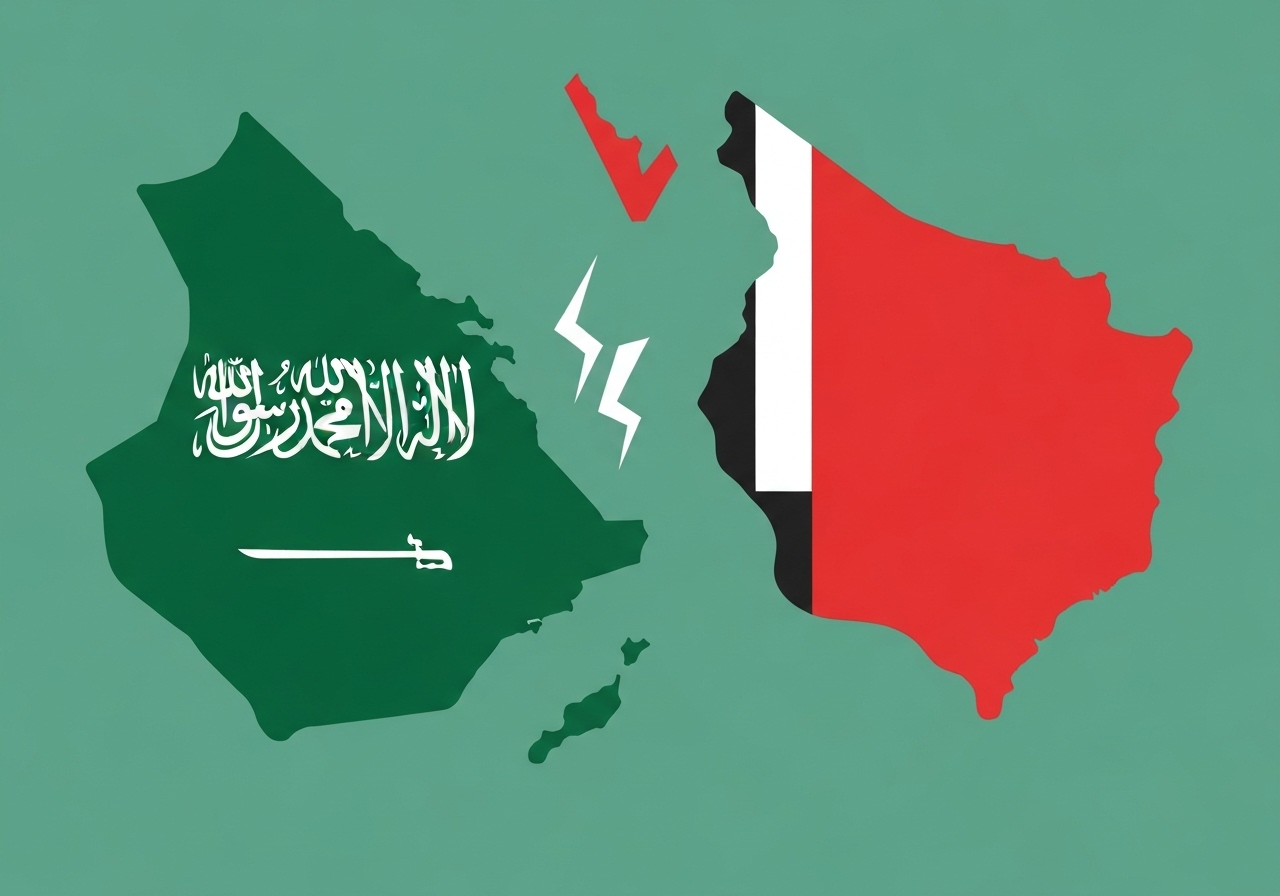
In early January 2026, long-standing Gulf partners Saudi Arabia and the United Arab Emirates publicly confronted one another over operations in Yemen after Saudi forces struck a UAE shipment of combat vehicles bound for the country. The incident, at Mukalla port in southern Yemen, followed days of fighting between UAE-backed southern separatists and forces aligned with the Saudi-backed Presidential Leadership Council (PLC). The strikes and a subsequent Saudi naval deployment mark a sharp deterioration in cooperation between Riyadh and Abu Dhabi, and risk widening instability across the Red Sea littoral.
Key takeaways
- In 2014 the Iran-aligned Houthi movement seized Sana’a; a Saudi-led military intervention began in 2015 to reverse their gains.
- The UAE-backed Southern Transitional Council (STC), founded in 2017, has pursued autonomy or independence for southern Yemen and controls areas including Aden.
- A Saudi strike hit a UAE shipment of combat vehicles at Mukalla port in early January 2026, an unprecedented direct attack between the two partners in Yemen.
- The UAE announced it would withdraw its counterterrorism forces following the recent escalation; Abu Dhabi framed its role as part of the Saudi-led coalition.
- Riyadh deployed naval assets off Yemen’s coast after PLC-aligned forces launched operations described by Saudi sources as aimed at retaking areas from southern separatists.
- The STC said it will hold an independence referendum in two years, signaling a formal move toward southern self-determination.
- Analysts warn the rift strengthens the Houthis’ strategic position and could complicate Western policy toward two key Gulf partners.
Background
Yemen’s modern trajectory has been shaped by long-standing North–South divisions and recurrent conflict. North Yemen and South Yemen were separate states through much of the 20th century, unifying in 1990; a brief 1994 civil war left southern grievances unresolved. That historical fragmentation has made Yemen susceptible to local secessionist movements and external intervention.
The current civil war escalated when the Houthi movement, also known as Ansar Allah, captured Sana’a in 2014 and later established control over large swaths of the northwest and key Red Sea coastline. Tehran’s political and military support for the Houthis increased Iran’s influence on the Arabian Peninsula’s southern flank and prompted a Saudi-led intervention in 2015 to bolster the internationally recognized government.
Over time the coalition that entered Yemen splintered. The UAE invested heavily in southern local forces, including the STC, focusing on counterterrorism and securing ports and maritime approaches. Saudi planners prioritized a unified Yemen on their southern border and backed the Presidential Leadership Council (PLC), created in 2022 to consolidate anti-Houthi authorities. These divergent priorities set the stage for competition among erstwhile partners.
Main event
In the first days of January 2026, escalating clashes in southern Yemen saw UAE-backed fighters make rapid gains in several oil-producing areas, at times contesting positions held by PLC-aligned units. Videos circulating on social media showed large convoys of armored vehicles moving toward contested zones; Saudi sources later said one such shipment was struck at Mukalla port after being identified as a UAE consignment of combat vehicles.
Saudi Arabia described the strike as a response to actions it deemed threatening to its national security. Abu Dhabi condemned the attack and stated it would conclude the presence of its counterterrorism forces in Yemen, emphasizing that its earlier deployments had been conducted as part of the Saudi-led coalition and at Riyadh’s request.
Following the port incident, Saudi naval vessels were observed off Yemen’s southern coast, a deployment Riyadh framed as protecting maritime approaches. PLC-aligned ground units reported launching what they called operations to retake territory from southern forces; separatist leaders rejected descriptions of those moves as peaceful and accused Riyadh of misleading external observers.
The STC announced plans for an independence referendum in two years, formalizing a political trajectory toward secession that had long been a feature of southern separatist aims. The announcement intensified debate among regional capitals about whether Yemen’s future will be a united state or divided into distinct northern and southern polities.
Analysis & implications
The public split between Saudi Arabia and the UAE represents a major recalibration of Gulf politics. For a decade the two states coordinated military and diplomatic efforts in Yemen; their current divergence signals competing long-term visions for Yemen’s governance and security arrangements. Where Riyadh emphasizes a unified buffer on its border, Abu Dhabi has invested in local southern actors whose priorities include autonomy or independence.
Strategically, the rift creates immediate operational risks: coordination lapses among anti-Houthi forces could produce battlefield opportunism that the Houthis can exploit. The group, which retained operational capacity despite years of air campaigns and blockades, has previously launched missiles and drones that reached as far as Saudi cities and, later, even targeted infrastructure in the wider region. A divided front against the Houthis may reduce pressure on them and prolong insecurity along vital shipping lanes.
Diplomatically, Western governments face a delicate task. Both Riyadh and Abu Dhabi are key security and economic partners for the United States and Europe. A choice that is perceived as favoring one over the other risks undermining broader regional strategies, including efforts to contain Iran’s influence and to secure Red Sea shipping. Policymakers will likely push for rapid de-escalation while seeking to preserve lines of communication with both capitals.
Economically, continued instability threatens maritime trade through the Bab al-Mandeb and Red Sea and could drive up insurance costs and reroute commercial shipping. For Yemen itself, accelerating fragmentation reduces prospects for a negotiated settlement and increases humanitarian risks for a population already suffering from extreme poverty and aid dependency.
Comparison & data
| Year | Event |
|---|---|
| 2014 | Houthis seize Sana’a |
| 2015 | Saudi-led intervention begins |
| 2017 | STC founded (UAE-backed) |
| 2022 | Presidential Leadership Council formed; de facto truce with Houthis |
| Jan 2026 | Saudi strike on UAE vehicle shipment at Mukalla; UAE withdraws forces; STC plans referendum |
The table highlights how the conflict’s key turning points have reshaped local power balances. The most recent developments—direct action between Saudi and UAE-aligned forces and a scheduled southern referendum—represent new variables for analysts tracking conflict trajectories and regional shipping security.
Reactions & quotes
Governments and analysts responded swiftly, framing the events as both operational and political escalations.
“The UAE concluded the presence of its counterterrorism forces after acting within the Saudi-led coalition’s framework and at Riyadh’s request.”
UAE government statement (official)
The UAE framed its withdrawal as a measured, de-escalatory move while stressing that its earlier deployments were coordinated with Saudi authorities. Riyadh, for its part, has framed its actions as defensive measures to protect national security.
“These actions reflect fundamental disagreements between Riyadh and Abu Dhabi over Yemen’s political future and the balance of influence within it.”
Farea Al-Muslimi, Chatham House (think tank)
Analysts at Chatham House warn that the fallout could mark a turning point: former coalition partners now openly contesting each other weakens a unified approach to Yemen and may create openings for the Houthis and other spoilers.
“We are concerned about imperiling maritime security and complicating humanitarian access if hostilities expand.”
Independent security analyst (comment)
Maritime-security experts and humanitarian organizations have immediately flagged risks to shipping lanes and aid delivery, urging urgent diplomatic engagement to prevent a broader regional spillover.
Unconfirmed
- Precise intent behind the Mukalla strike: states reported defensive motives, but independent confirmation of targeting rationale remains limited.
- Claims about the full composition and ownership of the struck vehicle shipment have not been independently verified beyond statements by involved governments.
- The scope and timeline for any UAE force withdrawal may be subject to change and lacks an independent implementation schedule.
Bottom line
The public confrontation between Saudi Arabia and the UAE over Yemen marks a significant departure from a decade of coordinated policy in the country. Tactical rivalry between their proxies has now spilled into direct actions that could reshape local battle lines and diplomatic calculations in the Gulf.
For Yemenis, the shift reduces the likelihood of a quick political settlement and heightens humanitarian and security risks. For regional and Western policymakers, the immediate priority is defusing tensions between Riyadh and Abu Dhabi to prevent a wider deterioration that would complicate efforts to manage Houthi activity and protect maritime commerce.
Observers should watch three near-term indicators: whether the UAE completes a measured withdrawal of its forces, whether Riyadh maintains or expands its naval posture, and how the STC and PLC manage local ceasefires and political timelines ahead of the STC’s proposed two-year referendum.
Sources
- CNN — (international news organization; primary report on the Mukalla strike and regional reactions)
- Chatham House — (independent think tank; commentary from researcher Farea Al-Muslimi quoted in reporting)