
Lead
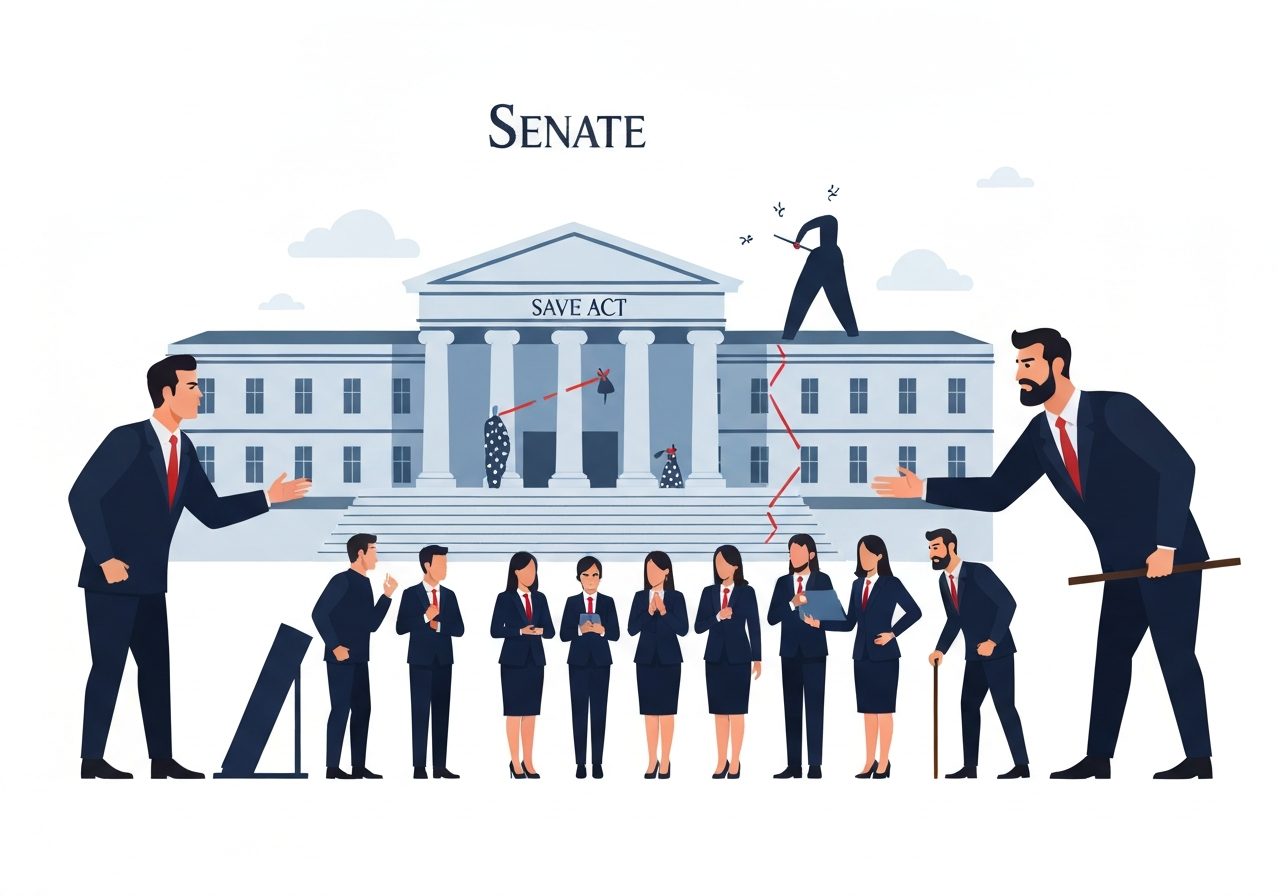
On March 17, 2026, the U.S. Senate began floor consideration of the SAVE America Act, a broad GOP-backed election package that would add federal proof-of-citizenship requirements for voter registration. The measure is a legislative priority for former President Donald Trump but faces strong Democratic opposition and the Senate’s legislative filibuster, making passage unlikely. At the same time, Republican governors and legislatures in several states are moving similar proof-of-citizenship measures through statehouses; some bills would take effect before this year’s midterm elections. Advocates say the rules strengthen election security; critics warn they could disenfranchise eligible voters who lack easy access to documents such as passports or certified birth certificates.
Key takeaways
- The SAVE America Act would impose documentary proof-of-citizenship to register to vote at the federal level and take effect immediately if enacted.
- Senate consideration began March 17, 2026, but the bill is unlikely to clear unified Democratic opposition combined with the Senate filibuster.
- GOP-led states have similar measures: bills sit on governors’ desks in Florida, South Dakota and Utah, with Utah and South Dakota measures slated to take effect before the 2026 midterms.
- Florida’s version was advanced but its main provisions would not take effect until 2027; Gov. Ron DeSantis signaled support and is photographed on Aug. 12, 2025 backing such requirements.
- Voting Rights Lab reports similar laws exist already in Louisiana, New Hampshire and Wyoming, while Arizona maintains a bifurcated registration system that requires proof of citizenship for state and local ballots.
- Federal and state law already prohibit noncitizen voting, and multiple reviews have found noncitizen voting to be vanishingly rare.
- Opponents say proof-of-citizenship mandates risk disenfranchising part of the millions of Americans who report difficulty accessing required documents.
Background
Debate over whether to require documentary proof of citizenship to register to vote has intensified in recent years amid Republican concerns about election integrity. Proponents argue mandatory documentation—such as a valid U.S. passport or a certified birth certificate—would close hypothetical gaps and reinforce public confidence in elections. Opponents counter that many eligible voters, especially lower-income, rural, elderly and minority citizens, may face hurdles obtaining those documents, creating a risk of inadvertent disenfranchisement.
States have taken divergent approaches. Arizona long used a bifurcated registration system that treats federal and state/local ballots differently; other states have passed laws that courts subsequently blocked. National tracking groups such as Voting Rights Lab document both enacted statutes and pending bills that would expand documentary proof requirements at the state level. The legal and logistical consequences vary widely, from standardized ID-checking to wholesale changes in voter-roll maintenance and outreach.
Main event
On March 17, 2026, Senate Republicans opened debate on the SAVE America Act, an omnibus package that bundles proof-of-citizenship rules with other election-related reforms. The bill’s backers framed it as an effort to harden registration systems, but Democratic senators and voting-rights advocates said the measure is unnecessary and dangerous given existing prohibitions on noncitizen voting. Because the measure would take effect immediately, election officials warned it could disrupt registration procedures and record-keeping ahead of the 2026 midterms.
Beyond the Senate, several Republican-controlled state legislatures pushed similar laws this year. Voting Rights Lab reports bills are now on the desks of governors in Florida, South Dakota and Utah. South Dakota and Utah measures, according to the same tracking, would take effect before the 2026 midterm elections, while Florida’s primary provisions are slated to begin in 2027. Florida’s governor, Ron DeSantis, indicated support for the change and said he planned to sign the state bill into law; a photo of him on Aug. 12, 2025 accompanied that announcement.
Legal challenges are expected. Some past state laws imposing documentary proof requirements were enjoined by courts. Election administrators—many of whom are nonpartisan officials—have emphasized the operational burden of sudden, large-scale documentation checks and the need for extensive outreach and training to ensure eligible voters are not turned away at registration.
Analysis & implications
Short term, the SAVE Act’s prospects in the Senate are constrained by the filibuster and united Democratic opposition; passage would require an unusually large bipartisan shift or a change in Senate rules. If the bill fails federally, the current trajectory suggests more states will pursue their own proof-of-citizenship laws, producing a patchwork of requirements that could vary sharply by state. That fragmentation would complicate interstate voter registration and increase the administrative burden on both election officials and voters who move between states.
Legally, proof-of-citizenship statutes invite court review on multiple grounds, including equal protection and compliance with the National Voter Registration Act. Courts have previously blocked some state laws where judges found insufficient safeguards for eligible voters who lack immediate documentary proof. Ongoing litigation could result in staggered injunctions, creating uncertainty in the run-up to key election dates.
Politically, the issue plays differently across constituencies. Supporters present the measures as nonpartisan steps to ensure secure rolls, which can be persuasive in certain electorates. Critics argue the real-world effect will be to reduce turnout among demographic groups that tend to lean Democratic—older voters without recent passports, lower-income citizens, and people born outside hospital systems—though the exact magnitude of any turnout effects remains contested and dependent on implementation details.
Comparison & data
| State | Recent action | Effective timing |
|---|---|---|
| Florida | Bill on governor’s desk; Gov. DeSantis signaled support | Main provisions effective 2027 |
| South Dakota | Bill on governor’s desk | Would take effect before 2026 midterms |
| Utah | Bill on governor’s desk | Would take effect before 2026 midterms |
| Louisiana, New Hampshire, Wyoming | Laws enacted in recent years | Already in force (varies by state) |
| Arizona | Bifurcated registration system | Proof required for state/local ballots |
| Ohio | Narrower measures enacted in some jurisdictions | Varies by locality |
The table above summarizes the present patchwork of state action as documented by Voting Rights Lab and public reporting. Differences in timing—immediate federal effect versus delayed state implementation—are consequential because they determine whether changes will influence the 2026 midterm cycle. Administrative capacity, court rulings, and the vigor of outreach programs will shape how those laws play out on the ground.
Reactions & quotes
Supporters and opponents offered succinct, competing rationales as the Senate debated the bill and state executives considered similar measures:
“Documentary proof of citizenship will help protect the integrity of our voter rolls,”
Republican sponsor / GOP backer (statement to press)
Proponents framed the policy around security and confidence; their remarks emphasized prevention of hypothetical irregularities and standardization of registration checks.
“Forcing documentary proof risks denying eligible citizens their franchise, especially those who face barriers obtaining birth records or passports,”
Voting rights advocate / civil-society group
Opponents focused on access and the administrative strain of rapid implementation, warning of disenfranchisement without robust remedies such as free document provision or expanded assistance programs.
Unconfirmed
- That proof-of-citizenship rules will materially eliminate any noncitizen voting beyond already-vanishing levels—available public reviews describe noncitizen voting as vanishingly rare, but direct causal impact of new documentary rules is unproven.
- Precise estimates of how many eligible voters would be unable to provide required documents vary by study and jurisdiction and remain contested.
- Whether state-level laws will survive upcoming court challenges depends on litigation outcomes and specific statutory language; results are not yet settled.
Bottom line
The SAVE America Act puts proof-of-citizenship at the center of a broader political and legal fight over election rules. In the Senate, the bill’s immediate-effect provisions and partisan alignment make passage unlikely without a shift in Senate procedure or bipartisan support; state-level efforts mean the policy debate will continue regardless of the federal outcome.
For voters and election officials, the practical effects will turn on implementation details, court decisions and outreach efforts. If governors sign state bills that take effect before the 2026 midterms, administrators will face compressed timetables to adjust systems and inform the public—creating the real risk of confusion or uneven access at the polls. Observers should watch court challenges and state implementation plans closely, since those will determine whether these measures reshape voter access or prompt statutory reversals.
Sources
- NPR (news report on SAVE Act consideration and state bills)
- Voting Rights Lab (policy tracker and analysis of state proof-of-citizenship measures)