
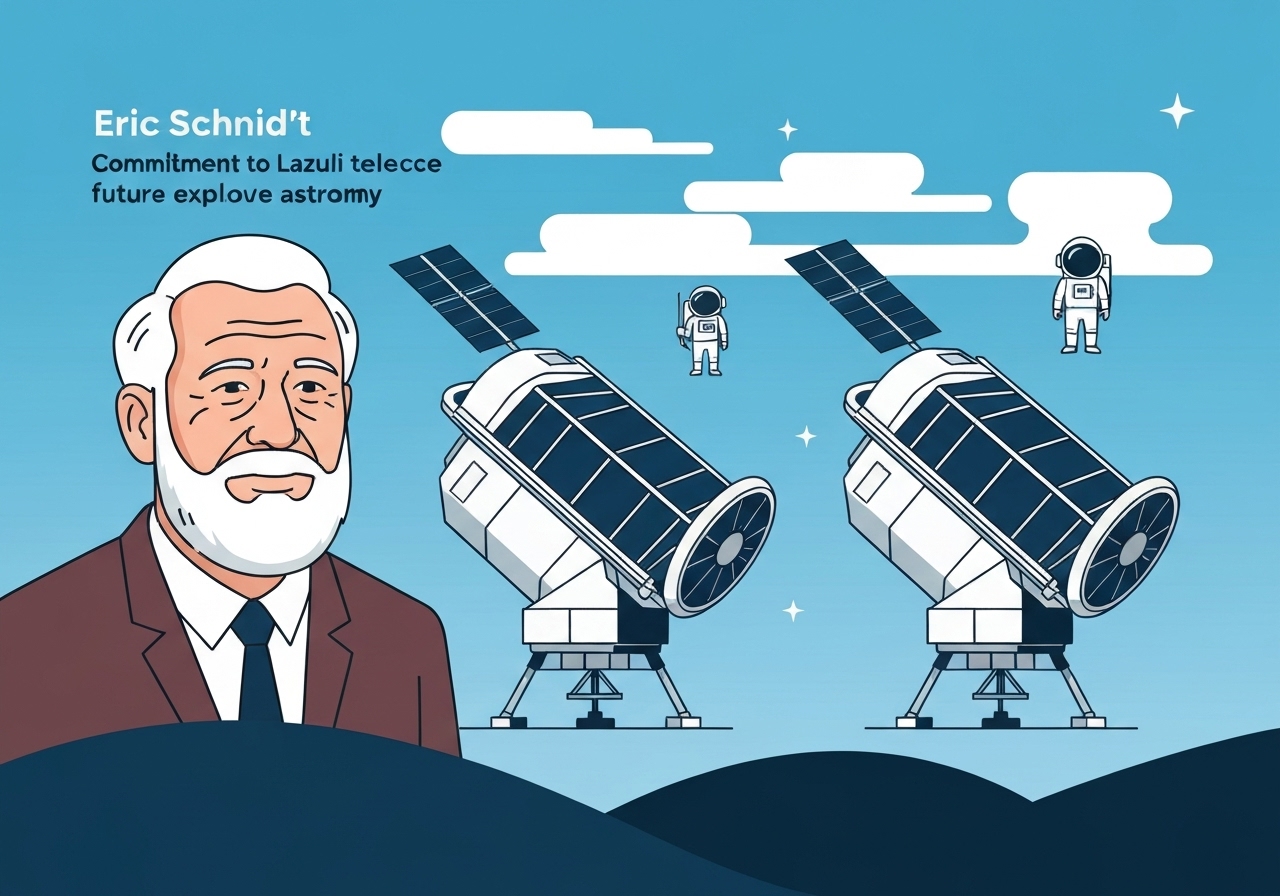
Lead: Eric and Wendy Schmidt announced funding for four new telescopes—one space observatory named Lazuli and three ground-based systems—intended to accelerate astronomy development and open data access. The Lazuli space telescope, with a 3.1-meter primary mirror, is planned to launch as early as late 2028 and begin operations in 2029. The ground projects include a 1,200-unit optical array, a 1,600-dish radio array, and a modular spectroscopic facility, all designed to be faster and more modular than recent major government-led observatories. The Schmidts have not disclosed a full figure but outside analysis places their commitment at least in the mid-hundreds of millions, and possibly half a billion dollars or more.
Key Takeaways
- Eric and Wendy Schmidt are funding the Schmidt Observatory System, which comprises four telescopes including the Lazuli space telescope (3.1 m mirror) slated for launch late 2028 and operations in 2029.
- Lazuli will operate in a high elliptical orbit (apogee ~275,000 km; perigee ~77,000 km), offering reduced contamination from low‑Earth orbit satellites compared with Hubble (2.4 m mirror at ~500 km).
- The Argus Array will deploy roughly 1,200 11‑inch optical telescopes—producing images every second and reaching roughly 18th–19th magnitude—to effectively emulate an ~8 m class aperture across the Northern sky.
- The DSA radio project plans about 1,600 six‑meter dishes in a Nevada valley, aiming to map over a billion radio sources and produce sky images approximately every 15 minutes.
- LFAST will use 20 × 80 cm mirrors in a single rack to deliver the equivalent of a 3 m spectroscopic aperture; a prototype could be fielded by mid‑2026 and the system is expandable.
- Schmidt Sciences will act as program integrator; data from all instruments are intended to be openly available and not commercialized.
- Project partners include the University of North Carolina (Argus), California Institute of Technology (DSA management), University of Arizona (LFAST), and Observable Space (hardware for Argus).
Background
Private philanthropy financed many early major telescopes prior to World War II, but the mid‑20th century saw a shift toward government and academic funding as mirror sizes and spaceflight costs grew. Large observatories increasingly required multi‑decade planning and national budgets, producing long gestation cycles for flagship projects. In recent years, rapid advances in computing, miniaturization, artificial intelligence, and lower launch costs have opened new architectural possibilities for faster, modular observatories that distribute capability rather than concentrate it in single, monolithic instruments.
Against this technological backdrop, the Schmidts have chosen to underwrite several proposals originally developed for public funding. Their stated aim is to shorten development timelines and lower risk by funding aggressive but rigorously engineered designs. The outcome would be a set of complementary instruments—space and ground—that trade some of the scale and lifetime of traditional flagship missions for speed, modularity, and open scientific access.
Main Event
The headline element is Lazuli, a 3.1‑meter optical space telescope named for the deep blue of lapis lazuli. Lazuli’s planned high elliptical orbit, with apogee around 275,000 km and perigee near 77,000 km, places it far beyond most Earth satellites and well above Hubble’s roughly 500 km altitude. That higher vantage aims to reduce contamination from low‑orbit constellations and enable continuous control and faster data downlink, according to the project team.
Schmidt Sciences will manage the Lazuli program; the organization has not yet named prime contractors. Instruments planned for Lazuli include a wide‑field imager, a spectrograph, and a coronagraph to block starlight for direct study of exoplanet atmospheres. Project leads say the design leverages decades of post‑Hubble advances in optics, detectors, and spacecraft systems to deliver quicker science returns.
On the ground, the Argus Array seeks to combine 1,200 small optical telescopes—each with an ~11‑inch mirror—to synthesize the throughput of a much larger aperture. Managed by the University of North Carolina with hardware from Observable Space and co‑funding from Alex Gerko, Argus is designed to image the entire Northern Hemisphere every second and routinely record objects down to about 18th–19th magnitude, enabling rewindable movies of transient events.
The DSA radio array will place roughly 1,600 six‑meter antennas in a Nevada valley and is being overseen by Caltech. The configuration trades individual dish size for dense numbers, permitting high cadence sky mapping and the intent to catalog over a billion radio sources, producing large‑format sky maps every ~15 minutes. LFAST, led by the University of Arizona, will field racks of 20 80 cm mirrors for scalable spectroscopy and aims to prototype hardware by mid‑2026.
Analysis & Implications
The Schmidt funding model represents a hybrid: private capital enabling public‑style science with an emphasis on open data. If delivered on schedule, these instruments could compress a typical 20–25 year public mission timeline into a fraction of that time, accelerating discovery cycles and the training of early‑career researchers. Shorter timelines could also mean lower nominal program overheads and faster technology refreshes, reducing the chance that instruments are obsolete before their science returns accrue.
Operationally, the high elliptical orbit chosen for Lazuli reduces interference from low‑orbit satellites but introduces different engineering tradeoffs—longer communications paths, thermal cycling, and radiation environment challenges—that historically have required conservative design and testing. The Schmidt teams say they will assume higher programmatic risk than NASA typically accepts, balanced by focused schedules and modern hardware approaches.
For the wider astronomy community, the open‑data commitment is significant. Free, rapid public access to continuous or high‑cadence sky imagery and radio surveys could democratize follow‑up science and spur rapid multi‑wavelength coordination. However, success depends on robust pipelines, petabyte‑scale storage, and AI tools to sift streams of transient and survey data—infrastructure that must be funded and sustained over time.
Comparison & Data
| Instrument | Primary | Elements | Location | Cadence/Notes |
|---|---|---|---|---|
| Lazuli (space) | 3.1 m | Single space telescope | High elliptical orbit (apogee 275,000 km / perigee 77,000 km) | Launch late 2028; ops 2029; wide‑field, spectrograph, coronagraph |
| Argus Array | 11 in (individual) | ~1,200 telescopes | Likely Texas | Images every 1 s; reaches ~18th–19th magnitude; effectively ~8 m |
| DSA radio array | 6 m (dish) | ~1,600 dishes | Nevada valley | Sky images ~every 15 min; maps >1 billion radio sources |
| LFAST | 20 × 80 cm | 20 mirrors in rack | Likely Arizona | Prototype by mid‑2026; expandable; spectroscopy for biosignatures |
These designs emphasize modularity and parallelization rather than a single monolithic aperture. The table highlights how combined small elements can approximate larger apertures while enabling rapid production and incremental upgrades.
Reactions & Quotes
Project leadership framed the gifts as catalytic for the scientific community, stressing open access and rapid timelines.
“We are enabling multiple approaches to understanding the vast universe,” said Wendy Schmidt through Schmidt Sciences, emphasizing a philanthropic motive to broaden research beyond typical government pathways.
Wendy Schmidt / Schmidt Sciences (philanthropic organization)
Program management spoke to the chosen risk posture and schedule ambition.
“We have moderate‑high confidence in deployment and operations while accepting some risks that large government programs might avoid,” said Stuart Feldman, president of Schmidt Sciences, describing an emphasis on speed and rigorous engineering.
Stuart Feldman / Schmidt Sciences (program president)
Industry partners highlighted the open‑data model and technical opportunities.
“Argus’s commitment to open science represents a new model for astronomical discovery,” said Observable Space’s CEO, noting the potential for unexpected findings from continuous, rewindable sky imagery.
Observable Space (commercial partner)
Unconfirmed
- The exact dollar amount of the Schmidts’ total commitment has not been disclosed publicly; public estimates place it at least in the mid‑hundreds of millions to roughly half a billion dollars.
- Final prime contractors for Lazuli and some ground systems have not been announced; procurement and supplier choices could shift technical schedules and costs.
Bottom Line
The Schmidt Observatory System is an unusual, ambitious philanthropic effort that pairs a modern space telescope with three cutting‑edge, modular ground facilities and an explicit open‑data policy. If these projects meet their schedules and technical goals, they could accelerate how quickly new facilities deliver science and broaden global access to survey‑scale data.
Risks remain: high elliptical operations, large‑volume data management, and sustaining open infrastructure over time. Nonetheless, the Schmidts’ approach—favoring speed, modularity, and open access—could reshape how major astronomical capabilities are developed and used in the coming decade.
Sources
- Ars Technica — journalism coverage and interviews with project spokespeople
- Schmidt Sciences — philanthropic organization / program statements
- Observable Space — commercial partner for Argus hardware
- California Institute of Technology (Caltech) — project management partner for DSA
- University of Arizona — lead institution for LFAST