
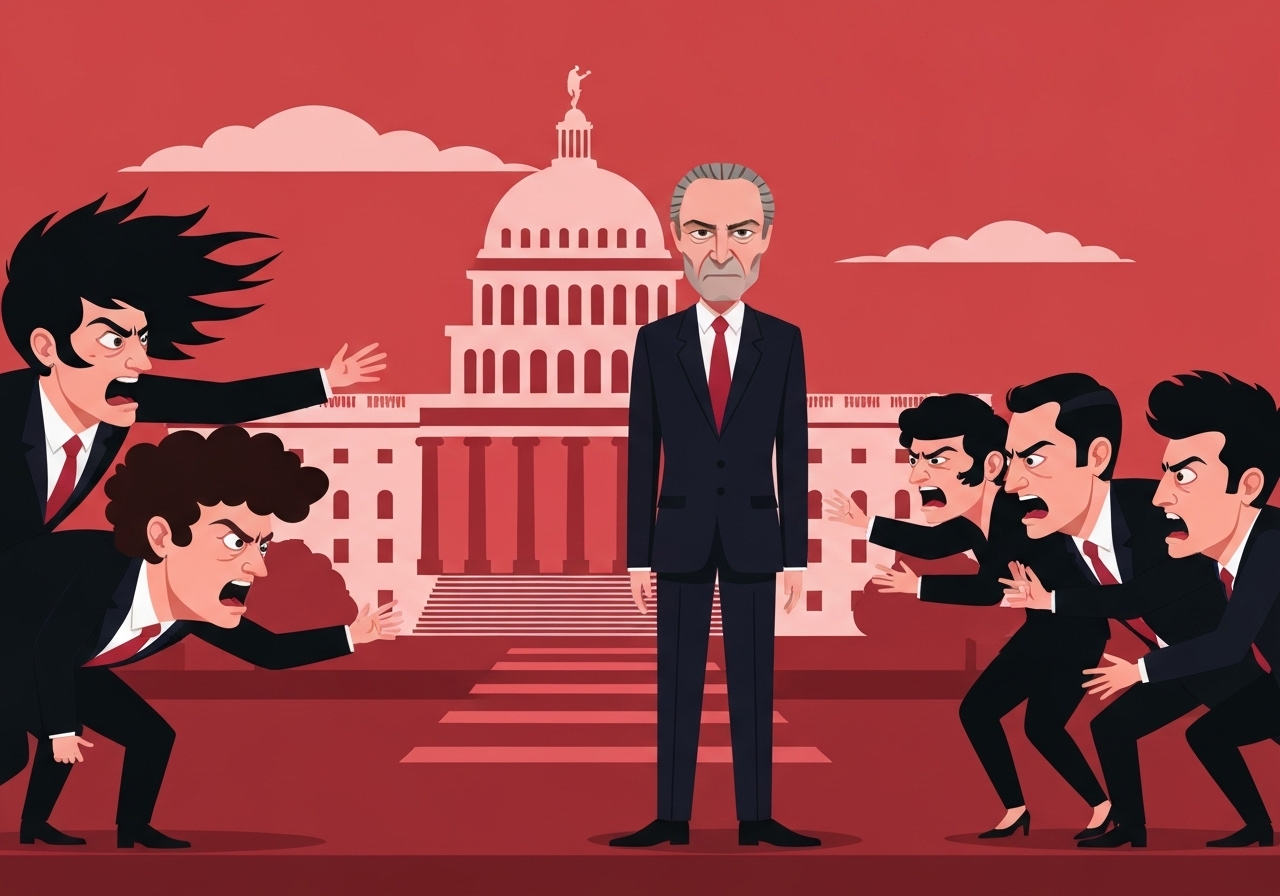
Lead: On Sunday, Nov. 9, 2025, news broke that eight Senate Democrats worked with Republicans on a deal to reopen the government, ending what has been widely described as the longest US shutdown in history. The package would fund agencies through January and include a promise of a later vote on extending Affordable Care Act (ACA) premium tax credits, but it contains no immediate healthcare concessions Democrats had sought. The revelation prompted sharp criticism from progressive groups and some Democratic officials, who singled out Senate Minority Leader Chuck Schumer and urged him to step down. Schumer denied backing the agreement and voted against advancing the measure, but the party remains deeply divided over responsibility and direction.
Key takeaways
- Eight Senate Democrats collaborated with Republicans on a compromise to reopen the government; the deal authorizes funding through January and schedules a future vote on ACA tax credits.
- Progressive organizations and several House Democrats publicly called for Chuck Schumer to resign as Senate minority leader, criticizing his handling of the shutdown fight.
- Schumer, 74, did not vote to advance the compromise and stated he could not support a resolution that failed to address the healthcare crisis directly.
- Some prominent Democrats — including House leader Hakeem Jeffries and most Senate Democrats — have not joined calls for Schumer’s removal.
- Political groups including Indivisible and the DCCC signaled concern about tone and electoral consequences, urging restraint in public attacks on Senate leadership.
- The dispute recalls an earlier funding fight three months into President Donald Trump’s 2017 term, in which Schumer faced intra-party backlash after pivoting on a funding vote.
- Progressives argue the compromise leaves millions at risk of higher ACA premiums; moderates counter that reopening the government was an urgent priority for their constituents.
Background
The standoff began more than a month ago, as Democrats insisted that any short-term funding bill include an extension of the ACA premium tax credits to prevent price spikes for millions of enrollees. House Republicans advanced short-term measures that did not include such healthcare provisions, making a closure of parts of government likely. Over 41 days of negotiation, Democrats and allied advocacy groups coordinated strategy to maximize pressure for healthcare relief while rejecting piecemeal funding that would leave subsidies unresolved.
Senate Minority Leader Chuck Schumer emerged as a public face of that stance, framing the fight around preventing premium increases and preserving coverage. The effort invoked memories of an earlier confrontation in late 2018 and early 2019, when a series of votes and concessions produced deep intra-party tensions. That episode ended with significant grassroots backlash and calls for new leadership from liberal groups; Schumer ultimately retained his post.
Main event
On Sunday Nov. 9, a group of eight Democratic senators negotiated a compromise with Republicans to reopen the government. The agreement funds federal operations through January and includes a commitment to hold a vote on legislation extending ACA tax credits in the near term, but the timetable and ultimate prospects for passage are uncertain. The deal cleared a key procedural hurdle in the Senate that night, signaling imminent action to end the funding lapse.
News that these eight Democrats had played a central role in crafting the compromise sparked immediate denunciations from progressive organizations and several House Democrats. Critics said the package abandoned the central Democratic demand: immediate protection from rising premiums. Social and digital organizing channels amplified those grievances quickly, turning internal disagreement into a public leadership crisis.
Schumer himself disavowed support for the substance of the deal, saying he could not in good conscience back a resolution that failed to address what he described as a healthcare emergency for families. He also did not vote to advance the bill during the crucial Sunday procedural vote. Still, opponents argued Schumer’s leadership set conditions that made the compromise possible and therefore culpable.
Analysis & implications
The episode exposes an enduring tension within the Democratic coalition between progressive activists focused on policy purity and moderates prioritizing short-term governance and constituent services. For moderates, ending the shutdown quickly averts immediate harm to federal employees, contractors and beneficiaries; for progressives, accepting a reopening without firm healthcare protections risks long-term policy setbacks and electoral backlash among base voters.
Strategically, calls for Schumer’s resignation reflect both policy and political calculations. Removing a long-serving leader mid-crisis would be disruptive and could fracture Senate organization; yet that same demand serves as leverage, signaling to moderate senators that the party’s left flank remains mobilized and punitive. The absence of endorsements for removal from most Senate Democrats and House Leader Hakeem Jeffries suggests institutional reluctance to pursue a leadership change now.
Legislatively, the agreement’s promise of a future vote on ACA tax credits is uncertain in effect. Even if the Senate were to pass an extension, the House would still need to act, and the political math there is unclear. Meanwhile, millions of consumers remain exposed to potential premium increases unless concrete legislative protections are enacted before insurers set rates for the coming coverage year.
Comparison & data
| Shutdown | Dates | Context |
|---|---|---|
| Previous longest (modern era) | Dec 22, 2018 – Jan 25, 2019 | 35-day lapse during Trump administration over border wall funding |
| Current (ongoing as of Nov 10, 2025) | Ongoing; reopened under Jan funding authorization | Described by participants as the longest government funding lapse in US history |
The table places the current closure in historical context by noting the 2018–2019 lapse commonly cited as the prior benchmark. While precise day counts depend on final closure and reopening timestamps, the political consequence is clear: intraparty conflict intensified as the shutdown dragged on and then ended through a contentious compromise.
Reactions & quotes
Progressive groups and former Republican operatives alike used sharp language to criticize the senators involved and to press for leadership consequences. Those reactions helped transform a legislative disagreement into an open debate about party direction.
“It was a colossal leadership failure, and Chuck Schumer should resign as minority leader immediately if he had a shred of honor or shame.”
Rick Wilson, Lincoln Project co-founder (political group)
Wilson, a former Republican strategist now aligned with anti-Trump conservative groups, framed the outcome as a betrayal of Democratic priorities and urged an immediate change in leadership.
“Chuck Schumer should step down as Senate minority leader immediately…If he secretly backed this surrender and voted no to save face, he’s a liar. If he couldn’t keep his caucus in line, he’s inept.”
Joseph Geevarghese, Our Revolution (progressive organization)
Our Revolution’s executive director emphasized grassroots frustration, arguing the compromise jeopardizes protections that keep premiums lower for ACA enrollees.
“Chuck Schumer has not met this moment and Senate Democrats would be wise to move on from his leadership.”
Rep. Mike Levin (House Democrat)
House Democrats from districts seen as politically competitive joined the call for new leadership, arguing electoral considerations and policy effectiveness warranted a change.
“Yes and yes.”
Rep. Hakeem Jeffries (House Democratic leader)
When asked if Schumer remained effective and should retain his post, House leader Hakeem Jeffries replied tersely, declining to join the push for immediate change and underscoring divided sentiment among top Democrats.
Unconfirmed
- Whether Chuck Schumer privately endorsed the compromise before publicly opposing it — there is no public evidence confirming a secret agreement.
- Whether the promised future vote on ACA tax credits will result in a law protecting premiums in time — passage in both chambers is not guaranteed.
- Exact private negotiations among the eight moderate senators and Republican negotiators remain incompletely documented in available public records.
Bottom line
The episode exposed deep fault lines in the Democratic coalition: a clash between immediate governance imperatives and a progressive demand for concrete policy wins on healthcare. Calls for Schumer’s resignation reflect political anger and strategic calculation, but they have not (as of Nov. 10, 2025) coalesced into an organized effort by senators who could force leadership change.
For voters and activists, the practical stakes are twofold: whether the promised ACA tax-credit vote will translate into lasting consumer protections, and whether Democratic leaders can reconcile competing priorities without damaging electoral prospects. In the near term, attention will focus on who bears responsibility politically and whether the party can pivot to legislative action that secures the subsidies many observers say are critical.
Sources
- The Guardian — Media report covering the developments, Nov. 10, 2025.
- Our Revolution — Progressive organization cited for public statement (organizational website).
- The Lincoln Project — Political group where Rick Wilson is active; commentary referenced (organizational site).
- Democratic Congressional Campaign Committee (DCCC) — Official House campaign arm; memo referenced for guidance to House Democrats (official organization).
- Indivisible — Progressive advocacy group that commented on leadership and strategy (organizational site).
- U.S. Senate and member pages — For official biographies and statements (official government).