
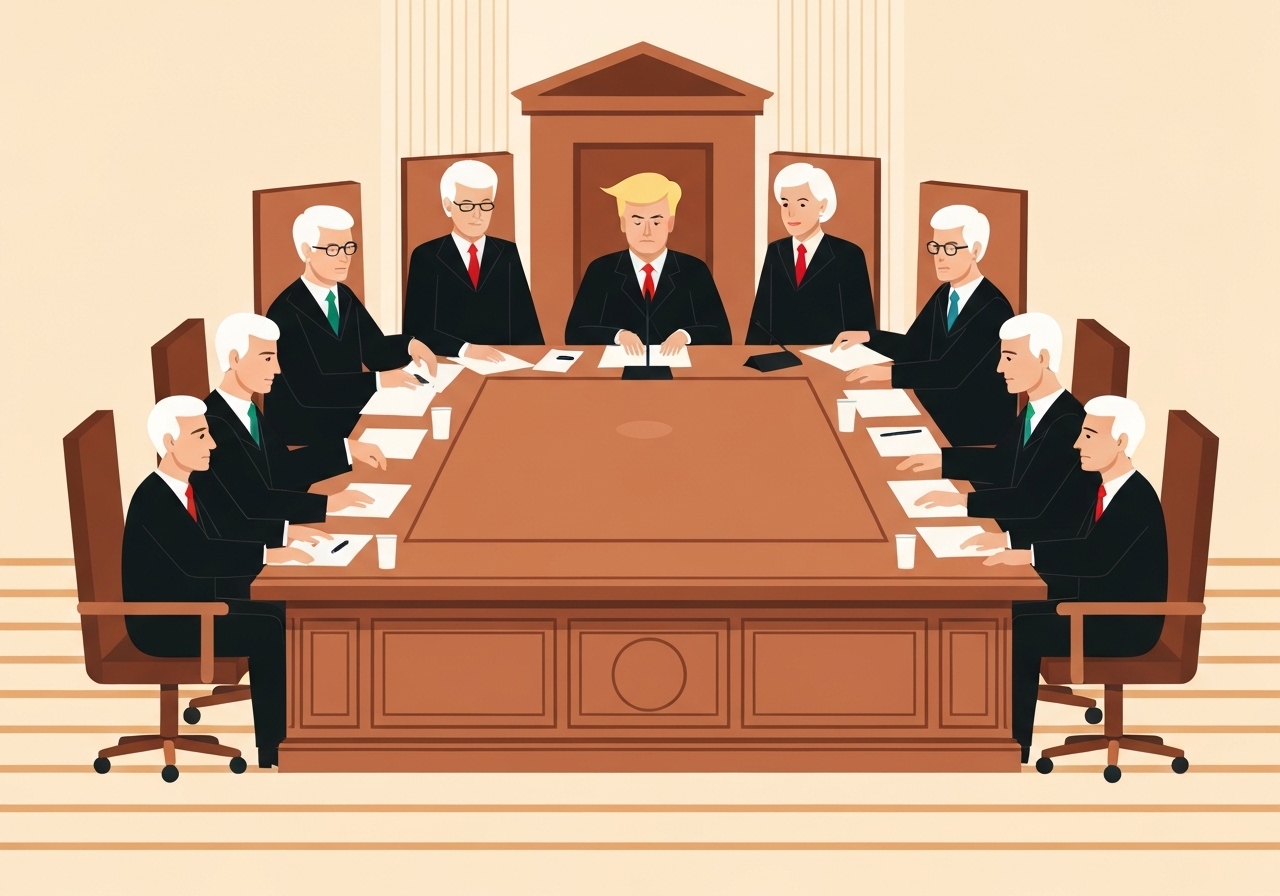
Lead: The Supreme Court heard arguments on Jan. 21, 2026, over President Donald J. Trump’s attempt to remove Lisa D. Cook from the Federal Reserve Board, a move that would alter the balance of the central bank. Justices from both ideological wings pressed the administration about whether the allegations of mortgage-related misconduct, which Cook denies and has not been charged for, suffice as legal “cause” for dismissal. Several justices signaled reluctance to permit a removal that could erode the Fed’s long-standing statutory insulation from partisan pressure. The court appeared likely to send parts of the dispute back for further fact-finding while potentially keeping Cook in place during additional proceedings.
Key Takeaways
- The oral argument took place on Jan. 21, 2026; a majority of justices indicated they may order further proceedings rather than issue an immediate removal order.
- President Trump publicly announced his intention to remove Cook in late August 2025 and cited alleged mortgage misrepresentations from 2021 as the basis for “cause.” Cook has not been charged with any crime and contests the allegations.
- Lower courts have so far sided with Cook: a D.C. district judge enjoined her removal and the D.C. Circuit affirmed that decision in a 2–1 ruling, citing statutory tenure protections.
- Key conservative justices, including Brett Kavanaugh and Amy Coney Barrett, expressed concern that permitting the removal on the administration’s theory would “weaken, if not shatter” Fed independence.
- The Justice Department opened a criminal inquiry this month into Fed Chair Jerome H. Powell’s handling of renovation cost disclosures; Powell attended the argument and has pushed back against political pressure.
- If the Court allows Cook to remain while the case proceeds, the president’s efforts to remake the Fed could be paused for weeks or months pending further litigation.
- Central unresolved legal questions include what qualifies as “cause,” whether pre-office conduct can justify removal, and what procedural notice or hearing is required before dismissal.
Background
Congress established statutory protections for Federal Reserve governors in the Federal Reserve Act of 1913, including staggered 14-year terms and removal only “for cause,” to insulate monetary policy from short-term political influence. Those safeguards were designed so officials could set interest rates focused on price stability and employment, without being subject to electoral cycles or direct White House control. Historically, no president had attempted to remove a Fed governor until the current dispute, leaving the meaning of “for cause” sparsely litigated and largely undefined.
The present conflict began in August 2025 after Bill Pulte of the Federal Housing Finance Agency publicly referred alleged discrepancies in Cook’s mortgage filings to prosecutors; President Trump then announced on social media that Cook “must resign, now!!!” and days later declared he was removing her. The administration framed the action as grounded in apparent mortgage fraud or gross negligence from 2021, while Cook’s lawyers call the move pretextual and argue any supposed conduct predates and is unrelated to her official duties at the Fed. The Justice Department is defending the president’s removal letter in court rather than challenging the Federal Reserve Act itself.
Main Event
On Jan. 21 the Court heard roughly two hours of argument. Justices repeatedly questioned the administration’s lawyer, D. John Sauer, about the practical and constitutional consequences of allowing a president broad latitude to discharge Fed governors for alleged misconduct that occurred before office. Several justices pressed whether social-media announcements or public criminal referrals satisfy any required notice, and whether a meaningful opportunity to respond must precede removal.
Paul D. Clement, representing Cook, urged the Court to preserve the Fed’s special status and emphasized markets’ reliance on institutional independence. Clement proposed a specific procedural baseline: notice of allegations, an opportunity to present evidence, and safeguards against presidential prejudgment. He argued that an expedited “mandamus” ousting on a preliminary record would dismantle more than a century of statutory protections.
Conservative and liberal members of the bench alike probed the thin factual record and indicated a disposition toward remanding disputed factual questions to lower courts rather than issuing a final resolution now. Several justices — including Chief Justice Roberts and Justices Kavanaugh and Barrett — sought to reconcile respect for presidential authority with the historical purpose of insulating monetary policy from short-term political swings.
The immediate practical effect is uncertain: after the argument the Court appeared likely to order further proceedings, which could keep Cook in place while lower courts develop the record, thereby temporarily halting the president’s push to change Fed personnel pending further litigation.
Analysis & Implications
The case probes the tension between two enduring principles of American governance: presidential control of the executive branch and Congress’s power to shape independent agencies. If the Court accepts the administration’s broad theory that any alleged wrongdoing— even if it predates office—constitutes “cause,” presidents would gain a potent tool to remake independent agencies by fiat. That outcome could enable quicker, politically aligned turnover at the Fed and other agencies that Congress intended to keep at arm’s length from politics.
Conversely, a ruling that strengthens procedural or substantive limits on removal would reaffirm longstanding market expectations that monetary policy decisions will be guided primarily by economic evidence rather than electoral politics. Financial markets prize predictability in central-bank governance; judges mindful of systemic risk flagged the economic consequences of permitting politically driven firings. Economists and former Fed officials warned during argument preparation that politicization of personnel decisions risks higher inflation or dampened credibility at critical junctures.
There are also institutional ripple effects. A narrower reading of “for cause” tied to official duties would preserve a firewall that supports independent technical judgment across federal agencies, affecting regulatory stability in banking, labor, trade and competition policy. A broad presidential removal power, by contrast, could shift the federal bureaucracy toward responsiveness to the White House and shorten the effective horizon of regulatory policymaking.
Finally, the Court’s procedural disposition matters: remanding for fact-finding would slow any personnel changes and impose evidentiary standards on the administration’s contentions, while an immediate declaration in the president’s favor would accelerate turnover at the Fed and could embolden similar tactics across other independent bodies.
Comparison & Data
| Feature | Federal Reserve (Fed) | Other Independent Agencies |
|---|---|---|
| Typical Term Length | 14 years (staggered) | Varies (often 5–7 years) |
| Removal Standard | “For cause” | Often “inefficiency, neglect of duty, malfeasance” |
| Historical Removals | None prior to 2025 attempt | Occasional (varies by agency) |
The table summarizes statutory differences that underlie the legal debate. The Fed’s long staggered terms and the ambiguous, seldom-tested “for cause” language make its protections particularly robust on paper, but their strength depends on judicial enforcement. Legal scholars highlight that many removal standards across federal statutes are similar in purpose but differ in phrasing, which is now central to how courts interpret presidents’ dismissal powers.
Reactions & Quotes
Cook issued a public statement after the hearing emphasizing the institutional stakes: her legal team framed the case as defending the Fed’s ability to set rates independently of presidential preferences.
“This case is about whether the Federal Reserve will set key interest rates guided by evidence and independent judgment or will succumb to political pressure.”
Lisa D. Cook, Federal Reserve Governor
Several justices voiced concern during argument that permitting broad removal authority could undermine the Fed’s independence; those comments were reported and underscored the court’s attention to systemic risk.
“Accepting the president’s view would weaken, if not shatter, the independence of the Federal Reserve.”
Justice Brett M. Kavanaugh (questioning counsel)
The solicitor general defended the administration’s actions as legally permitted and stressed that, in the government’s view, publicizing the referral and waiting several days satisfied any required process.
“The president identified a valid cause for removing Cook: apparent fraud or gross negligence in a financial matter.”
D. John Sauer, U.S. Solicitor General (court filing summary)
Unconfirmed
- Whether the mortgage-related notations on Cook’s pre-2022 loan documents reflect intentional fraud remains disputed and has not been proven in criminal or civil court.
- The Justice Department’s criminal inquiry into Fed renovation disclosures has not produced charges, and the motives behind its timing are contested.
- It is not yet settled whether the Court will issue a final ruling or remand the case for further fact-finding; that outcome is pending.
Bottom Line
The Supreme Court’s Jan. 21 argument exposed deep ambivalence among justices about allowing a president broad authority to remove a Fed governor on the present record. Many members of the Court appear inclined to require a fuller factual record or procedural protections before endorsing dismissal, a posture that would preserve Fed independence at least temporarily. If the Court requires more process or ties “for cause” to official duties, it will reinforce statutory protections that Congress designed to shield monetary policy from short-term political aims.
By contrast, an opinion endorsing the administration’s theory would accelerate the White House’s ability to reshape the Fed and could have broad implications for the structure of independent agencies. For markets, the immediate effect could be increased uncertainty about the Fed’s future policy path; for governance, the stakes include whether technical economic decisions remain insulated from political cycles. The Court is expected to issue further orders or opinions in the coming weeks or months that will determine whether Lisa Cook remains on the Fed while litigation continues and, more broadly, how firmly independence is protected in practice.