
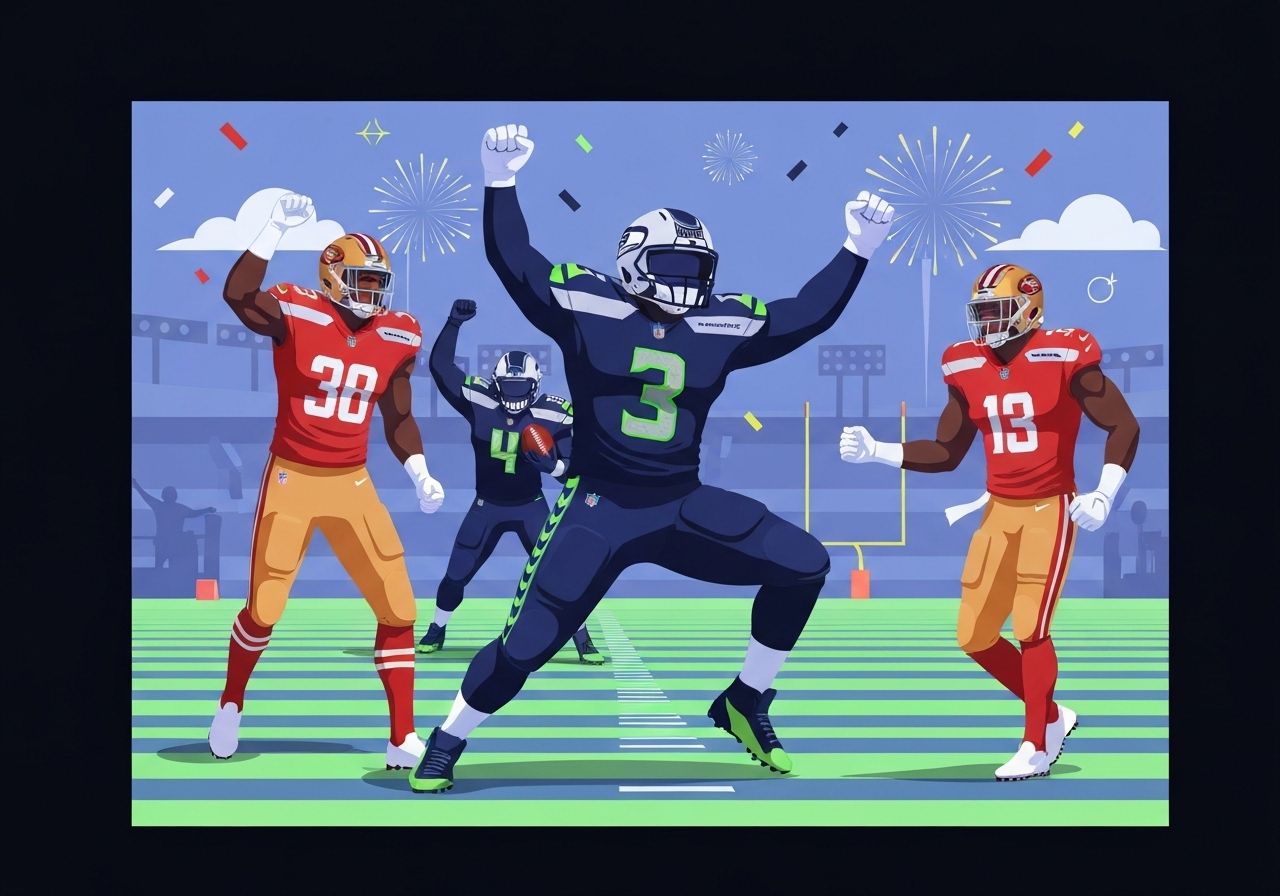
Lead: In Santa Clara on Saturday, the Seattle Seahawks beat the San Francisco 49ers 13-3 at Levi’s Stadium to claim the NFC West title and the conference’s top playoff seed. The victory, Seattle’s 14th against three losses, also secured a first-round bye and home-field advantage deep into January. Players celebrated in the locker room but repeatedly stressed that the postseason quest is unfinished. The win extended Seattle’s streak to seven consecutive victories and set franchise season-win records under second-year coach Mike Macdonald.
Key takeaways
- The Seahawks defeated the 49ers 13-3, clinching the NFC West and the No. 1 seed in the NFC playoffs.
- Seattle improved to 14-3 on the season, the most wins in franchise history, and will receive a wild-card bye.
- Coach Mike Macdonald, in his second year, guided a defense that limited San Francisco to 3 points, 173 yards and nine first downs.
- Seattle dominated the line of scrimmage with a 263-105 yard advantage through three quarters and controlled time of possession, holding the ball for 37:48.
- The Seahawks are 8-1 on the road this season and have won seven straight games since a Nov. 16 loss to the Rams.
- Sam Darnold engineered a critical 89-yard, 16-play clock-draining drive late in the third quarter, converting third downs including a 24-yard pass to Cooper Kupp.
- Drake Thomas intercepted a tipped Christian McCaffrey pass at the 3-yard line with 10:21 left, sealing San Francisco’s final realistic scoring opportunity.
Background
The Seahawks entered the regular-season finale with a chance to win the NFC West and earn the conference’s top seed, both milestones the franchise last reached in 2014 (No. 1 seed) and 2020 (division title). Seattle hired Mike Macdonald after the 2023 season to revamp a defense that had been inconsistent under previous leadership; Macdonald’s rapid ascent as a defensive assistant raised expectations about scheme and in-game adjustments.
San Francisco came in with an offense that had posted eye-popping numbers in recent games, averaging 42.3 points, 455.3 yards and 29.3 first downs over its previous three outings. The matchup therefore presented a classic test of a high-octane offense versus an opportunistic, retooled Seattle defense. Both franchises, with strong postseason pedigrees, had additional stakes: Seattle for a deep playoff run at home and the 49ers to avoid an early road test.
Main event
Seattle’s defense set the tone early, turning what many expected to be an aerial shootout into a low-scoring, field-position battle. The Seahawks took a 10-3 halftime lead after Zach Charbonnet’s 27-yard touchdown run late in the first quarter and a Jason Myers field goal. Despite several trips near the red zone, Seattle’s offense left points on the board in the first half but consistently chewed clock.
The third quarter saw Seattle build control, compiling a 263-105 yard edge through three quarters and forcing San Francisco into short fields and few third-down conversions. An 89-yard, 16-play drive late in the third ate more than eight minutes off the clock, underscoring Seattle’s game plan to shorten the contest and protect its lead even though the drive culminated in a missed Myers field goal.
San Francisco mounted one late threat in the fourth quarter. A tipped pass intended for Christian McCaffrey ricocheted into the hands of linebacker Drake Thomas at the 3-yard line with 10:21 remaining, ending the 49ers’ best chance to score. That turnover preserved Seattle’s 10-point cushion, and a later field goal extended the lead to the final 13-3 margin.
Sam Darnold’s poise on critical downs—completing 4 of 5 passes on the closing drive, including two key third-down conversions—gave the offense timely combustion even as the unit avoided turnovers for only the fourth time this season. The Seahawks finished with 67 offensive plays to San Francisco’s 42, a reflection of their time-of-possession strategy.
Analysis & implications
Defensively, the Seahawks delivered a blueprint for containing a prolific attack: disruption up front, disciplined coverage, and opportunistic pass-rush moments. Holding a 49ers offense that had averaged 42.3 points recently to only 3 points is a stark demonstration of scheme execution and situational coaching. If sustained, that performance suggests Seattle’s defense could be matchup-proof against many NFC opponents.
Offensively, Seattle did not need to flash explosiveness to win; instead, its ability to sustain long drives and convert third downs under pressure highlighted a maturation in play-calling and ball security. Sam Darnold’s late-drive composure reduces some public concern about his performance in high-leverage moments, but the offense must clean up red-zone efficiency and capitalize on field-position chances in future playoff rounds.
The broader implication for the NFC bracket is that Seattle now controls a path: a divisional-round home game Jan. 17-18 and potential hosting of the NFC title game on Jan. 25 if it advances. Historically, the Seahawks have converted top-seed positioning to deep postseason runs—previous top-seed years include 2005, 2013 and 2014, all of which ended with a Super Bowl appearance—raising expectations that home advantage can be decisive.
Comparison & data
| Metric | 49ers (last 3-game avg) | 49ers vs Seahawks (this game) |
|---|---|---|
| Points per game | 42.3 | 3 |
| Total yards | 455.3 | 173 |
| First downs | 29.3 | 9 |
| Time of possession (Seahawks) | — | 37:48 |
| Seattle season record | — | 14–3 |
| Seattle road record | — | 8–1 |
These figures illustrate the anomaly of the night: a dominant defensive showing that flattened recent offensive momentum for San Francisco. Seattle’s ability to win with ball control and situational defense is a contrast to the league’s trend of high-scoring shootouts, and it places a premium on matchup planning for upcoming opponents.
Reactions & quotes
Coach Mike Macdonald credited his group’s chemistry while deflecting singular praise.
“You can hear them in there. They love each other man. It’s so much fun to go to work every day and coach this team.”
Mike Macdonald, Seahawks head coach (postgame news conference)
Veteran defensive lineman Leonard Williams framed the victory as a milestone rather than an endpoint, stressing the team’s focus on the next challenge.
“Overall the job is not done,”
Leonard Williams, Seahawks defensive lineman
49ers running back Christian McCaffrey accepted responsibility for the tipped interception that swung momentum away from San Francisco.
“I absolutely have to make that play. … it’s completely on me.”
Christian McCaffrey, 49ers running back
Unconfirmed
- Final injury statuses for both teams after Saturday night’s game have not been fully released and could influence available personnel in the divisional round.
- Exact opponent for Seattle’s divisional-round home game will not be known until wild-card results are finalized; a rematch with the 49ers or a matchup with the Rams is possible but not certain.
- Any inside-team adjustments or playbook changes planned for the playoffs have not been publicly disclosed and remain internal coaching decisions.
Bottom line
The Seahawks’ 13-3 victory at Levi’s Stadium is both a capstone and a springboard: it validated a defensive identity under coach Mike Macdonald and secured strategic advantages—rest and home field—that materially improve Seattle’s odds in the postseason. While the offense showed enough situational competence to complement the defense, efficiency in the red zone and sustained explosive plays remain areas to polish before playoff opponents narrow margins.
With a clear path to hosting playoff games on Jan. 17–18 and potentially Jan. 25, Seattle’s roster and coaching staff now face the test of converting regular-season momentum into postseason execution. For fans and analysts, the key questions are whether the defense can replicate this level against top opposition and whether the offense can consistently close out tighter games under playoff pressure.