
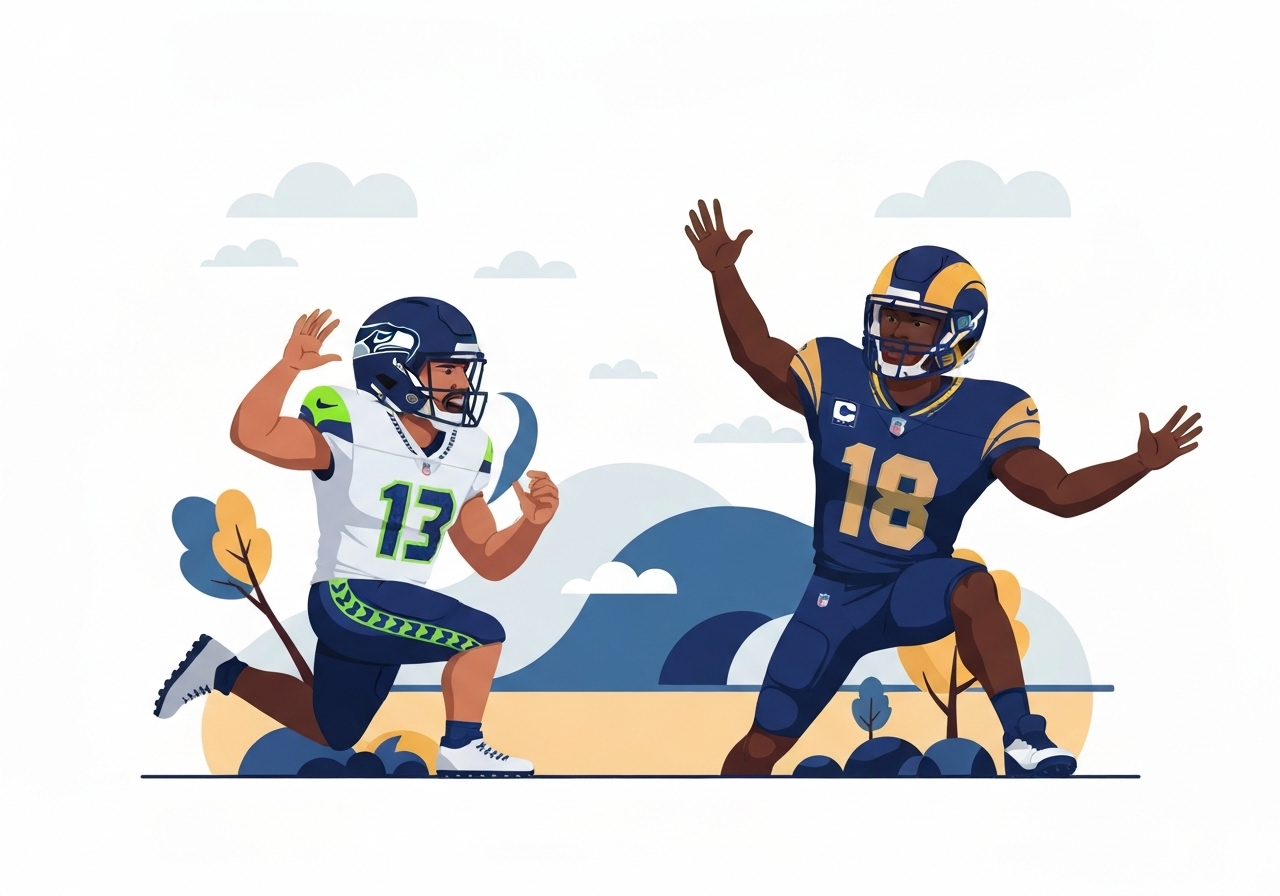
Lead: The NFC West arrives at Week 11 with two 7–2 clubs trending upward: the Seattle Seahawks and the Los Angeles Rams will meet in Inglewood after contrasting but equally dominant performances last weekend. Seattle routed the Arizona Cardinals 44–22 in a game in which the offense ran 46 times and attempted only 12 passes, while the Rams downed the San Francisco 49ers 42–26 as Matthew Stafford threw for 280 yards and four touchdowns. Both coaches describe a disciplined, buy-in locker room and adaptable week-to-week methods; the matchup on Sunday will be a first direct test of which formula is more durable. The result will have immediate playoff implications for a division that already looks like one of the NFL’s best.
Key Takeaways
- Seattle improved to 7–2 with a 44–22 win over Arizona, scoring 38 points by halftime and logging only 12 pass attempts while rushing 46 times.
- Sam Darnold has posted a triple-digit passer rating in six of his last seven starts, a major factor in Seattle’s offensive efficiency.
- The Seahawks have scored 30+ first-half points three times in nine games, showing sustained early-game production.
- The Rams, also 7–2, beat San Francisco 42–26; Matthew Stafford finished 24-for-36 for 280 yards and four TDs in that game.
- Los Angeles has expanded its personnel packages—leaning into 13-personnel—and targeted tight ends Colby Parkinson and Davis Allen for touchdowns in the 49ers game.
- Los Angeles addressed a cornerback need by acquiring Roger McCreary from Tennessee; the defense pairs a heavy front with versatile receiving and blocking options.
- Both coaching staffs emphasize principle-driven preparation with flexible methods: Seattle adjusted tempo and practice structure midweek, and the Rams mix formations to create mismatches.
Background
Seattle’s rapid improvement in Mike Macdonald’s second season has been built on balance and depth. The Seahawks pair a top-10 defense with a run-oriented offensive identity that is now complemented by more efficient quarterback play. Sam Darnold’s recent surge—high passer ratings in six of seven games—has allowed Seattle to convert a ground-first approach into consistent scoring drives.
Los Angeles, under Sean McVay and GM Les Snead, is similarly deep but in a different configuration: the Rams boast a veteran quarterback playing at an MVP-caliber level, a stout offensive line, multiple receiving options and a physical defensive front. Recent roster tweaks—including the addition of Roger McCreary—have sought to shore up the lone defensive vulnerability at cornerback and give McVay more schematic flexibility.
Main Event
Seattle’s win over Arizona was notable not just for the final score but for how it was achieved: the Seahawks opened with long touchdown drives on their first three possessions and took a 38–7 halftime lead. The ground game dominated—46 rushes to 12 called pass attempts—yet the offense still produced explosively. Macdonald credits his leadership council and small practice alterations for preserving player freshness after a Sunday night flight and a heavy travel week.
The Rams’ victory over San Francisco displayed the opposite but complementary formula: an airborne, distribution-heavy attack. Stafford spread the ball to eight receivers and targeted four tight ends in an outing that featured two tight end touchdown catches. Los Angeles repeatedly used 13-personnel to force defensive conflicts, then exploited play-action for chunk gains.
Situational details matter. In the 49ers game, an offside on a hard count with 2:42 remaining ended a San Francisco drive and underscored the Rams’ use of cadence and tempo as a weapon. Seattle, meanwhile, showed that it can win while throwing sparingly—an indication of offensive schematic trust and confidence in its rushing and play-calling balance.
Analysis & Implications
Matchup-wise, this is an archetypal contrast: Seattle’s run-first, complementary pass game versus a Rams offense built around an elite passer who can target any position. If Seattle can sustain its rushing success and force Los Angeles out of preferred down-and-distance situations, it increases the value of short-yardage play-calling and clock control. Conversely, the Rams’ ability to spread defenses with multiple tight ends and receivers can neutralize an aggressive Seattle front.
Coaching philosophies will be decisive. Mike Macdonald emphasizes principles while allowing methods to change—short walk-throughs, moderated tempo, and leader-driven adjustments—that have kept his roster fresh. Sean McVay’s schematic breadth puts a premium on pre-snap complexity and personnel mismatches; how Seattle defends 13-personnel sets and in-line play-action will be central to the game plan.
Special teams and turnover margin are likely tie-breakers. Both teams have playmakers who can shift momentum quickly—Jaxon Smith-Njigba’s explosive receiving, Stafford’s distribution to tight ends, and strong defensive fronts that can create short-field opportunities. Small edges—an offside, a third-down stop, a return touchdown—could determine a close contest and tilt NFC seeding conversations.
Comparison & Data
| Team | Record | Last-Game Score | QBs: recent form |
|---|---|---|---|
| Seattle Seahawks | 7–2 | 44–22 vs. Arizona | Sam Darnold: triple-digit passer rating in 6 of last 7 |
| Los Angeles Rams | 7–2 | 42–26 vs. San Francisco | Matthew Stafford: 280 yards, 4 TD (last game) |
The table summarizes the basic state of each club entering Week 11: identical records but different offensive identities. Seattle’s rushing tilt (46 rushes vs. Arizona) contrasts with Los Angeles’ more balanced personnel usage and passing volume in their win over the 49ers.
Reactions & Quotes
“What’s good, what I love about our team, is however we decide we want to do our process, they’re bought in on it… We talked to the leaders on Friday. They told me, ‘We still need to slow down the tempo.’ And so we adjusted on Friday.”
Mike Macdonald, Seahawks head coach
“Any time you don’t have to run the play to get that first down, after staying disciplined? That’s one of our tools, our cadence. We did a good job at it, and we’re going to continue to use it.”
Davante Adams, Rams receiver
“The way Sean’s able to dial it up obviously puts us in great position, and makes it tough on defenses… we got a lot of weapons at each position.”
Davante Adams, on Rams schematic versatility
Unconfirmed
- Exact Week 11 play-call distribution for either team is unconfirmed; coaches typically withhold final tendencies until game day.
- Any last-minute injury implications or lineup changes for Sunday remain unverified until official gameday reports are released.
Bottom Line
This matchup is a collision of two ascending teams built differently but equally well-equipped for postseason runs. Seattle’s ground-first identity and recent passing efficiency have created a balanced offense that complements a top-10 defense, while the Rams’ veteran-led aerial attack and personnel versatility produce matchup problems across the field.
Coaching and in-game adjustments will matter. If Seattle can dictate tempo and keep drives long, it can blunt Los Angeles’ ability to leverage play-action and personnel-induced mismatches. If the Rams convert pre-snap conflicts into quick strikes, they can force Seattle into uncomfortable down-and-distance scenarios and open the field for Stafford’s passing tree.
Ultimately, Week 11 will be an early barometer for which approach is more sustainable in this deep NFC race. Both teams are peaking; Sunday in Inglewood should reveal whether that peak is matchup-specific or a sign of true division dominance.
Sources
- Sports Illustrated (feature) — original reporting and game context.
- NFL.com (official) — league boxscores and statistics.
- Seattle Seahawks (team official) — team releases and practice reports.
- Los Angeles Rams (team official) — team releases and coach quotes.