
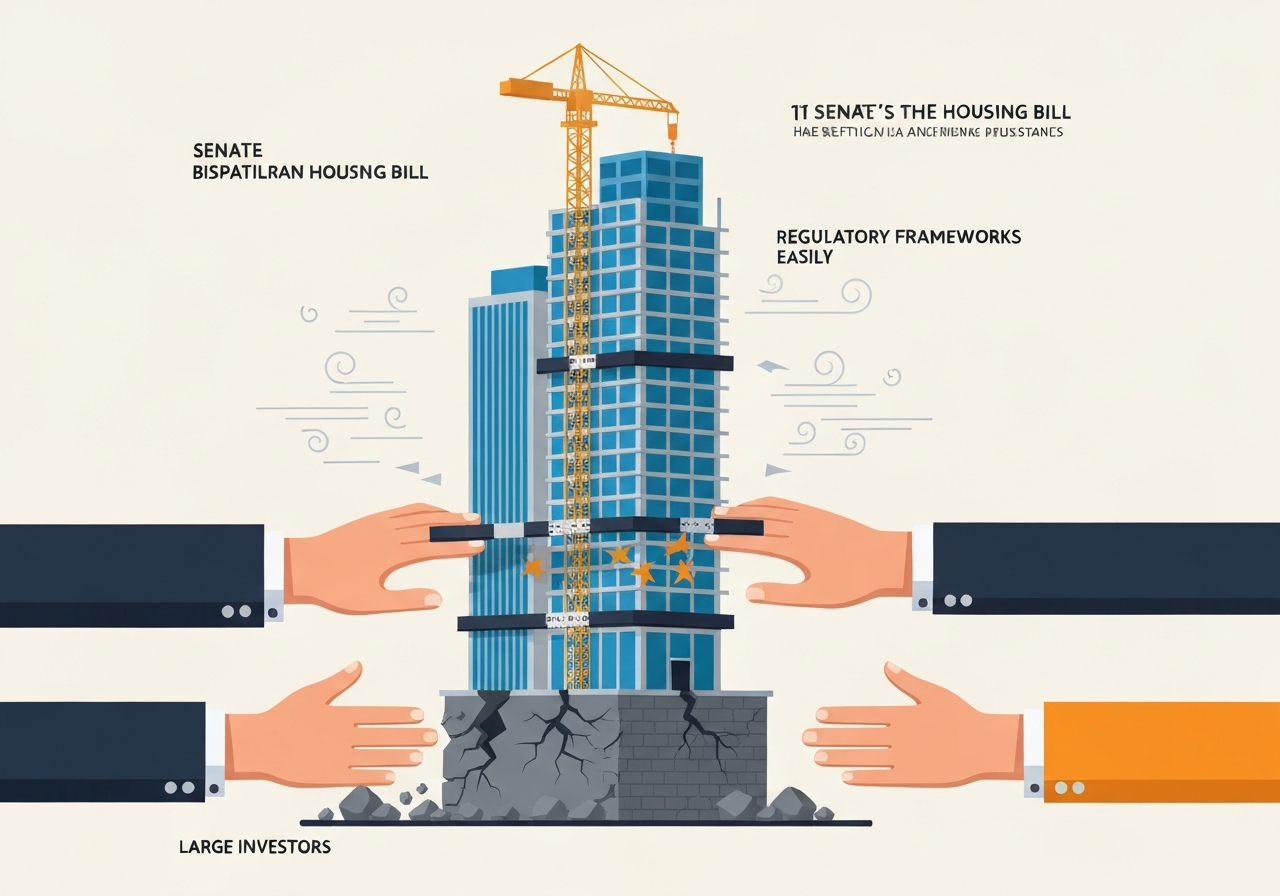
Lead
The Senate approved a wide-ranging, bipartisan housing package on March 12, 2026, passing the measure 89–10 with strong cross‑party backing. Sponsors Sen. Elizabeth Warren (D‑Mass.) and Sen. Tim Scott (R‑S.C.) framed the bill as a supply-focused response to the nation’s affordability crisis, combining deregulation, expanded programs and new limits on large institutional buyers. A central feature bars investors owning at least 350 single‑family homes from acquiring additional houses, with carve-outs for significant renovation and build‑to‑rent projects. Lawmakers said the goal is to increase housing production while expanding pathways to homeownership for families.
Key Takeaways
- The Senate passed the bill 89–10 on March 12, 2026, after bipartisan negotiations led by Sens. Warren and Scott.
- The measure bans investors who own 350 or more single‑family homes from buying more, with exceptions for major rehabs and build‑to‑rent units that must be sold after seven years.
- About 84% of provisions from the House bill were retained in the Senate version, keeping broad alignment between chambers.
- A Realtor.com estimate cited in debate places the U.S. housing shortfall at roughly 4 million units; the typical U.S. home price cited is about $400,000.
- The bill would raise the public welfare investment (PWI) cap for banks from 15% to 20%, unlocking additional private capital for affordable rental projects.
- Manufactured‑housing rules are loosened by removing the permanent‑chassis requirement, potentially saving builders approximately $5,000–$10,000 per unit.
- Build‑to‑rent now represents about 7% of new single‑family construction; the bill preserves that model but requires resale after seven years with tenant right of first refusal.
- The package includes expedited environmental reviews, design pattern‑book grants and expansions of block grants to speed construction.
Background
U.S. housing policy has been dominated for decades by local zoning limits, rising construction costs and patchwork federal programs meant to support supply and affordability. The mismatch between demand and available homes has pushed prices higher: nationwide estimates put the current shortfall at roughly 4 million units, contributing to median home prices well above what many families can afford. Policymakers from both parties have argued that boosting supply is the principal route to lower prices over time.
In Congress, the past year saw parallel efforts in the House and Senate to confront those constraints. The House passed its own comprehensive housing bill last month; Senate negotiators folded about 84% of those provisions into their version, while adding new investor‑targeted rules and other changes. Stakeholders—from builders and property managers to renter advocates—have pushed for reforms that both increase production and preserve affordable options.
Main Event
On the Senate floor, debate emphasized bipartisan collaboration. Sen. Elizabeth Warren described the bill as a collection of complementary measures intended to accelerate housing production. Sen. Tim Scott framed the effort around expanding homeownership opportunities for working families, invoking personal stories to underline the bill’s priorities. The vote concluded with overwhelming support, 89 senators in favor and 10 opposed.
Key policy steps include a ban preventing institutional owners with portfolios of 350 or more single‑family homes from making further purchases, subject to limited exemptions. Investors may acquire houses that need substantial renovation and homes built explicitly for rent, but the latter category—build‑to‑rent—would be subject to a seven‑year sale requirement, with tenants given the first chance to buy.
The bill also targets regulatory bottlenecks: it would relax certain manufactured‑housing rules by eliminating the requirement for a permanent chassis, streamline environmental reviews for infill construction, create grants for preapproved housing pattern books, and expand block grants like the HOME program to rehabilitate vacant buildings. Supporters argue these changes will speed construction and reduce per‑unit costs.
Analysis & Implications
Proponents say the bill’s combination of supply‑side deregulation, expanded incentives and limits on large investors could meaningfully increase housing starts and owner‑occupied sales over the medium term. Raising the PWI cap for banks from 15% to 20% would permit more private investment in projects that utilize expanded low‑income housing tax credits, potentially moving billions of additional dollars into affordable development.
However, academic and market research offers mixed expectations about the investor ban’s price effects. A recent Urban Institute result cited in the debate found very large investors (those with at least 1,000 homes and multi‑market footprints) account for a small share of single‑family rentals nationwide—around 3%—suggesting limited aggregate impact from constraining those players. Freddie Mac likewise has said institutional purchasing is a smaller contributor to price growth than limited building and migration into high‑cost metro areas.
The build‑to‑rent carve‑out with a seven‑year resale rule creates a tradeoff: it preserves a pathway for new rental supply while pressuring long‑term institutional ownership. Industry groups warn that a mandatory resale could chill production of build‑to‑rent communities; advocates counter that conditional sale timelines increase opportunities for occupant purchase and long‑term owner occupation. The net effect on supply will hinge on developer response and secondary‑market dynamics.
Politically, the bill still faces negotiation with the House, where some GOP members seek more permanent prohibitions on a Federal Reserve digital currency than the Senate’s temporary clause. Additionally, the White House calculus is uncertain: President Trump has tied his signature to progress on unrelated voting‑related legislation, potentially affecting enactment timing. If the president neither signs nor vetoes within ten days while Congress is in session, the measure could become law without his signature.
Comparison & Data
| Metric | Reported Value |
|---|---|
| Senate vote | 89–10 |
| Investor purchase cap | 350 single‑family homes (buying ban above threshold) |
| Build‑to‑rent share of new single‑family | ~7% |
| Single‑family rental share owned by very large investors | ~3% (Urban Institute, defined as ≥1,000 homes) |
| Estimated housing shortfall | ~4 million units (Realtor.com estimate) |
| PWI cap for banks | Raised from 15% to 20% |
The table summarizes figures discussed during floor debate and in stakeholder responses. While some numbers—such as investor market share—show limited aggregate concentration, local market impacts can differ substantially, and the bill’s incentives target construction, financing and regulatory barriers that affect supply across jurisdictions.
Reactions & Quotes
Supporters highlighted bipartisan achievement and the bill’s breadth; opponents warned about federal overreach and ineffective incentives. The following selected remarks capture key perspectives.
“It’s Democrats. It’s Republicans. It’s pieces they built out together. That is the strength of this bill.”
Sen. Elizabeth Warren (D‑Mass.), bill co‑sponsor
Warren emphasized the bill’s multiple provisions—more than 40 in her characterization—as a unified effort to spur building and expand homeownership opportunities.
“It’s not a Republican issue or a Democrat Issue. It’s an issue about helping moms like the one who raised me … become homeowners.”
Sen. Tim Scott (R‑S.C.), bill co‑sponsor
Scott framed the legislation around family homeownership and opportunity, using personal anecdote to underline the social goals behind production‑focused measures.
“Lifting the PWI cap would open up billions of dollars in additional investment capacity.”
Sarah Brundage, National Association of Affordable Housing Lenders (industry)
Industry advocates for affordable housing finance said the PWI increase is a central lever for unlocking private capital into projects that benefit low‑income renters.
Unconfirmed
- Precise long‑run effect of the 350‑home purchase ban on national house prices is uncertain; studies show mixed local versus national impacts.
- Industry claims that the seven‑year resale rule will “effectively eliminate” build‑to‑rent production reflect developer projections and are disputed by policy supporters.
- How quickly banks and developers will deploy newly available PWI capacity depends on market incentives and regulatory guidance that have not yet been finalized.
Bottom Line
The Senate bill represents the most expansive federal housing effort in decades, combining supply‑focused deregulation, incentives for affordable construction and limits on large institutional buyers. Its bipartisan passage by an 89–10 margin signals broad congressional appetite to address supply shortages, but the measure balances competing priorities that could alter developer behavior in different ways.
Key outcomes to watch are whether the House concurs with the Senate language, how build‑to‑rent developers respond to the resale mandate, and whether increased PWI capacity translates into sizable private investment in affordable rentals. If enacted, the package could nudge production higher and expand financing for affordability, but substantive price relief will likely take years and will hinge on local zoning, construction costs and market migration patterns.
Sources
- NPR — reporting on Senate passage and provisions (news)
- Urban Institute — research on investor share of single‑family rentals (research/think tank)
- Freddie Mac — analysis of housing market drivers (government‑sponsored enterprise)
- Realtor.com — housing shortfall and market data (industry/market site)
- National Association of Realtors — industry position and statements (trade association)
- Cato Institute — critical commentary on federal housing incentives (think tank)
- National Association of Home Builders — industry perspective on build‑to‑rent and regulation (trade association)