
Lead
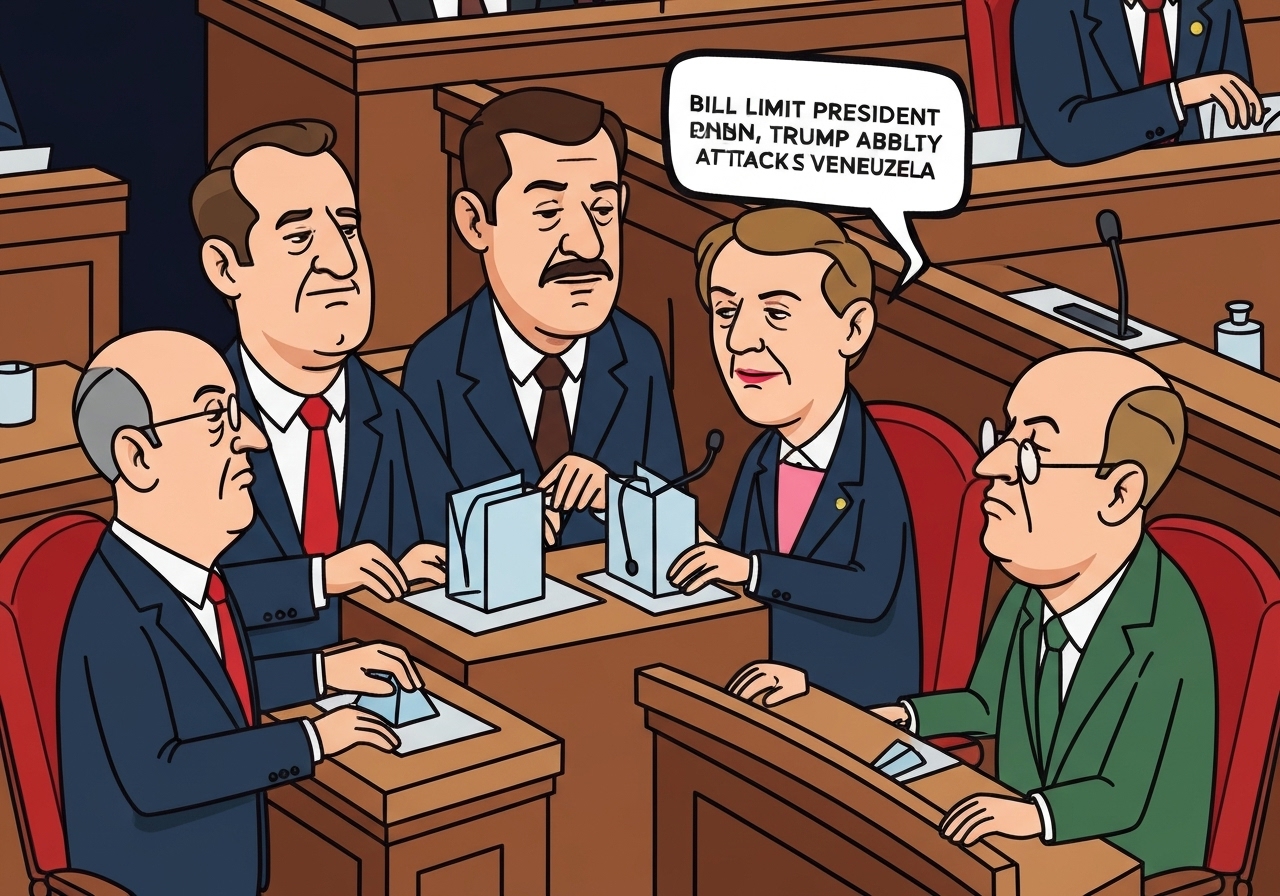
On Thursday, Senate Republicans voted 51-49 to block a measure that would have constrained President Donald Trump’s ability to order strikes on Venezuelan soil without congressional approval. The roll call followed weeks of Democratic pressure and concern on Capitol Hill about a U.S. naval buildup in the Caribbean and repeated strikes on suspected drug-smuggling vessels. Lawmakers pressed the administration for more detail on the intelligence, legal rationale and objectives behind the operations, which have been tied to at least 17 strikes that officials say have killed 69 people. The failed motion signals GOP willingness to allow the White House greater latitude even as some Republicans voiced unease.
Key Takeaways
- The Senate rejected the measure 51-49; Sens. Rand Paul and Lisa Murkowski were the only Republicans to join Democrats in favor.
- Sen. Jim Risch defended administration actions as protecting Americans from lethal narcotics while others warned of mission creep.
- The operations have involved an unusually large U.S. force in the Caribbean, including the country’s most advanced aircraft carrier, according to lawmakers.
- Congressional Democrats invoked the 1973 War Powers Resolution to force the vote, signaling repeated efforts to assert oversight.
- At least 17 known strikes tied to the campaign have resulted in 69 reported deaths, including a strike reported Thursday on a Caribbean vessel.
- Senate hearings this week featured criticism of the Defense Department policy office and classified briefings by administration officials.
Background
The confrontation stems from an intensified U.S. campaign in the Caribbean and eastern Pacific aimed at vessels alleged to be smuggling narcotics. The Trump administration has described the strikes as targeted efforts to intercept drug shipments that threaten American communities, while critics argue the scale and posture suggest a larger strategic push against the Maduro government in Venezuela.
Congress has grown increasingly frustrated as Pentagon actions and broader shifts in U.S. defense priorities — including pauses or reductions in support for allies — have unfolded with what some lawmakers say is insufficient consultation. The War Powers Resolution of 1973 exists to reassert congressional authority over significant military engagements, and Democrats have used that statute to press for votes and public debate.
Main Event
Thursday’s procedural vote followed weeks of floor speeches and committee hearings. Democrats, led on the floor by Sen. Adam Schiff and others, argued that the administration’s campaign risks entangling U.S. forces in a wider conflict and that the legal justification offered so far is too thin for expanded action. Republicans, including Foreign Relations Committee Chair Jim Risch, countered that decisive steps are necessary to stem deadly drug flows.
Senators described a recent classified briefing in which administration officials outlined the intelligence used to target vessels and presented the legal reasoning for strikes. Lawmakers who attended said the briefing included discussion of operational details but stopped short of disclosing whether a direct attack on Venezuela was being planned. That uncertainty helped drive the clash on the Senate floor.
Some Republican senators who voted against the measure still voiced reservations. Sen. Thom Tillis noted the operational cost and logistical challenge of diverting an aircraft carrier and questioned whether resources would be better used at the U.S.-Mexico border to counter fentanyl trafficking. Sen. Todd Young said he opposed the resolution because he deemed it unnecessary at the moment but signaled discomfort with aspects of the operation.
Analysis & Implications
The narrow defeat of the resolution underscores a divided Congress: Republicans largely deferential to executive military prerogative, while Democrats press for institutional checks. If the administration continues an expanded posture in the Caribbean — backed by carrier groups and increased naval presence — pressure for formal oversight votes and additional classified briefings is likely to intensify.
Strategically, the campaign raises questions about objectives and exit criteria. Lawmakers such as Sen. Jack Reed argued the approach lacks a clear strategic aim and warned that kinetic action alone cannot resolve the transnational drug problem. If strikes are primarily interdiction, policymakers will demand evidence tying operations directly to drug interdiction outcomes rather than regime-change aims.
Domestically, the dispute touches on public appetite for foreign engagements and the allocation of defense resources. Some GOP senators appealed to constituents who favor reduced overseas entanglement, even while backing measures that preserve executive flexibility. Internationally, any escalation near Venezuelan territory risks diplomatic fallout in the Western Hemisphere and could complicate relations with regional partners.
Comparison & Data
| Metric | Figure |
|---|---|
| Senate Vote | 51-49 (failed) |
| Known Strikes | 17 strikes |
| Reported Deaths | 69 people |
| Republicans for Measure | 2 (Rand Paul, Lisa Murkowski) |
The numerical record shows tight margins in Congress and a measurable operational footprint at sea. Those figures are likely to be focal points in subsequent oversight hearings and in public debates over policy trade-offs between interdiction, deterrence and the risk of broader confrontation.
Reactions & Quotes
“President Trump has taken decisive action to protect thousands of Americans from lethal narcotics.”
Sen. Jim Risch (R), Senate Foreign Relations Committee chair
Risch framed the strikes as protective interdiction measures aimed at drug flows, which helped persuade many Republicans to oppose the limiting resolution.
“It’s really an open secret that this is much more about potential regime change.”
Sen. Adam Schiff (D)
Schiff used the floor to argue that the pattern of deployments and strikes indicates a broader campaign that could entangle the U.S. in direct conflict, pressing for congressional review.
“We should not be going to war without a vote of Congress. The lives of our troops are at stake.”
Sen. Tim Kaine (D)
Kaine, who sponsored the War Powers motion, reiterated Democrats’ intent to force repeated votes under the 1973 statute to assert legislative authority.
Unconfirmed
- Whether administration planners have formally decided on a direct strike against Venezuelan territory remains unconfirmed by publicly available sources.
- Claims that the campaign’s primary objective is regime change are asserted by some lawmakers but lack definitive, publicly released policy documentation backing that intent.
- Details of all intelligence used to justify the strikes were not disclosed to the public; senators were briefed in classified settings, limiting public verification.
Bottom Line
The Senate vote highlights a Senate majority willing to defer to the Trump administration’s operational judgments while leaving a vocal minority seeking stronger congressional checks. With 17 known strikes and 69 reported deaths tied to the campaign, the issue will remain a live political and policy debate as lawmakers press for more facts and legal explanations.
Expect continued friction: Democrats will continue to force War Powers votes and publicize concerns, while many Republicans will press for classified briefings and assurances rather than public restraints. The dispute exposes deeper questions about U.S. strategy in the region, the boundaries of executive war powers, and how the United States balances counter-narcotics objectives with the risks of escalation.
Sources
- AP News (news organization) — original reporting on Thursday’s Senate vote and recent strikes.