
Lead
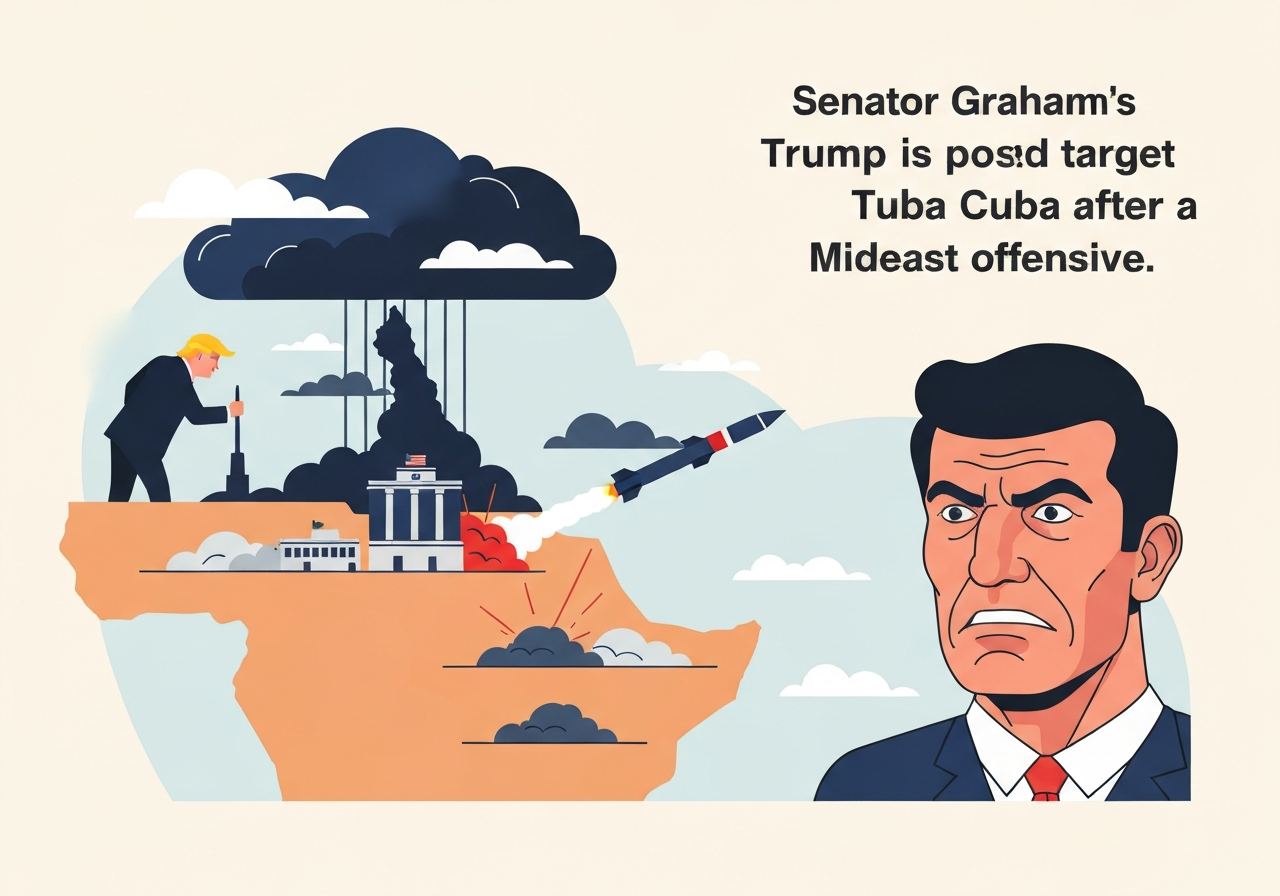
Senator Lindsey Graham told Fox News late Sunday that President Donald Trump has exceeded former President Ronald Reagan on foreign policy and signaled Cuba could be the next U.S. focus after a weekend escalation in the Middle East. The remarks came amid reports that Trump ordered major strikes against Iran and that Tehran and its proxies responded with strikes across the region. Graham framed recent actions as proof of a new, more assertive U.S. posture; White House officials are reportedly discussing further options with regional partners. The developments have raised alarms among diplomats and analysts about the risk of a wider confrontation and potential moves toward Cuba.
Key Takeaways
- Sen. Lindsey Graham publicly praised President Trump’s foreign-policy approach on Fox News, saying Trump surpassed Ronald Reagan in effectiveness, according to the report.
- The Daily Beast and other outlets reported Trump authorized large-scale strikes on Iran over the weekend; those attacks prompted retaliatory strikes attributed to Iran against at least eight jurisdictions, including Saudi Arabia and Cyprus.
- The article cites claims that the administration has taken action in Venezuela to detain former President Nicolás Maduro and that Maduro faces narcoterrorism charges in a New York federal court.
- Graham and other GOP figures, including Secretary of State Marco Rubio, signaled they view Cuba’s government as a potential near-term target; the White House said it is in high-level talks with Havana.
- U.S. sanctions, the loss of Venezuelan oil support, and severe domestic shortages have left Cuba under economic strain, the report says.
- A White House spokesperson told reporters the administration is “talking to Cuba” and suggested Cuban leaders should consider a deal in light of recent setbacks.
Background
For months President Trump has portrayed himself at times as a peacemaker while also warning adversaries that the United States will act decisively. Last year he publicly claimed credit for resolving multiple global disputes—using figures such as “six, seven, eight” conflicts in media appearances—language that has drawn scrutiny and skepticism from foreign-policy observers. The weekend escalation followed a breakdown in talks over Iran’s nuclear program, according to multiple reports, prompting the U.S. to undertake substantial military actions.
Regional dynamics are complicated by long-standing rivalries: Iran, its regional allies, and Gulf states have a history of proxy conflict, while Cuba and Venezuela have maintained political ties that the Trump administration has sought to sever. Marco Rubio, a Cuban American and leading GOP voice on Latin America, has pressed for a tough approach to Havana; some in the administration view Cuba’s economic and political instability as an opening for pressure or negotiation. At the same time, diplomatic channels remain partly active as officials discuss contingency options and possible “deals.”
Main Event
According to the reporting, the U.S. launched extensive strikes against targets in Iran on Saturday after nuclear negotiations faltered, marking an abrupt intensification of military pressure. Iranian-aligned forces responded with attacks that were reported across the region, including strikes affecting Saudi Arabia, Qatar, the UAE, Bahrain, Kuwait, Iraq, Jordan, and Cyprus. Administration sources described an internal mood that officials believe the campaign is producing results and that momentum is building in Washington.
Sen. Graham, in a televised interview, framed the operation as fulfilling objectives previous administrations did not complete and named Cuba as the next likely focus. He told Fox News that the U.S. had removed Nicolás Maduro’s support network and suggested Havana could be isolated or compelled to change course. The White House confirmed it is engaged in high-level contacts with Cuban officials and described Cuba as a “failing nation” facing economic turmoil.
Separately, the report states that U.S. forces carried out an operation in Venezuela that led to the detention of Maduro; U.S. officials are said to be pursuing narcoterrorism charges in New York. The administration also reportedly discussed potential measures involving neighboring countries and territories, including public comments about Greenland, which is an autonomous Danish territory and a NATO partner. These developments have prompted questions among allies and international organizations about legality, escalation risk, and multilateral coordination.
Analysis & Implications
The comments by Graham and contemporaneous actions illustrate a shift toward a more interventionist posture that mixes public rhetoric with kinetic operations. If the reported strikes on Iran and any operations in Venezuela are confirmed, they represent a faster, broader use of force than many analysts expected and could alter strategic calculations across multiple theaters. Such moves risk galvanizing opposition coalitions in the Middle East and Latin America and could complicate relations with NATO partners if actions extend to allies’ territories or places like Greenland.
Targeting Cuba would raise legal and diplomatic questions distinct from the Middle Eastern theater: Cuba is a sovereign state still suffering severe economic hardship, and American interventions there would face intense international scrutiny. The White House’s stated aim of inducing regime change or a negotiated settlement in Havana would require a combination of economic pressure, diplomatic isolation, and potentially covert or overt actions; each carries thresholds of international law and geopolitical cost.
Domestically, assertive foreign operations can produce short-term political gains for a president who frames them as decisive leadership, but they also carry long-term risks: drawn-out engagements, blowback from proxy actors, disrupted alliances, and economic consequences. For NATO and regional partners, the priority will be assessing whether U.S. moves are coordinated and sustainable, and whether diplomatic channels remain open to de-escalate if broader conflict threatens trade, energy supplies, or regional stability.
Comparison & Data
| Claim / Action | Reported Details |
|---|---|
| Self-described “President of Peace” claims | Trump reportedly claimed to have resolved “six, seven, sometimes eight” conflicts in public remarks last year |
| Recent military actions (reported) | Major strikes on Iran and reported operations in Venezuela; Iran reportedly retaliated across eight jurisdictions |
The juxtaposition highlights a contrast between public messaging on peacemaking and recent kinetic activity. Observers note that rhetoric emphasizing peace can coexist with unilateral operations when administrations view strategic objectives as urgent; the data above captures that tension without adjudicating motive.
Reactions & Quotes
President Trump has said the administration is engaging with Cuba’s leaders to seek a “deal” and signaled tougher measures if talks fail.
White House spokesperson (statement to reporters)
“The president is feeling like, ‘I’m on a roll’; like, ‘This is working’,” an administration official said in reporting about Situation Room discussions.
The Atlantic (administration official quoted)
Sen. Lindsey Graham described recent operations as completing objectives prior presidents did not achieve and suggested Cuba’s government could be next to face pressure.
Sen. Lindsey Graham (Fox News interview)
Unconfirmed
- Reports that U.S. forces have completed a ground invasion in Venezuela and taken Nicolás Maduro into custody remain unverified by independent international news organizations.
- Claims that the White House has finalized plans to “take over” Cuba have not been corroborated by official Cuban sources or independent diplomatic channels.
- Details about the precise targets and legal authorization for the strikes on Iran are not publicly confirmed in official documents; reporting relies on administration and regional accounts.
Bottom Line
Recent reporting portrays a White House pursuing an assertive, wide-ranging foreign-policy posture that mixes public rhetoric, military action, and high-level diplomatic engagement. Senator Lindsey Graham’s comments reflect a political narrative that frames these moves as accomplishing unfinished tasks of prior administrations, while the administration’s own officials appear to be weighing further steps, including intensified pressure on Cuba.
Key unknowns remain: independent confirmation of operations in Venezuela, the full legal and intelligence basis for strikes on Iran, and whether allied states will support or rebuke further U.S. actions toward Cuba. In the near term, diplomats, regional governments, and markets will watch for clear signals about whether Washington moves from targeted strikes to sustained campaigns or seeks negotiated outcomes that reduce the risk of wider war.