
Lead
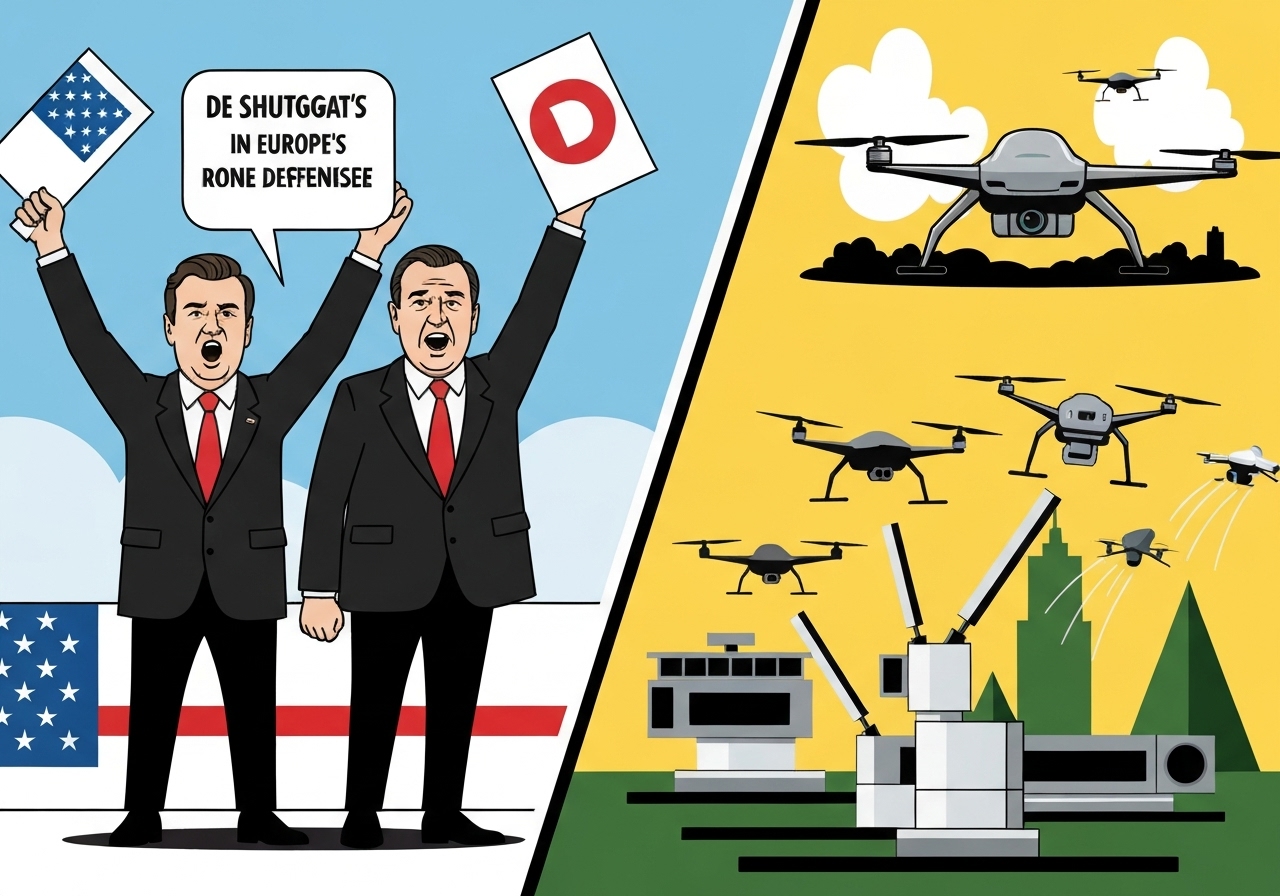
Eight Senate Democrats reached a deal with Republicans to end a six-week government shutdown that became the longest in U.S. history, producing a stopgap funding package and targeted wins for Democrats. The agreement funds several appropriations through next fall, secures SNAP through September 2026 and requires reinstatement of furloughed federal workers, while leaving key health-care tax credits unresolved. In Europe, a small Latvian firm is developing a three-foot interceptor drone called Blaze as part of a broader effort to blunt frequent Russian-style UAV strikes. Meanwhile, U.S. equities have trailed most global markets this year, with the S&P 500 ranked 41st among more than 60 country indexes.
Key takeaways
- Eight Senate Democrats cut a deal with Republicans to end a six-week government shutdown, which had become the longest in U.S. history.
- The compromise includes a “minibus” of three appropriations bills funding parts of government through next fall and keeps the rest funded through Jan. 30.
- SNAP (food assistance) is financed through Sept. 2026, removing food stamps as a bargaining chip for the coming fiscal year.
- The agreement requires the administration to reinstate federal workers who lost jobs during the shutdown and bars large-scale firings during the resolution.
- Democrats did not secure an extension of Affordable Care Act tax credits that expire Dec. 31; Senate leaders pledged a vote by mid-December but the House made no matching commitment.
- In Riga, Origin’s three-foot interceptor drone, Blaze, is a private-sector response to recurrent UAV incursions and is part of wider EU plans for layered drone defenses.
- The S&P 500 has underperformed global benchmarks by more than 10% year-to-date and ranks roughly 41st out of over 60 national indices in our comparison.
- Other notable items: a threatened $1 billion lawsuit by former President Trump against the BBC, and FAA-driven airline cancellations affecting about 6% of flights at 40 major airports.
Background
The shutdown unfolded across six weeks as lawmakers sparred over appropriations, culminating in an agreement brokered after high-level talks that included Senate Democratic Leader Chuck Schumer and House Democratic Leader Hakeem Jeffries. The interruption disrupted federal services, furloughed employees and intensified public frustration, creating leverage for both parties as the dispute stretched into the fall and November enrollment season for the Affordable Care Act.
Historically, shutdown showdowns have prompted tradeoffs: short-term funding to reopen the government in exchange for bargaining on future priorities. This episode followed that script but left key policy fights unresolved — most notably the ACA premium tax credits that expire on Dec. 31 — and set up separate legislative and political battles ahead of a mid-December window that Senate leaders have promised to use.
Main event
The negotiated package included a three-bill minibus that covers certain agencies through next fall while extending overall funding to Jan. 30 to avoid an immediate lapse. Negotiators secured language preventing mass reductions in force for the duration of the continuing resolution and obtained an agreement to reinstate federal workers displaced during the shutdown through reductions in force. Those provisions were notable wins for Democratic lawmakers and affected employees.
On nutrition policy, the deal finances the Supplemental Nutrition Assistance Program (SNAP) through September 2026, effectively taking food assistance off the bargaining table for the near term. That outcome was widely welcomed by advocates who feared SNAP might be used as leverage during future funding standoffs.
Health-care provisions were the most conspicuous gap. Democrats sought to extend Affordable Care Act premium tax credits that expire at year-end but only secured a Senate pledge from a Republican leader to schedule a vote by the second week of December; the House has not committed to the same timeline. Senate Republicans tied possible ACA funding extensions to tougher restrictions on abortion coverage in some insurance plans, creating a political impasse on a deeply divisive issue.
In Europe, Origin — a Latvian startup — is pitching Blaze, a compact interceptor drone, to counter growing UAV threats. European governments and NATO allies have discussed networked defenses — sometimes described as a “drone wall” — combining sensors and countermeasures. Blaze represents a private-sector element of that layered approach, intended to detect, track and neutralize incoming unmanned aerial vehicles.
Analysis & implications
For Democrats, the deal is mixed: operational and personnel protections represent tangible gains that affect millions of people and guardrails for federal workers, but the failure to lock in ACA subsidies undermines a major policy objective that could have immediate effects on premiums and enrollment in 2026. The delayed Senate vote on subsidies leaves Democrats with a political window to press the case publicly, but absent House action the path to a durable extension remains uncertain.
Politically, the agreement may reduce short-term damage from the shutdown and blunt attacks that hinge on service interruptions or visible hardship. Yet some progressives interpret the concessions as capitulation, arguing that the party surrendered negotiating leverage built by public frustration. That internal tension could shape messaging and candidate positioning in coming primaries and general-election cycles.
In Europe, the rapid proliferation of inexpensive attack drones — used nightly in Ukraine and appearing in incidents at civilian infrastructure — has prompted a patchwork of responses. Private firms like Origin are moving quickly to field practical interceptors, but capability alone is insufficient: effective defense requires integration with radar, electronic warfare, rules of engagement and supply chains. The emergence of commercially driven counter-UAV systems highlights both innovation and interoperability challenges across NATO members.
On markets, the S&P 500’s relative weakness compared with global peers may affect investor sentiment and allocation decisions, especially for global funds and pension plans. A substantial outperformance gap — more than 10% behind broad international indices and a mid-pack ranking internationally — suggests sectoral or factor leadership overseas this year. Unless the U.S. benchmark posts outsized gains in the near term, portfolio managers may continue to rebalance toward faster-growing or higher-return foreign markets.
Comparison & data
| Index | Year-to-date change (approx.) | Global rank (out of ~60) |
|---|---|---|
| S&P 500 (U.S.) | Trailing global peers by >10% | 41st |
The table summarizes the S&P 500’s position relative to a global universe of more than 60 national indices: roughly 40 markets outperformed the U.S. this year. That gap reflects sectoral rotations, currency swings and differing economic growth expectations. Closing the difference would require a pronounced rebound in U.S. equities or a turn in foreign markets.
Reactions & quotes
“I think I have an obligation to do it, because you can’t get people, you can’t allow people to do that.”
Donald J. Trump (Fox News interview)
President Trump said he felt compelled to pursue a threatened $1 billion suit against the BBC after an internal report criticized editorial decisions; the remark followed resignations by senior BBC news executives.
“The S&P 500 is lagging behind the world broadly by more than 10%.”
Steve Kopack, NBC News senior business reporter
That assessment frames a broader data analysis showing U.S. equities underperforming many international peers this year, a trend investors and policy watchers are monitoring as the year winds down.
Unconfirmed
- The provision that could let senators sue for millions if their data are obtained without notice has been described as possible but its legal scope and likelihood of payouts remain untested.
- Reports that Senate Republicans will condition ACA funding extensions on stricter abortion restrictions are current positions but details and final legislative text have not been finalized.
Bottom line
The shutdown deal produced concrete, immediate protections for federal workers and long-term funding for SNAP that Democrats can point to as wins, even as major policy goals — notably ACA tax credits — remain unresolved and hinge on future votes. The political calculus going forward will weigh short-term stability against the costs of leaving a flagship Democratic priority unsettled into December.
Across the Atlantic, private-sector innovators like Origin are moving to fill capability gaps exposed by drone attacks, but national and alliance-level coordination will determine whether such systems provide reliable defense at scale. For investors, the S&P 500’s relative underperformance this year is an additional factor shaping portfolio decisions as managers consider geography, sector and currency risks into year-end positioning.
Sources
- NBC News (news report and analysis)