
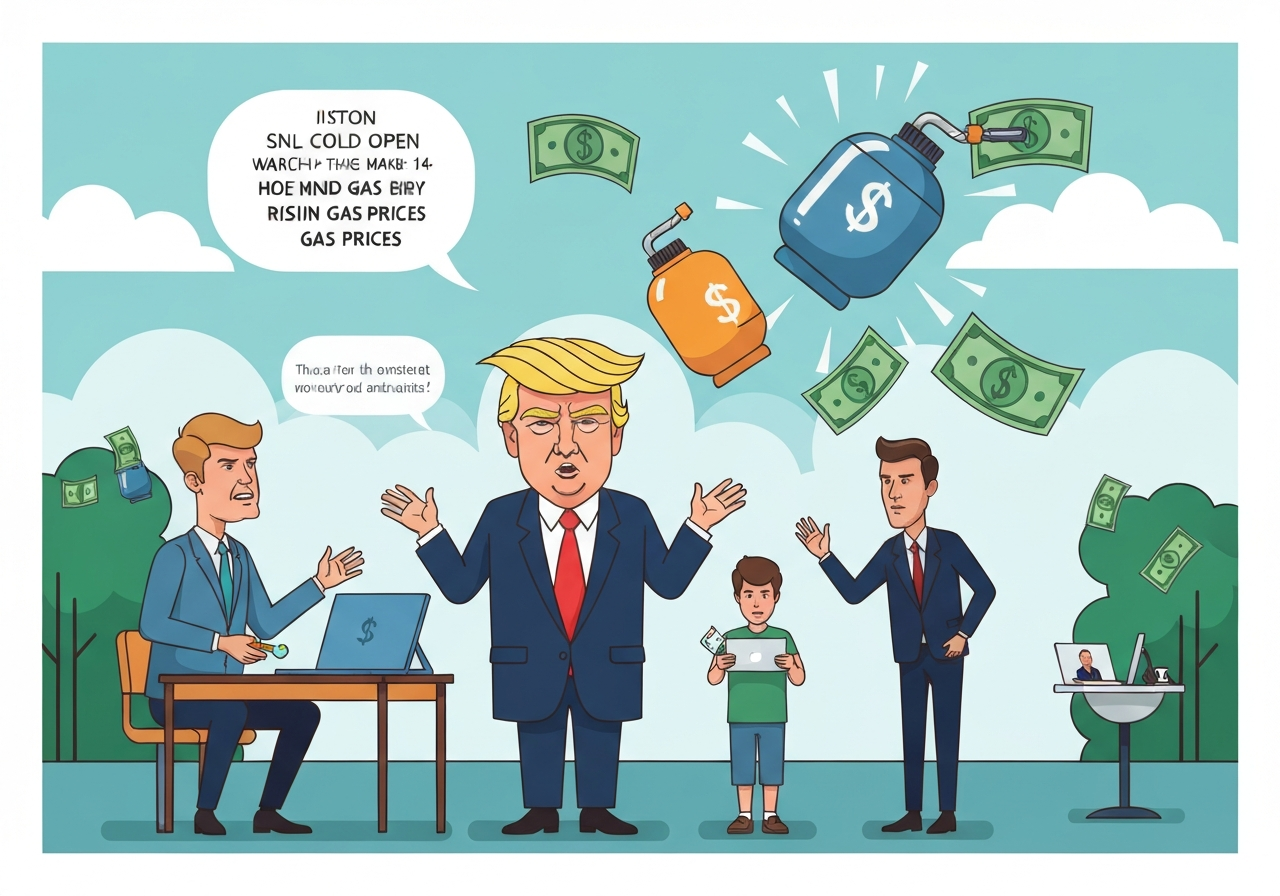
Saturday Night Live opened its March 14 episode by lampooning soaring U.S. gas prices and tying the issue to the ongoing conflict with Iran, centering a sketch on a family at the pump and James Austin Johnson’s impression of former President Donald Trump. Host Harry Styles, who also performed musically, appeared in the episode’s broader frame, while the cold open referenced recent remarks by Timothée Chalamet about ballet and opera. The sketch included Colin Jost in the role of Pete Hegseth and used blunt satire to link price pain at stations with political messaging about the Iran conflict. The sequence continued a streak: SNL has addressed the United States’ confrontation with Iran in multiple recent cold opens.
- Episode date: March 14, 2026—cold open targets gas prices amid U.S.-Iran tensions, with Harry Styles hosting and serving as musical guest.
- Principal performer: James Austin Johnson portrayed Donald Trump; the sketch foregrounded complaints about fuel costs and blamed the Iran conflict in satirical fashion.
- Supporting cast: Colin Jost appeared as a Pete Hegseth figure; a family of four at a gas station anchored the scene.
- Cultural jab: The cold open referenced Timothée Chalamet’s recent comments about ballet and opera, folding celebrity controversy into political satire.
- Pattern: This marks at least the third consecutive SNL cold open addressing the U.S.-Iran situation, including the Feb. 28 episode that aired alongside U.S. and Israeli strikes.
- Next episode: SNL returns April 4, 2026, with host Jack Black and musical guest Jack White, as previewed in the episode’s closing notes.
Background
Saturday Night Live has a long tradition of beginning episodes with a cold open that skewers the week’s biggest political and cultural stories. In early 2026, the program has repeatedly returned to the escalating U.S.-Iran confrontation, using comedy to process developments that dominated headlines. The Feb. 28 broadcast coincided with U.S. and Israeli military action, and the writers have since used the program to rehearse public anxieties, from foreign policy to domestic pocketbook issues like gasoline costs.
Comedy on SNL often blends current-events reporting with caricature: performers such as James Austin Johnson channel recognizable political figures while writers compress complex issues into brief, sharp scenes. Hosts who also serve as musical guests—Harry Styles in this case—can help bridge pop-culture moments and political satire, as the show folded celebrity commentary about the arts into its commentary on the economy. Against a backdrop of rising pump prices, the sketch used the family-at-the-pump conceit to make national policy feel local and immediate.
Main Event
The cold open staged a four-person family frozen at a gas station as escalating prices provoked disbelief and frustration. James Austin Johnson’s Trump-style character addressed the camera, delivering a mock explanation that connected the spike in fuel costs to the conflict with Iran, while leaning on the exaggerated certainties of a campaign persona. The sketch traded in hyperbole—the comedic device of overstating costs—to make the economic pinch tangible for viewers.
Writers folded in a pop-culture sidebar by referencing Timothée Chalamet’s recent remarks about ballet and opera, using the comparison to lampoon the conflation of cultural tastes and foreign-policy rhetoric. Colin Jost’s Hegseth figure arrived in a vehicle-staged bit of absurdity—beer cans spilling from the back seat—then offered a comic confession about not knowing the plan, a gag that tied back to public questions about clarity in policy-making. The scene mixed short, pointed lines with sight gags to keep the tone brisk and overtly satirical.
Throughout, the sketch steered clear of deep policy argument and instead targeted the rhetoric surrounding responsibility for price changes, suggesting that public-facing explanations sometimes simplify complicated economic and geopolitical interactions. The comedy emphasized political posture and messaging over technical analysis of supply chains or energy markets.
Analysis & Implications
SNL’s choice to connect gas prices with the Iran confrontation reflects how late-night satire functions as a public thermometer: it measures and shapes audience sentiment by spotlighting pain points that cross party lines. By couching the critique in a familiar character (the Trump impression) and a domestic scene (a family filling a tank), the writers translated geopolitical events into everyday terms that are more emotionally resonant than policy memos.
Satire like this can influence public conversation by framing which questions feel urgent—here, how foreign policy affects household budgets. That framing may push lawmakers and commentators to address economic explanations more directly, even if the sketch itself does not provide granular causal analysis. In electoral contexts, repeated satirical emphasis on pocketbook issues can shift media coverage toward consumer impact and accountability narratives.
At the same time, comedy’s compression of cause and effect risks oversimplifying. Fuel prices reflect a mix of global supply, refining capacity, logistics and policy; attributing increases solely to one international factor is rhetorical shorthand rather than full explanation. Viewers seeking deeper understanding will need to consult economic data and official statements to separate partisan one-liners from measurable drivers.
Comparison & Data
| Date | Cold-open focus | Notable elements |
|---|---|---|
| Feb. 28, 2026 | U.S. and Israeli strikes on Iran | Responded on same day as military actions; political-joke framing of presidential response |
| Early March, 2026 | Follow-up Iran-related sketches | Continued focus on conflict themes and national security rhetoric |
| March 14, 2026 | Rising gas prices tied to Iran conflict | Family-at-pump conceit; James Austin Johnson as Trump; Harry Styles host |
The table summarizes how SNL’s recent cold opens have threaded the Iran confrontation into multiple episodes, with March 14 shifting emphasis to economic effects at the consumer level. These sketches prioritize satirical resonance over statistical exposition; readers should consult energy-market reports for numerical explanations of price movements.
Reactions & Quotes
Cast and audience response was primarily contained to the episode’s broadcast and social-media aftermath, where viewers shared clips and commentary. The sketch prompted both amusement and criticism in online conversations, reflecting polarized readings of satire that targets politicians and foreign-policy decisions.
“If you’re wondering why I was in the back seat of this random family’s car, I’ll tell you the same thing I say when people ask about our plans for Iran: I don’t know.”
Colin Jost as Pete Hegseth (in the cold open)
Jost’s line was framed as an admission of uncertainty, playing on public expectations that officials provide clear strategies; the joke landed by highlighting perceived confusion. The sequence used that comic vulnerability to undercut confident rhetoric and invite viewers to laugh at institutional ambiguity.
“We will win this war because Iran is old and nobody likes them,”
James Austin Johnson as Donald Trump (parodic line in sketch)
That biting, exaggerated assertion functioned as satire of simplistic justifications for conflict, intentionally caricaturing hawkish rhetoric. Presenting such lines through impersonation signals the show’s intent: to critique tone and messaging rather than to document policy detail.
Unconfirmed
- The sketch’s repeated linkage of rising U.S. gas prices solely to the Iran conflict is satirical shorthand and does not establish a direct causal chain; a full causal analysis requires economic data and expert assessment.
- Any suggestion that the cold open materially changed public opinion or electoral behavior is unverified; measurable impact would require polling or audience-reaction studies.
- Attribution of writer intent beyond public jokes—such as claims about internal motivations or undisclosed coordination with external actors—remains unconfirmed.
Bottom Line
SNL’s March 14 cold open used familiar tools—impersonation, a domestic scenario and pop-culture reference—to make a pointed comment about how geopolitics can be refracted into everyday economic pain. The sketch continued a recent run of openings focused on the U.S.-Iran confrontation, but it emphasized the immediate, relatable effect of higher pump prices rather than offering policy analysis.
Viewers seeking a fuller picture should treat the sketch as cultural commentary rather than a source of factual explanation about fuel markets or foreign-policy causation. The program’s April 4 episode, with Jack Black hosting and Jack White as musical guest, will provide another opportunity to watch how SNL folds current events into satire in the coming weeks.
Sources
- USA Today (news)