
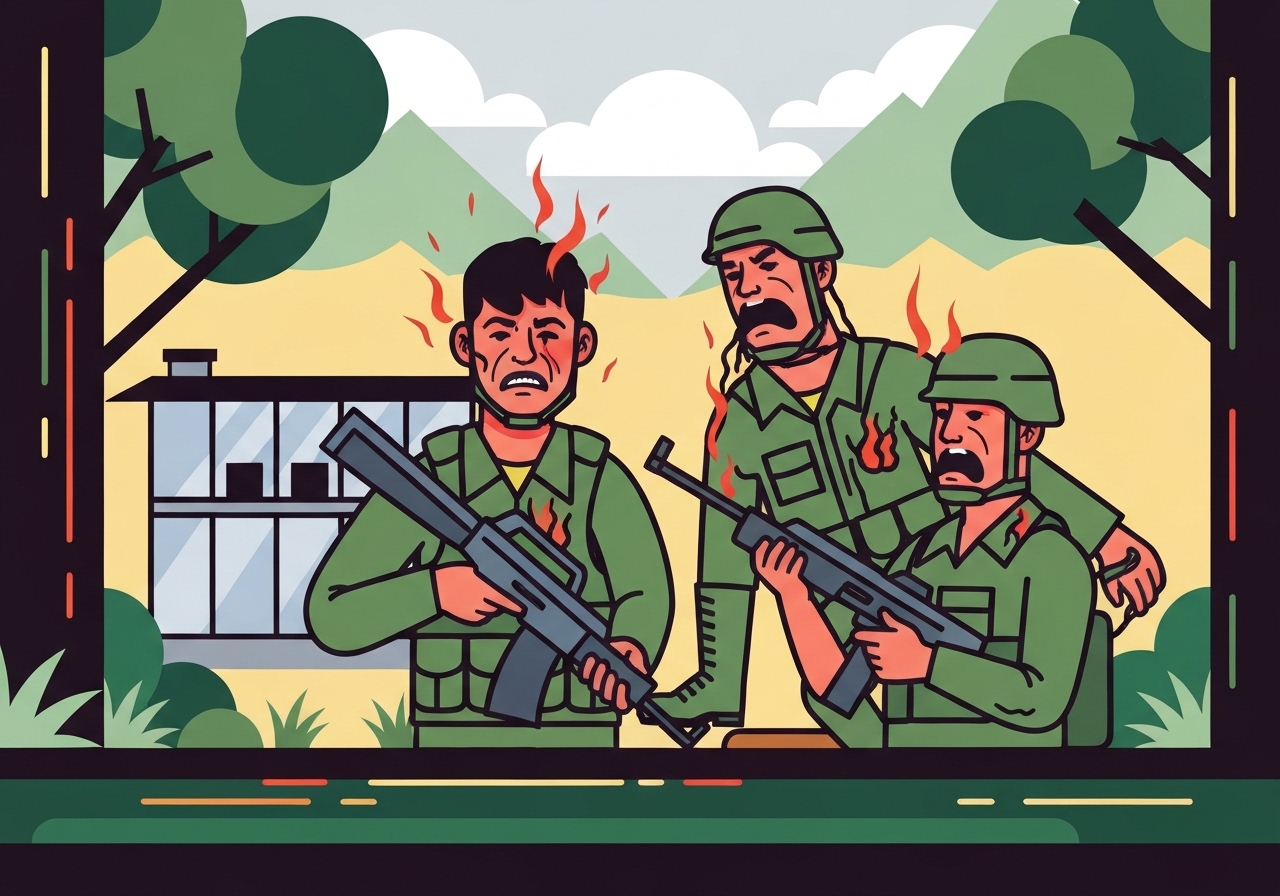
On Sept. 4, 2025, two Colombian service members were doused with gasoline and set on fire during an operation to destroy a cocaine laboratory in northern Putumayo; both sustained severe burns and were flown to hospital for treatment, the army said.
Key Takeaways
- The attack occurred during a mission to dismantle a cocaine-processing lab in Putumayo, near the Ecuador border.
- One officer and one soldier suffered serious burn injuries and are receiving hospital care.
- The army says civilians attacked the patrol with fire to stop the operation.
- Authorities accused the Comandos de Frontera (Border Command) dissident faction of orchestrating the assault.
- Defense Minister Pedro Sanchez labeled the perpetrators “criminals and narcos” and posted video of a wounded service member being evacuated.
- The incident comes amid rising violence linked to drug trafficking, illegal mining and extortion across Colombia.
- Prosecutors previously arrested Comandos de Frontera leader Andrés Rojas (alias Arana) in February; extradition is being sought.
Verified Facts
The Colombian army reported that troops were conducting a mission to destroy a cocaine laboratory in a rural part of northern Putumayo, a department that borders Ecuador, when a disturbance broke out and civilians attacked the uniformed personnel with fire. The military statement said the assault aimed to prevent the dismantling of the lab.
An officer and a soldier sustained severe burns and were evacuated by helicopter to receive medical care. The army did not release the names of the injured service members but confirmed both remained under hospital treatment following the Sept. 4, 2025 attack.
Officials attributed the attack to the Comandos de Frontera, a dissident group that rejected the 2016 FARC peace accord and operates along the Colombia–Ecuador frontier. Prosecutors arrested the group’s alleged leader, Andrés Rojas (known as Arana), in February 2025 during talks with government representatives; he faces charges tied to cocaine shipments to the United States and is subject to extradition requests.
Colombian and Ecuadoran authorities have linked the faction to other deadly incidents this year. Ecuador blamed the group for an operation in May 2025 that killed 11 soldiers. Colombian forces also reported a series of explosive attacks during mid-2025 operations: a bomb that wounded a military dog in July and an earlier device strapped to a donkey that killed one soldier and wounded two others.
Context & Impact
Violent resistance to state anti-drug and anti-mining operations has increased in remote, guerrilla-influenced areas of Colombia. Criminal networks profit from coca cultivation and trafficking, illegal mining and local extortion, contributing to what officials call the country’s worst security crisis in a decade.
The army’s accusation against Comandos de Frontera underscores the broader challenge of carrying out law-enforcement actions in areas where armed groups exert control or influence over civilian populations. Such confrontations risk escalating local tensions and endangering both security personnel and residents.
Possible near-term impacts include intensified military and judicial operations in Putumayo, renewed pressure on peace and negotiation tracks with dissident factions, and increased coordination with Ecuadoran authorities on cross-border security.
Operational implications
- Heightened force protection measures for future lab-destruction missions.
- Expanded intelligence and interagency actions to identify organizers and local coercion networks.
- Potential temporary suspension or adaptation of ground operations in the most contested zones.
“They are neither peasants nor communities claiming their rights. They are criminals and narcos who attempted to murder our soldiers,”
Unconfirmed
- Whether the civilians who carried out the attack acted of their own accord or under coercion from armed groups remains unclear.
- Definitive, independently verified attribution of the assault to Comandos de Frontera beyond the army’s accusation is pending investigation.
- The precise number of attackers and the sequence of events on the ground have not been publicly verified by independent observers.
Bottom Line
The Sept. 4 attack in Putumayo, which left two service members with severe burns, highlights the rising risks faced by Colombian forces tackling drug production sites in contested rural areas. Authorities have pledged action against the accused dissident group, and the incident is likely to lead to intensified security operations and judicial investigations as Bogotá seeks to protect personnel and disrupt criminal networks.