
Lead
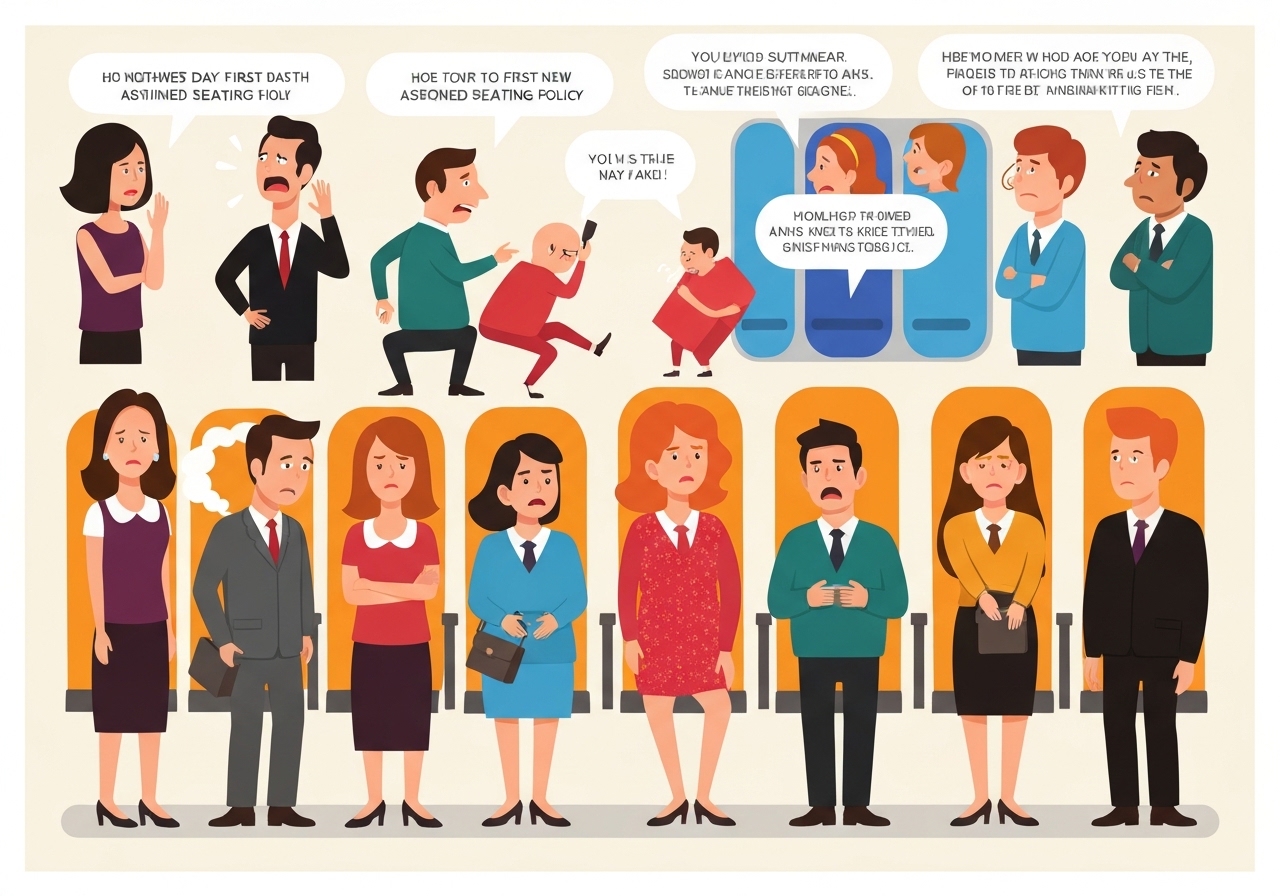
On Tuesday, Southwest Airlines ended more than a 50-year open-seating practice, rolling out assigned seats and new fare bundles across its network. The change—debuted amid celebratory scenes at Dallas Love Field and stressed gate operations at several airports—introduced eight numbered boarding groups plus priority options. Passengers and staff reported both immediate benefits, such as families sitting together, and frictions, including software glitches and slower boarding on crowded flights. The launch marks a major shift in Southwest’s brand identity and day-to-day operations.
Key Takeaways
- Southwest replaced open seating with assigned seats on Tuesday, ending a policy in place since the airline began in 1971.
- The airline implemented eight numbered boarding groups and preserved paid priority tiers for active-duty military and purchased early boarding.
- New fare bundles and seat categories—”Extra Legroom,” “Preferred,” and “Standard”—launched alongside assigned seating.
- Company research cited by CEO Robert E. Jordan found about 80% of existing customers and 86% of potential customers prefer assigned seats.
- Operational hiccups appeared: a gate-to-cabin software issue required roughly 20 minutes to reassign seats on one early flight.
- Passenger reactions were mixed: some praised family-friendly seating while other longtime customers expressed frustration and threatened to stop flying Southwest.
- Boarding times lengthened on busy flights, with one traveler noting a 45-minute boarding process on a packed return flight.
Background
Southwest Airlines launched its first flight from Dallas Love Field in 1971 and built a distinctive identity around open seating and rapid turnaround. That model fit well when routes were short and flights seldom full, letting the carrier advertise simplicity and speed. Over decades the airline expanded into longer routes and more connecting itineraries, increasing the operational stakes of unchecked seating assignments. Meanwhile, industry peers monetized cabins through seat-selection fees and tiered boarding, a trend Southwest resisted until recent years.
The company began signaling a shift in 2024, framing the change as a response to customer preference and competitive pressure. Executives argued assigned seating would reduce defections to rivals and unlock new ancillary revenue streams. Recent moves—bag fees, tightened change policies and ancillary charges—show a broader pivot toward the routing and revenue mix common among legacy carriers. That commercial context set the stage for Tuesday’s rollout, which was positioned internally as both a customer-service improvement and a business opportunity.
Main Event
At Dallas Love Field, off-duty flight attendants gathered near a gate in white skirts and sneakers, waving pompoms to mark the milestone. Cheerful gate agents broadcast boarding calls and encouraged passengers to wait for their numbered group, a visible ritual shift from the old A/B/C queue system. Elsewhere, at Reagan National’s Terminal 1, staff began operations at 5:30 a.m., starting with preboarding for customers with disabilities and small children, followed by a priority boarding group for active-duty military and paid early-board customers.
On an early Washington-to-Dallas morning flight, the assigned-seat rollout produced mixed outcomes. Some travelers welcomed automatic assignments, while others said preboarded passengers filled overhead bins at the front of the cabin, creating delays as later groups looked for space. One passenger reported being assigned seat 17A and then seeing adjacent rows fill up; flight attendants spent about 20 minutes troubleshooting a seat-assignment system glitch before redistributing passengers according to fare class.
On a crowded return flight, passengers described lengthy boarding—about 45 minutes—and typical in-flight discomforts such as crying children and limited overhead space. For customers who had paid for or held higher status, the new model ensured predictable seats; for others, the shift eliminated the late-night online scramble that once defined Southwest’s fan culture. The rollout thus delivered clarity for some and friction for others, depending on fare type, status and the state of on-the-day technology.
Analysis & Implications
Strategically, assigned seating gives Southwest a more direct way to segment the cabin and charge for premium location and legroom, aligning its ancillary revenue strategy with widespread industry practice. CEO Robert E. Jordan framed the change as a response to customer research and as a tool to reduce defections to competitors. If executed smoothly, the move can raise per-passenger revenue through branded fare bundles and predictable upsell paths.
Operationally, however, the transition increases complexity at gates and onboard systems. The early software hiccups illustrate how boarding systems, crew training and airport infrastructure must be tightly synchronized to avoid delays. On busy flights, the new process may lengthen boarding times as agents enforce assignments, potentially offsetting some customer-satisfaction gains if on-time performance suffers.
For customer loyalty, the risk is uneven. Longtime Southwest devotees who valued the airline’s quirky open-seating culture may feel alienated by a shift toward the industry norm and more monetized services. Conversely, customers who previously avoided Southwest because of open seating—families, long-haul travelers or those connecting to tight connections—may find the new certainty compelling. The near-term business outcome will depend on a balance of service reliability, perceived value of paid options, and communication clarity.
Comparison & Data
| Boarding Group | Typical Eligibility | Seat Categories |
|---|---|---|
| Preboarding | Disabilities, families with children under 2 | — |
| Priority | Active-duty military, paid early access | Preferred, Extra Legroom |
| Groups 1–8 | Based on fare tier and loyalty status | Standard, Preferred, Extra Legroom |
The table summarizes the new boarding and seat categories introduced on Tuesday. Compared with the old open-seating model, the assigned approach creates explicit product tiers that can be priced and marketed separately. This mirrors trends at other U.S. carriers that now sell seat location, legroom and priority boarding as discrete ancillaries.
Reactions & Quotes
Frontline staff and travelers offered contrasting takes on the launch. At Dallas Love Field, off-duty attendants celebrated the change as a relief from old crowding patterns, while some frequent flyers voiced frustration.
“Assigned seats! What a treat! Southwest spirit can’t be beat!”
Off-duty Southwest flight attendants, Dallas Love Field
One traveler described a chaotic boarding sequence caused by preboarded passengers filling overhead bins, then threatened to stop flying the airline; another said the new system finally allowed groups and families to sit together.
“When you’re flying cross-country, I don’t want to potluck my seat for a long flight.”
Mike Boyd, aviation consultant, Boyd Group International
Industry analysts framed the change as a predictable commercial evolution: airlines increasingly rely on diversified revenue streams, but long-term loyalty will hinge on reliability rather than product mix alone.
“The important thing is running the airline reliably—that’s what brings customers back.”
Robert Mann, president, R.W. Mann & Co.
Unconfirmed
- The extent to which early software glitches were systemic across the network is not yet confirmed and may be isolated to specific airports or flights.
- It is unclear whether the customer-preference figures cited internally fully reflect long-term sentiment after the implementation.
- Any immediate measurable impact on loyalty program churn or ticket refunds following the change has not been independently verified.
Bottom Line
Tuesday’s rollout of assigned seating is both symbolic and practical: it signals Southwest’s departure from a defining cultural practice and aligns the carrier more closely with industry norms for revenue generation. In the short term, passengers will experience trade-offs—greater predictability for some, longer boarding times or new fees for others.
The airline’s ability to minimize technical problems, communicate clearly about fares and maintain on-time performance will determine whether the change strengthens Southwest’s market position or alienates core customers. Observers should track boarding times, system error rates and loyalty metrics in the coming months to judge the long-term success of the shift.