
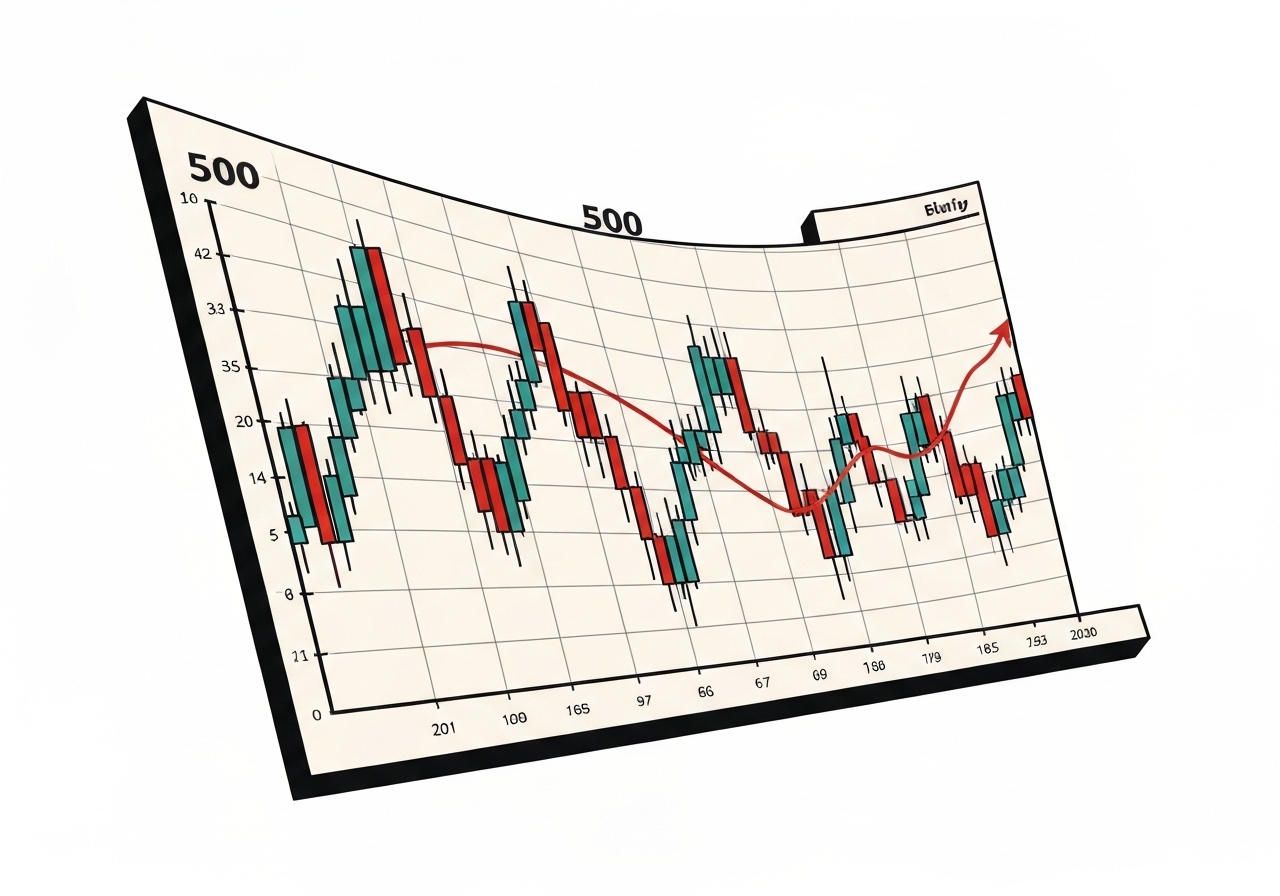
On January 15, 2026, U.S. equity benchmarks traded unevenly as President Donald Trump’s comments about a potential Federal Reserve succession roiled markets. The S&P 500 ticked up about 0.2% intraday but remained set for a small weekly loss, while the Dow held near flat and the Nasdaq rose roughly 0.2%. Traders reacted after Trump said he would prefer to keep National Economic Council Director Kevin Hassett in his current role and did not explicitly name him as the favored candidate to replace Fed Chair Jerome Powell, whose term ends in May. At the same time, gains in chip stocks led by Taiwan Semiconductor helped pare losses across the market.
Key Takeaways
- The S&P 500 rose roughly 0.2% on Friday, but was on track for a 0.2% decline for the week.
- The Dow Jones Industrial Average traded near unchanged on the session and was headed for a 0.1% weekly drop; the Nasdaq gained about 0.2% intraday and sat down 0.4% for the week.
- President Trump said he would rather keep Kevin Hassett in his National Economic Council role, and prediction markets on Kalshi pushed former Fed governor Kevin Warsh ahead in odds for Fed chair.
- Chip stocks outperformed after Taiwan Semiconductor reported strong Q4 results; a U.S.–Taiwan deal pledged at least $250 billion of Taiwanese investment in U.S. production capacity.
- Banking names lagged the week despite solid earnings, with JPMorgan Chase down more than 4% and Bank of America more than 5% week to date amid talk of a cap on credit-card rates.
- Market breadth was weak: FactSet data showed about 1,590 NYSE-listed issues declining versus roughly 850 advancing on the session.
Background
The Federal Reserve chairmanship is set to become a focal point as Jerome Powell’s four-year term expires in May 2026. Markets have been parsing potential successors on the assumption that different candidates could meaningfully change policy direction; Kevin Hassett has been viewed by many investors as a candidate likely to sustain easier financial conditions, while Kevin Warsh is perceived as relatively more hawkish. Any signal that shifts odds between those profiles tends to move rate-sensitive assets, financials and the dollar.
At the same time, broader headlines have amplified investor caution this week. Washington developments — from debates about Fed independence to tariff talk tied to Greenland and geopolitical tensions involving Iran — have created a volatile information backdrop. Separately, a strategic U.S.–Taiwan understanding on semiconductor investment has created a positive counterweight for technology and chip-equipment stocks, underscoring the industrial-policy forces reshaping supply chains.
Main Event
Equity markets opened modestly higher but fell to session lows after President Trump spoke from the White House on Friday morning. Trump singled out Kevin Hassett in the audience and said he would “rather keep you where you are,” a comment markets read as cooling Hassett’s prospects for Fed chair. Prediction markets reacted quickly: contracts on Kalshi shifted in favor of Kevin Warsh as the frontrunner.
Despite the policy chatter, sector moves were uneven. Taiwan Semiconductor led gains after reporting a stronger-than-expected fourth quarter, and related chip names including Broadcom and AMD helped lift the Nasdaq. The U.S.–Taiwan pact, which includes at least $250 billion in Taiwanese investment into American production capacity, was cited by traders as a bullish structural headline for semiconductors.
Financials underperformed on the week. Major banks delivered solid quarterly results overall, but risk around a proposed cap on credit-card interest rates and uncertainty over future Fed policy weighed on bank shares. JPMorgan Chase and Bank of America were among the biggest weekly decliners in the sector, each falling multiple percentage points through the week.
Analysis & Implications
Market pricing for short- and medium-term interest rates is sensitive to the perceived leanings of a prospective Fed chair. A candidate seen as more dovish would generally lower the likelihood of faster rate hikes and support equities and rate-sensitive growth stocks; a candidate perceived as hawkish would push yields higher and pressure growth names. The swift move in prediction markets toward Kevin Warsh indicates investors are re-evaluating the path of policy tightening and the volatility that could accompany that reassessment.
If Warsh or a similarly hawkish successor gains traction, banks and other financial firms could face a mixed outcome: higher rates can expand net-interest-margin prospects over time, but abrupt shifts in rate expectations can compress credit spreads and spark trading losses or deposit re-pricing stress. Conversely, chip and industrial names may benefit from the large-scale capital spending signaled by the U.S.–Taiwan investment pledge, which supports cyclical demand regardless of near-term headline-driven volatility.
Geopolitical remarks — including the president’s comment that he might impose tariffs on countries that “don’t go along with Greenland” — add another layer of risk. Trade-policy unpredictability can raise input-cost uncertainty for multinationals and complicate supply-chain planning even as onshore investment commitments aim to boost domestic capacity. Investors will watch successive political signals closely to reassess sector-level exposure and duration risk across portfolios.
Comparison & Data
| Index | Intraday Move (Jan 15) | Weekly Change |
|---|---|---|
| S&P 500 | +0.2% | -0.2% |
| Dow Jones Industrial Average | ~0.0% | -0.1% |
| Nasdaq Composite | +0.2% | -0.4% |
The table summarizes index performance for the session and the week. While daily moves were small, the weekly picture shows modest declines led by the Nasdaq, reflecting heavier selling in smaller-cap names and financials across the five-day span. Weak breadth on the NYSE reinforces that headline-driven trading was concentrated rather than broad-based participation.
Reactions & Quotes
Market participants and analysts offered immediate takes after the White House remarks, emphasizing how leadership signals can translate quickly into market odds and positioning changes.
“I actually want to keep you where you are, if you want to know the truth.”
President Donald Trump, White House remarks
Traders interpreted that line as a meaningful indication that Hassett was less likely to be nominated, prompting a reprice in prediction markets and a shift in risk appetite among rate-sensitive assets.
“COP’s breakeven is materially higher than peers and long-cycle projects are a headwind to cash returns.”
Kalei Akamine, Bank of America analyst (note)
Akamine’s comment (on ConocoPhillips) illustrated how company-specific fundamentals continued to drive stock moves even as macro headlines dominated headlines; investors are separating cyclical earnings dynamics from policy and geopolitical noise.
Unconfirmed
- Whether President Trump has made a final decision on the Fed nomination remains unconfirmed; his Friday remarks stopped short of an explicit announcement.
- The exact breakdown, timeline and sector allocation of the pledged $250 billion in Taiwanese investment in U.S. capacity await formal release and verification from participating firms.
- It is unclear if or when any tariffs linked to Greenland would be formally proposed or enacted; the president’s comment represents intent rather than a binding policy move.
Bottom Line
The market reaction on January 15 shows how political signals — even informal ones from the White House — can promptly alter expectations for monetary policy and reshape risk pricing. Small intraday index moves masked important shifts in odds around the Fed succession and uneven sector leadership, with semiconductors buoyed by corporate spending announcements and financials pressured by policy uncertainty.
Investors should treat the latest moves as a reason to recheck rate-sensitive exposures and portfolio concentration in cyclical versus defensive sectors. With Jerome Powell’s term ending in May, the nomination process and subsequent confirmation timeline will be primary drivers of volatility; traders and longer-term investors alike will need to monitor both official announcements and market-based signals for indications of the likely policy path.