
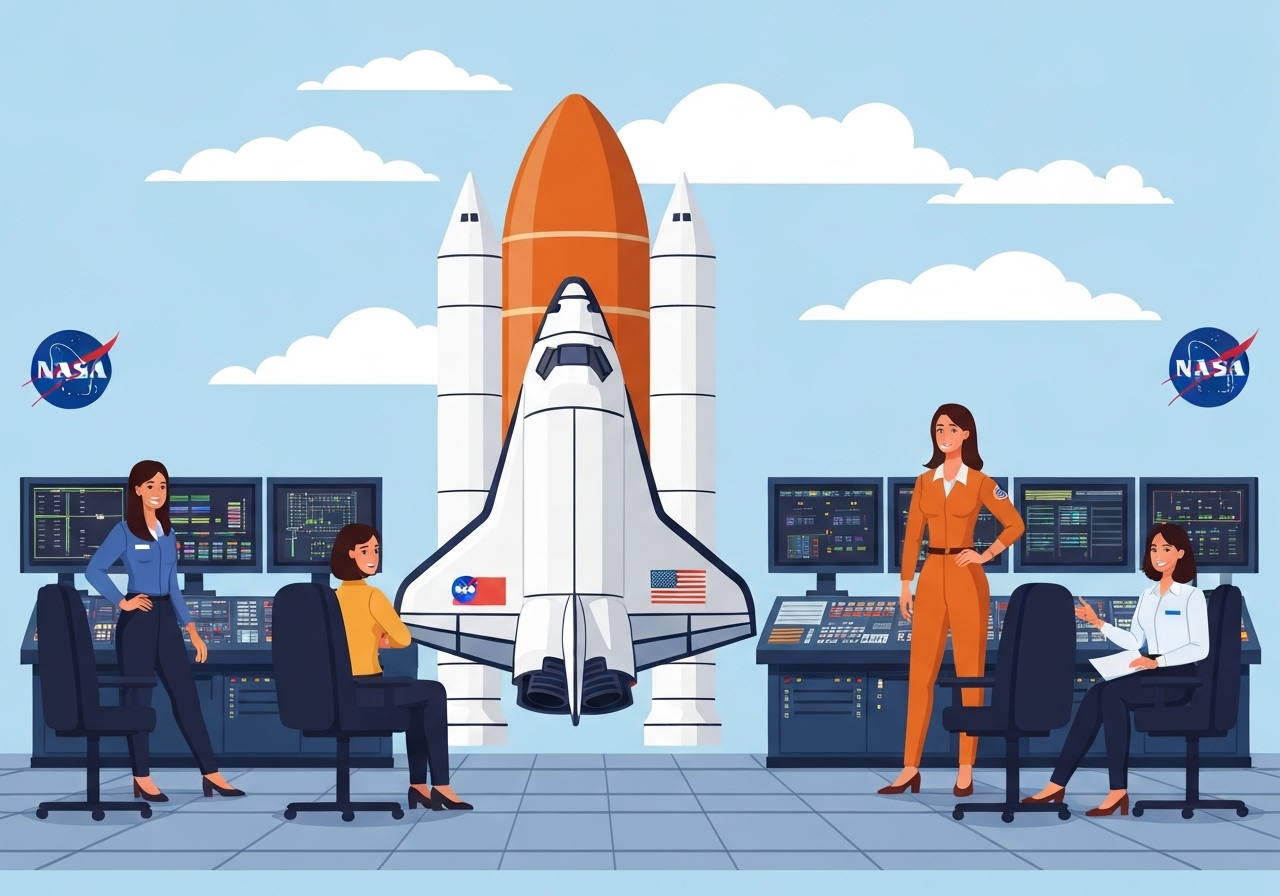
In 1978 NASA selected 35 new astronaut candidates — including six women — and the Space Shuttle era that followed (notably Sally Ride’s flight on 18 June 1983, STS-7) forced the agency to confront equipment gaps, cultural biases and recruitment practices that had limited women’s roles in human spaceflight.
Key takeaways
- In 1978 NASA’s astronaut class included 35 recruits; six were women who expanded the agency’s talent pool.
- Sally Ride flew on STS-7 (18 June 1983), becoming a highly visible symbol of change.
- Practical issues — from flight garments to hygiene supplies — required redesign for mixed crews.
- The Shuttle shifted selection toward mission specialists (scientists, engineers, physicians), not only pilots.
- Outreach efforts, including collaboration with Nichelle Nichols, broadened applicant diversity.
- Early female astronauts often faced scepticism and had to prove competence repeatedly.
- By the 1990s and 2000s female crewmembers set records and moved into leadership roles.
Verified facts
NASA opened a new era of astronaut selection in 1978, recruiting 35 candidates that included 20 mission specialists and 15 pilots; six of the mission specialists were women (Sally Ride, Judy Resnik, Anna Fisher, Kathryn Sullivan, Shannon Lucid and Rhea Seddon). The Shuttle’s reusable design required a broader set of skills on each flight and created roles that matched scientists and engineers as well as aviators.
On 18 June 1983, Space Shuttle Challenger launched STS-7 with Sally Ride aboard; she was the first American woman in space. Worldwide, Valentina Tereshkova had flown in 1963 as the first woman in space, and Soviet cosmonaut Svetlana Savitskaya became the second woman in space in 1982.
Equipment originally designed for all-male crews needed modification: personal kits, flight garments and absorbency garments were adapted for different body sizes and biological needs. NASA developed individual disposable absorption and collection garments after recognizing differences in fit and comfort between existing designs and female crew requirements.
Recruitment and outreach changed as well. NASA enlisted public figures such as Nichelle Nichols to encourage women and people of colour to apply. The agency also faced internal scrutiny over equal-opportunity practices; officials and managers were pushed to expand hiring and to rethink selection criteria.
Context & impact
The Shuttle programme shifted the culture of astronaut selection by valuing mission specialists — scientists, physicians and engineers — alongside pilots. That change opened doors to applicants from civilian scientific backgrounds and changed the expectations of what an astronaut could be.
Public visibility mattered: Ride’s flight and the media attention it drew challenged stereotypes about who belonged in space. Over subsequent decades, women accumulated experience, took on more demanding tasks (including spacewalks and long-duration missions) and moved into prominent roles within NASA.
Resistance and casual sexism surfaced publicly and privately — from jokes and intrusive questions to assumptions about priorities and capabilities. Some male colleagues later acknowledged early scepticism and, in many cases, revised their views after working alongside women on missions.
By the 1990s and 2000s women recorded notable achievements — Shannon Lucid logged multiple Shuttle flights and held the record for the most time in space by a woman (1996–2007), and subsequent generations have continued to diversify crews and leadership at NASA.
“A whole kit devoted to make-up suggested to me that someone thought we might be less mission-focused than our male counterparts.”
Kathryn Sullivan (astronaut)
Official statements
“NASA had made the commitment to accepting women into the programme… even if you looked in mission control, there were women. The first female flight director wasn’t until 1984.”
Anna Fisher (astronaut)
Unconfirmed
- The internal deliberations and precise motives behind every early equipment decision are not fully documented in public records.
- Some anecdotes reported in memoirs and interviews (for example, specific backstage recruitment conversations) rely on personal memory and are not corroborated by contemporaneous documents.
Bottom line
The Space Shuttle programme materially changed NASA’s workforce by creating roles that matched scientific and engineering expertise, prompting equipment redesign and spurring outreach that widened the applicant pool. The six women in the 1978 class — and those who followed — repeatedly proved competence in flight and operations, helping to dismantle institutional assumptions about who could be an astronaut.
While cultural and logistical gaps persisted, these early Shuttle-era changes set a foundation for more diverse crews and leadership within NASA in the decades that followed.