
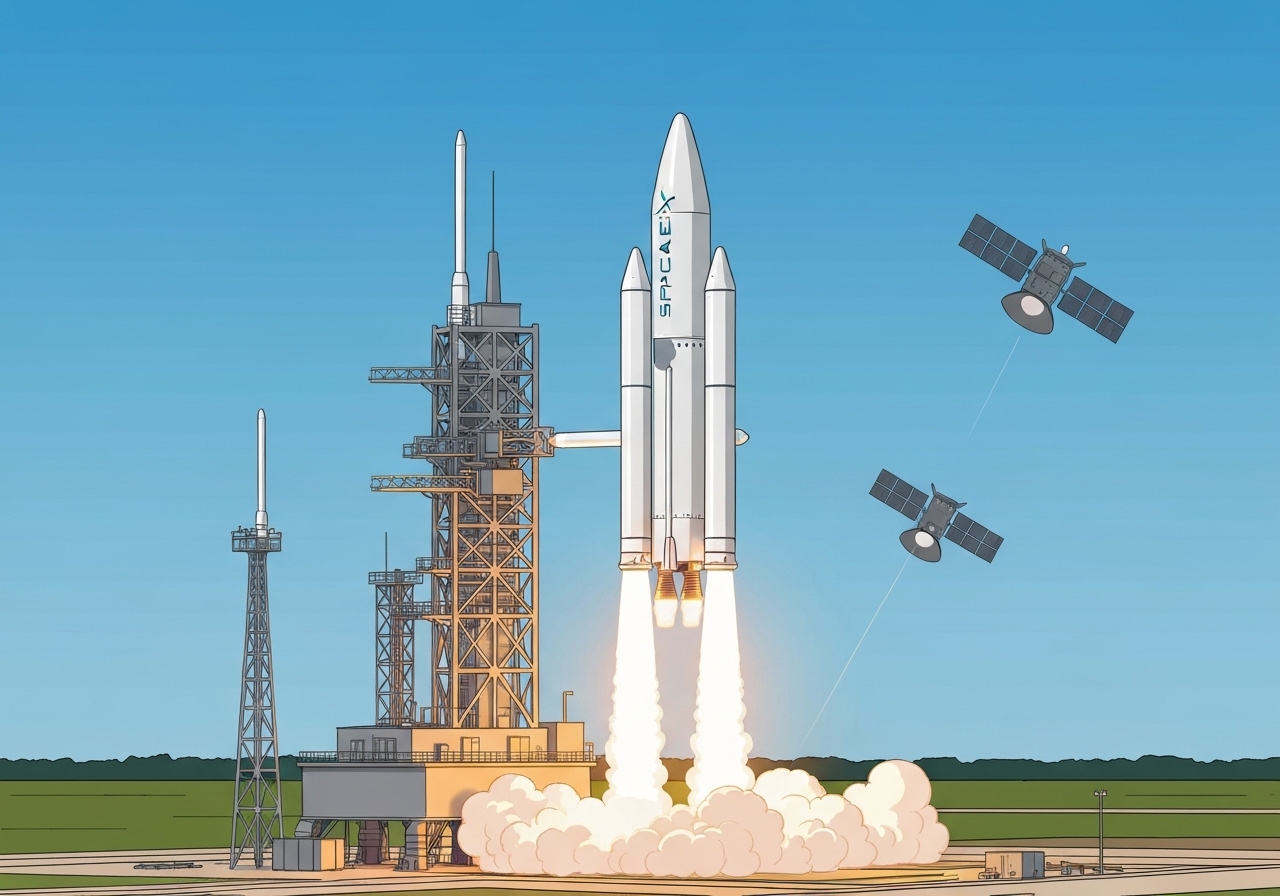
SpaceX postponed a planned Starlink liftoff on Dec. 7 after weather concerns, pushing the mission to no earlier than Dec. 8 from Kennedy Space Center’s Launch Complex 39A. The flight — Starlink 6-92 — will use booster B1067, set to make its record 32nd flight, and is expected to deliver SpaceX’s 3,000th Starlink satellite of 2025 to low Earth orbit. Meteorologists gave a roughly 50 percent chance of favorable conditions near the start of the window and a lower probability later in the evening; a stronger recovery of weather to 75 percent is forecast for the backup day on Dec. 8. Live coverage was planned to begin about an hour before liftoff, with a planned southeast trajectory off Florida’s Space Coast.
- Launch scrubbed Dec. 7 at 6:32 p.m. EST (2332 UTC); next earliest attempt set for Dec. 8 at 4:14 p.m. EST (2114 UTC).
- Mission Starlink 6-92 will carry the 3,000th Starlink satellite launched in 2025 to low Earth orbit.
- Falcon 9 booster B1067 is scheduled for its 32nd flight, the most by any Falcon booster to date.
- Weather odds: ~50% favorable near the opening of the window (~4:40 p.m. EST / 2140 UTC), dropping to ~30% near the end (~8:40 p.m. EST / 0140 UTC Dec. 8).
- Backup opportunity on Monday, Dec. 8 shows improved overall weather odds near 75%, though liftoff winds and recovery conditions could remain problematic.
- SpaceX’s operational target is certifying Falcon boosters for up to 40 flights; actual lifetime will depend on mission profiles and occasional expendable use.
Background
SpaceX has pursued reusability as a central cost-saving and cadence-enabling strategy since the first successful Falcon 9 booster recovery. The company’s certification goal of roughly 40 flights per first-stage booster reflects that strategy, with incremental steps demonstrated by boosters like B1067 as they accumulate missions. B1067’s approaching 32nd flight is a public milestone in that push; the booster’s actual longevity will still depend on wear patterns, mission loads and whether it is chosen for recovery or expended on any particular mission.
Starlink, SpaceX’s broadband-satellite constellation, has flown hundreds of satellites per year during recent high-cadence periods; the 3,000th Starlink satellite referenced for 2025 reflects an aggressive deployment tempo. Launch Complex 39A at NASA’s Kennedy Space Center has been a frequent Falcon 9 departure point for both Starlink and commercial/government payloads, and it remains central to SpaceX’s East Coast launch operations. Weather patterns over Central Florida, including seasonal cold fronts and near-coastal low-pressure systems, often dictate day-to-day launch feasibility and recovery planning for booster return to downrange droneships or land-based sites.
Main Event
On Dec. 7 SpaceX scrubbed the planned Starlink 6-92 launch late in the day due to unfavorable weather forecasts, delaying the attempt to the next available window. The company had prepared booster B1067 at Launch Complex 39A; the booster had been processed for another reuse, and teams were ready for a standard prelaunch sequence before the scrub. The mission’s stated objective is routine: deliver a batch of Starlink satellites to low Earth orbit, including what the company and observers have identified as the program’s 3,000th satellite for the calendar year.
Meteorologists with the 45th Weather Squadron cited an active synoptic pattern pushing a cold front and associated rain and thunderstorms across Central Florida, reducing the probability of a safe launch on the original day. Forecast guidance indicated the best chance would be near the opening of the scheduled window rather than later in the evening, when showers and onshore winds were expected to increase. If the teams shift to the backup opportunity on Dec. 8, conditions were predicted to improve overall but could present tougher winds at liftoff and more marginal conditions for booster recovery operations.
The planned trajectory for the Falcon 9 was southeast from the Space Coast, a standard corridor for many Starlink missions that balances orbital insertion needs with range safety and recovery geometry. Recovery considerations remain relevant: higher winds or storm-affected seas can force SpaceX to defer a launch even when ascent weather is acceptable, because the booster must return safely to a droneship or landing zone. SpaceX typically provides live updates and commentary in the hour or so before launch, and those feeds were scheduled to resume with coverage around an hour before the planned Dec. 8 attempt.
Analysis & Implications
B1067 reaching a 32nd flight would be another step toward SpaceX’s stated objective of routinely flying boosters many dozens of times. Each additional reuse provides engineers with more data about wear, refurbishment needs and failure modes, which lowers marginal mission cost if reliability remains high. The certification target near 40 flights is not a hard cap; it reflects an operational aim shaped by testing, inspection results and programmatic trade-offs between refurbishment expense and flight risk. If boosters reliably approach or exceed that range, launch costs could decline further and cadence could increase, benefiting both Starlink deployments and broader commercial/government markets.
However, more frequent reuse also raises maintenance and logistical demands: spare booster inventory, inspection throughput and dock/transport capacity must keep pace. Recovery weather constraints demonstrated here underscore a structural limit — even with reusable hardware, atmospheric conditions and range safety remain gating factors. For Starlink specifically, reaching the 3,000-satellite mark in a year is a notable production and launch-ops achievement, but it also continues to stir debate about orbital traffic management and long-term constellation sustainability.
Regulatory and international implications follow as well: higher launch rates and larger constellations attract more scrutiny from orbital debris monitors, spectrum managers and national regulators. SpaceX must balance commercial deployment speed with coordination on deorbiting plans, frequency assignments and collision-avoidance data sharing. For customers and investors, the operational success of high-reuse boosters like B1067 is a tangible signal of the company’s ability to compress costs and expand service capacity, but it does not eliminate external constraints such as weather, range availability and regulatory approvals.
| Metric | Value |
|---|---|
| Booster B1067 flights (scheduled) | 32 |
| SpaceX booster certification target | ~40 flights |
| Starlink satellites launched in 2025 (milestone) | 3,000th satellite |
| Weather odds (start of window) | ~50% |
| Weather odds (end of window) | ~30% |
| Backup-day favorable odds | ~75% |
The table above compiles the principal numeric facts cited by mission planners and meteorologists: booster flight counts, certification aims and the probabilistic weather outlook that determined the scrub and the timing of the next attempt. These figures underline that, while hardware reuse is progressing, environmental and operational variables continue to shape launch schedules.
Reactions & Quotes
“On Sunday, the synoptic pattern remains sloppy as a cold front moves into Central Florida… the latest high-resolution guidance shows the best weather opportunity to occur at the beginning of the window.”
45th Weather Squadron (official forecast)
The weather squadron’s advisory framed the scrub decision and the expectation that any successful attempt would most likely occur early in the scheduled range.
“This is the 30th flight for the Falcon 9 booster supporting today’s Starlink mission, now launching the most missions of the Falcon fleet.”
SpaceX (social media, Aug. 28, 2025)
SpaceX’s earlier social post tracked the booster’s flight tally at a previous milestone; followers have used such posts to mark B1067’s ascent to the most‑flown status as it approaches its 32nd scheduled flight.
Unconfirmed
- Whether B1067 will ultimately reach or exceed 40 total flights — certification aims are public, but final lifetime will depend on engineering assessments and mission needs.
- Exact number designation for the 3,000th satellite on orbit: while this flight is tied to the 3,000th satellite rollout, final numbering and in-orbit commissioning details are handled post-deployment.
- Precise recovery plan for this booster in the event of a Dec. 8 launch attempt — choice of droneship vs. land landing may depend on last-minute trajectory and sea-state assessments.
Bottom Line
The scrubbed Dec. 7 attempt highlights a simple operational truth: even as SpaceX makes strides in hardware reuse and launch cadence, meteorology and range conditions remain decisive. B1067’s near-term 32nd flight is a notable milestone toward the company’s broader reuse goals, and the mission’s payload marking the 3,000th Starlink of 2025 underscores the scale of SpaceX’s deployment effort this year. If flown successfully, the mission would reinforce the commercial and technical case for high-frequency reuse, but it will not eliminate external constraints like weather and recovery logistics that can throttle launch tempo.
Observers should watch two things in the coming days: the condition of B1067 after its flight, which will inform reuse confidence, and how operational planners manage recovery and range safety as launches pile up. Regulators, satellite operators and debris-monitoring services will also be monitoring the trend in annual launch counts and constellation sizes, given the broader implications for orbital traffic management.
Sources
- Spaceflight Now (news report) — primary event coverage and timeline.
- SpaceX (company social media) — booster milestone posts and mission notices.
- 45th Weather Squadron (official military weather unit) — launch weather forecasts and guidance.
- NASA Kennedy Space Center (official) — launch complex context and site background.