
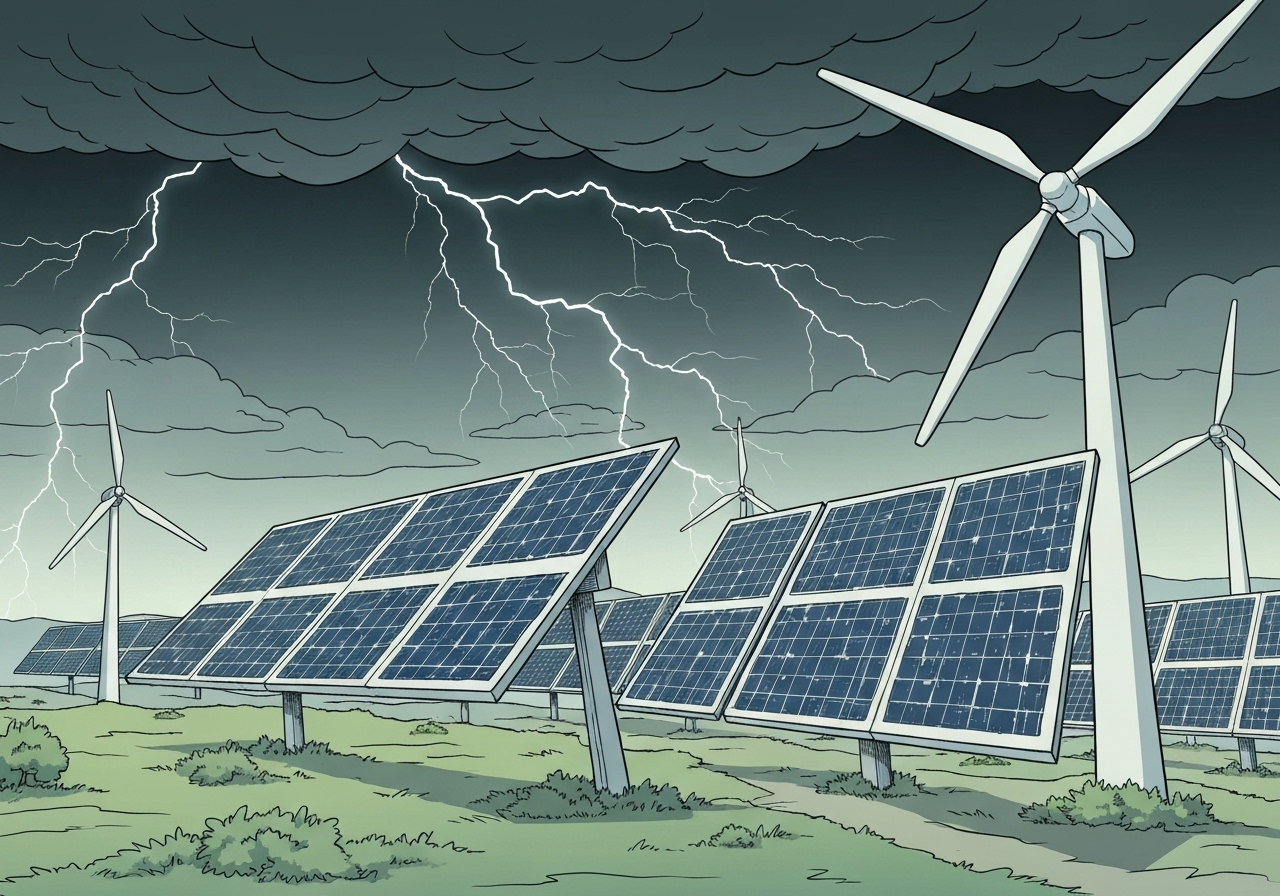
Lead: Spain’s rapid shift toward wind and solar has become a focal point of debate after a nationwide blackout on 28 April left homes, offices, transport and schools in Spain and Portugal without power for several hours. The outage prompted questions about grid resilience even as Spain attracts a €4bn battery-factory investment to Figueruelas in Aragón, a region powered heavily by wind and sun. The government and grid operator say investigations are ongoing and deny renewables were to blame, while political opponents and the nuclear sector urge a reassessment of the energy mix. The episode has sharpened discussion about storage, cross-border connections and the role of nuclear in a low-carbon system.
Key Takeaways
- Spain sourced 57% of its electricity from renewables last year, up from about one third in 2017, with a government target of 81% by 2030.
- A week before the 28 April blackout, solar supplied a record 61.5% of mainland Spain’s electricity mix, a fact used by critics to question the national energy model.
- The blackout on 28 April affected homes, government buildings and transport across Spain and neighbouring Portugal; Red Eléctrica cites anomalous voltage oscillations and an “unknown event” as factors under investigation.
- Chinese producer CATL and Stellantis plan a combined €4bn investment in a battery plant near Figueruelas in Aragón, a region with abundant wind and solar resources.
- Nuclear currently provides roughly 20% of Spain’s electricity; the government plans to close five plants between 2027 and 2035, a policy opposed by industry groups and some opposition parties.
- Since April there has been a measurable shift to greater reliance on natural gas in Spain’s generation mix while the system review continues.
- Grid isolation on the Iberian Peninsula and limited utility-scale storage are cited by grid operators as constraints to handling very high renewable shares.
Background
Spain’s electricity system has undergone a rapid transformation over the last decade, with large-scale deployment of wind and solar across regions such as Aragón. The government has pursued an ambitious decarbonisation timetable: renewables supplied around one third of electricity in 2017 and rose to 57% last year, with an 81% target for 2030. That shift reflects national policy, EU climate goals and private investment in clean power and manufacturing tied to the energy transition.
Figueruelas in north-eastern Aragón has become emblematic of that transition: wide plains host both wind and solar farms and now the site of a major battery-factory project backed by overseas investors. The presence of intermittent sources has provoked renewed attention to grid planning, storage capacity and international interconnections, especially after an unusually large share of solar generation preceded the late-April outage.
Spain’s grid operators and policymakers also face structural constraints. The Iberian Peninsula is less tightly connected to neighbouring continental networks than many EU countries, limiting cross-border balancing. Long-term decisions about nuclear plant lifespans, gas-fired backup capacity and investment in batteries and other storage technologies will determine how reliably the country can sustain high shares of variable renewables.
Main Event
On 28 April a widespread blackout left millions without power across Spain and parts of Portugal for several hours. Red Eléctrica, the national transmission operator, reported anomalous voltage oscillations following an “unknown event” on the system and said investigations were under way to identify the root cause. Authorities have repeatedly said there is no evidence of a cyberattack.
The timing of a national political debate came quickly. Opponents seized on the fact that solar had recently reached a record 61.5% of mainland generation to argue that reliance on renewables may have compromised stability. Alberto Núñez Feijóo, leader of the conservative opposition, accused the government of ideological rigidity for prioritising renewables over conventional sources.
The government and Red Eléctrica have both pushed back, saying past operation under even higher renewable shares had not threatened system security. Concha Sánchez, head of operations at Red Eléctrica, told officials and media that the blackout resulted from a combination of issues rather than the overall share of renewables at that moment.
In parallel, the battery plant project near Figueruelas moved from announcement to ground-breaking, with a reported combined investment of €4bn from China’s CATL and Stellantis of the Netherlands. Yao Jing, China’s ambassador to Spain, described the project as one of Europe’s largest Chinese investments, and local officials say the site was chosen for its access to renewable electricity and proximity to automotive supply chains.
Political fallout has followed. Spain’s Socialist-led coalition, already weakened by corruption scandals and a thinning parliamentary majority, faces the prospect of a snap election that could bring a more conservative government inclined to boost conventional generation. Voices across the spectrum — from industry to far-right parties — have called for reconsideration of nuclear and other baseload options.
Analysis & Implications
The blackout has crystallised a set of trade-offs that energy planners have long debated: accelerating renewables lowers carbon emissions but raises the need for flexible resources that can run when sun and wind do not. Storage, demand response, interconnectors and flexible gas or nuclear output are the principal ways to manage those gaps. Spain’s current storage capacity is small relative to the scale of variable generation already installed.
If the public and political reaction leads to a policy shift — for example, extending nuclear plant lifetimes or easing approvals for new gas capacity — the immediate effect would likely be a higher near-term emissions footprint compared with a pure-renewables pathway. However, proponents argue some combination of zero-carbon baseload (nuclear) plus renewables could lower emissions while improving reliability.
Investor confidence is an important variable. The CATL–Stellantis battery investment signals substantial private capital attracted by Spain’s renewables and industrial policy, but uncertainty over energy policy or sudden reversals could raise perceived risks. Firms that back manufacturing tied to clean power typically expect stable long-term rules on generation, grid access and storage incentives.
Finally, the Iberian grid’s relative isolation limits how much surplus or deficit it can export or import during stress events. Strengthening interconnections with France and the wider European system could reduce the need for domestic backup capacity, but such projects take years and significant political coordination to deliver.
Comparison & Data
| Metric | Value |
|---|---|
| Renewable share (2017) | ~33% |
| Renewable share (last year) | 57% |
| Solar peak share (week before 28 Apr) | 61.5% (mainland peak) |
| Government target (2030) | 81% of electricity |
| Nuclear contribution (current) | ~20% |
The table highlights the speed of Spain’s transition: renewables nearly doubled their share of generation between 2017 and last year. The government target of 81% by 2030 implies continued rapid build-out of wind, solar and storage. Nuclear’s current roughly 20% share is targeted for decline under present policy, which has raised industry objections and requests to extend plant lifetimes, notably a petition for Almaraz to operate until 2030.
Reactions & Quotes
The incident prompted immediate public statements and industry responses. Below are representative quotes with brief context.
“We have operated the system with higher renewable rates [previously] with no effect on the security of the system.”
Concha Sánchez, Head of Operations, Red Eléctrica
Red Eléctrica emphasised that high renewable penetration alone does not explain the blackout and underlined that detailed technical reports are still pending.
“One of the biggest Chinese investments Europe has ever seen.”
Yao Jing, Chinese ambassador to Spain
The ambassador’s remark accompanied the ground-breaking for the CATL–Stellantis battery factory, framed as major industrial validation of Spain’s renewable resources and supply-chain potential.
“It’s prudent to have a mix of renewables and nuclear energy.”
Ignacio Araluce, President, Foro Nuclear
Foro Nuclear and other industry groups argue that nuclear can provide low-carbon, 24/7 output to stabilise an increasingly renewable-dominant system, and some plant owners have requested life extensions for selected reactors.
Unconfirmed
- The precise technical root cause of the 28 April blackout has not been publicly released; official reports are awaited.
- Any direct causal link between the high share of renewables and the blackout has not been established by investigators.
- The timing, scale and political consequences of any change to Spain’s energy policy following potential snap elections remain speculative.
Bottom Line
The 28 April blackout has not definitively undermined Spain’s renewable strategy, but it has exposed gaps in public confidence, storage deployment and cross-border integration. Spain retains a strong renewable base and has attracted major manufacturing investment linked to clean electricity, yet the episode underscores that policy, technical upgrades and transparent investigation are necessary to sustain the transition.
Decisions over nuclear lifetimes, accelerated storage roll-out, and reinforcement of interconnectors will determine whether Spain pursues a renewables-dominant path with enhanced flexibility, or shifts to a mixed approach that retains more conventional capacity. Investors and voters will closely watch the forthcoming technical reports and any political shifts that follow.
Sources
- BBC News (news report)
- Red Eléctrica de España (REE) (official transmission operator)
- Foro Nuclear (industry association)