
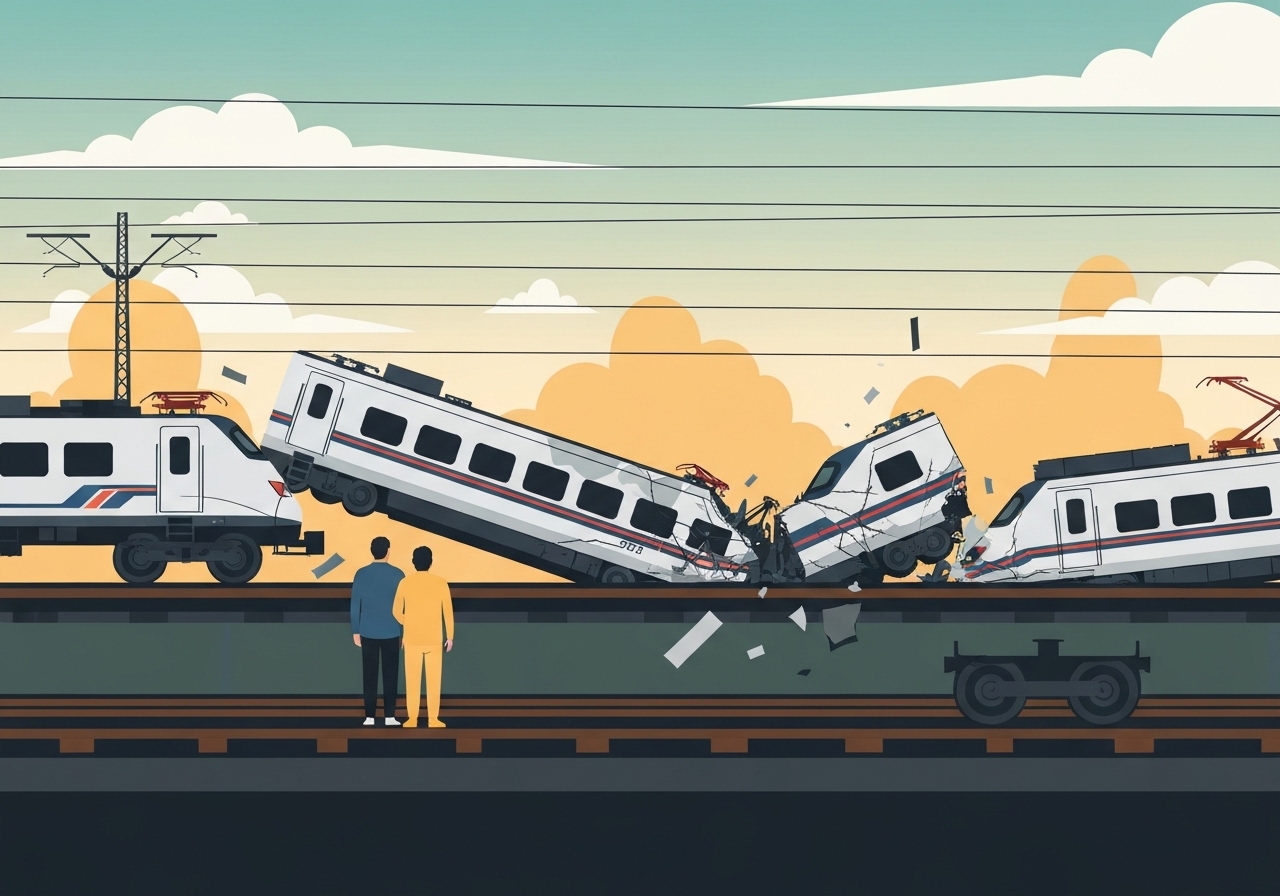
In the late evening of Sunday, Jan. 18, a high-speed train derailed near Adamuz, in southern Spain, and its trailing cars struck an oncoming high-speed service, killing at least 21 people and injuring at least 73, officials said. The collision occurred at about 7:45 p.m. local time on the main high-speed line linking southern Andalucía with Madrid. Regional emergency services reported 24 of the injured were in serious condition, and authorities warned the death toll could rise as rescue work continued into the night. Transport Minister Óscar Puente described the incident as baffling, saying the derailment happened on a straight section of recently renovated track.
Key Takeaways
- Fatalities and injuries: At least 21 people killed and at least 73 injured, with 24 in serious condition according to regional emergency services.
- Time and place: The crash occurred at about 7:45 p.m. on Jan. 18 near Adamuz, about 40 km northeast of Córdoba, on the high-speed corridor to Madrid.
- Train operators and passengers: The first train, operated by Iryo, had roughly 300 passengers; the second train was a Renfe service whose exact passenger count has not been released.
- Sequence: The rear cars of the first train derailed and spilled onto the opposite track, where they were struck by an oncoming high-speed train, derailing its front two cars.
- Infrastructure note: Officials said the track section had been recently renovated and that the first train was only a few years old, making the cause unclear.
- Service disruption: Adif announced suspensions of Madrid to southern Andalucía routes including Córdoba, Seville, Málaga and Huelva on the following day.
- Historical context: This is Spain’s deadliest train accident since the 2013 Santiago de Compostela derailment, which killed 79 people.
Background
Spain operates the second largest high-speed rail network in the world by length, trailing only China, and relies heavily on fast intercity links to connect regional capitals with Madrid. The main southern corridor that runs through Adamuz is a critical artery for passenger traffic between Andalucía and the capital. Private operators such as Iryo have begun to run services alongside the state operator Renfe in recent years after liberalization, increasing the number of high-speed services on shared infrastructure.
Safety on Spain’s high-speed lines has been a major public concern since the 2013 Santiago de Compostela accident, which prompted regulatory reviews and infrastructure changes. The 2013 crash occurred on a curve outside Santiago de Compostela and resulted in extensive scrutiny of driver protocols and signaling systems. Since then, authorities have overseen upgrades and maintenance programs, but incidents remain rare and politically sensitive when they occur.
Main Event
According to officials, the first train, an Iryo service bound for Madrid from Málaga, derailed first; its rear cars left the track and intruded onto the adjacent northbound track. At about 7:45 p.m., a Renfe high-speed train traveling from Madrid toward Huelva was passing on that track when it struck the derailed cars, causing the front two cars of the Renfe service to derail as well. Rescue teams, including regional emergency services and local health authorities, established an advanced medical post at the crash site to triage and treat the injured.
Authorities reported that crews were searching through wreckage into the early hours of Monday, and that heavy equipment would be needed to remove the derailed cars and clear the line. Transport Minister Óscar Puente said the first train was only a few years old and reiterated that the incident happened on a straightaway, calling the sequence of events extremely strange. Local officials in Córdoba issued an urgent request for medical personnel to assist at the scene as hospitals received the injured.
Rail traffic along the Madrid–southern Andalucía corridor was suspended on Monday by Adif as investigators and recovery teams worked on site, and Puente cautioned that closures could extend beyond Monday. Puente also noted that if the second train had not been on that track, the initial derailment might not have produced fatalities, underscoring the role of the collision in the high death toll.
Analysis & Implications
The immediate priority is establishing cause, but investigators face a perplexing scenario: a derailment on a straight, recently renovated section of track involving a relatively new trainset. If track failure, a technical malfunction on the Iryo set, or an external factor such as obstructions are excluded, investigators will turn to signaling, maintenance records and human factors. Each potential cause carries different regulatory and legal consequences, from infrastructure audit demands to scrutiny of operator procedures.
The collision will likely intensify political and public scrutiny of Spain’s rail oversight and the interaction between state and private operators on shared infrastructure. Since the liberalization of high-speed passenger services, policymakers have balanced increased competition with the need for coordinated maintenance and traffic management. Any findings of systemic shortcomings could prompt policy changes, temporary speed restrictions, or tighter inspection regimes.
For the operators, immediate consequences include service disruptions, reputational damage and potential civil liability for victims and families. Iryo and Renfe will face parallel demands: assisting victims, accounting for maintenance and operational records, and cooperating with judicial and technical inquiries. Insurers and legal teams will be engaged quickly, and compensation frameworks used after past rail accidents will likely inform early responses.
Comparison & Data
| Year | Location | Fatalities | Reported Injuries |
|---|---|---|---|
| 2026 | Adamuz, Córdoba | 21 | 73 |
| 2013 | Santiago de Compostela | 79 | Dozens |
This table places the Adamuz crash in recent historical context, showing that while deadly, it is smaller in scale than the 2013 Santiago de Compostela disaster. Spain’s high-speed network continues to carry millions of passengers annually, and serious accidents remain infrequent; nevertheless, each event prompts renewed examination of maintenance records, driver training and signaling integration across mixed-operator lines.
Reactions & Quotes
National leaders and regional officials expressed condolences and pledged full investigations, emphasizing support for victims and their families as rescue efforts continued.
Tonight is a night of deep pain for our country, and the entire nation stands with the victims and their families.
Prime Minister Pedro Sánchez
Transport authorities underscored uncertainty about how a modern train and renovated track produced a derailment on a straight section, and investigators said they were consulting multiple technical experts.
The accident is extremely strange; it happened on a straightaway and all the experts we have consulted are extremely baffled.
Transport Minister Óscar Puente
Operator statements highlighted immediate assistance to passengers and cooperation with investigators, while local officials appealed for medical reinforcements as hospitals managed incoming casualties.
Iryo can confirm about 300 passengers were on board its service; we are focusing on supporting those affected and cooperating with authorities.
Iryo, operator statement
Unconfirmed
- The precise technical cause of the initial derailment has not been established and remains under investigation.
- Renfe has not released a final passenger count for its northbound train, so the total number of people exposed at the time is uncertain.
- Reports about any third-party obstruction or external object on the track are unverified at this stage.
Bottom Line
The Adamuz collision is a stark reminder that even mature high-speed networks are vulnerable to rare but catastrophic failures, and that collisions amplify the human toll of an initial derailment. With a relatively new trainset and recently renovated track implicated, investigators will face pressure to identify whether this was an isolated mechanical failure, a lapse in maintenance, an operational error or an unexpected external factor.
In the near term, expect prolonged service disruptions on the Madrid to southern Andalucía corridor, expedited technical inspections across similar track segments, and intensive public and political attention as Spain seeks answers and accountability. The outcome of the inquiry will shape regulatory responses, operator practices and compensation for victims in the months ahead.
Sources
- The New York Times live coverage — media report and compilation of official statements
- Adif — official rail infrastructure administrator
- Renfe — state rail operator, official site
- Iryo — private high-speed operator, official site
- Spanish Ministry of Transport — government ministry for transport and mobility