
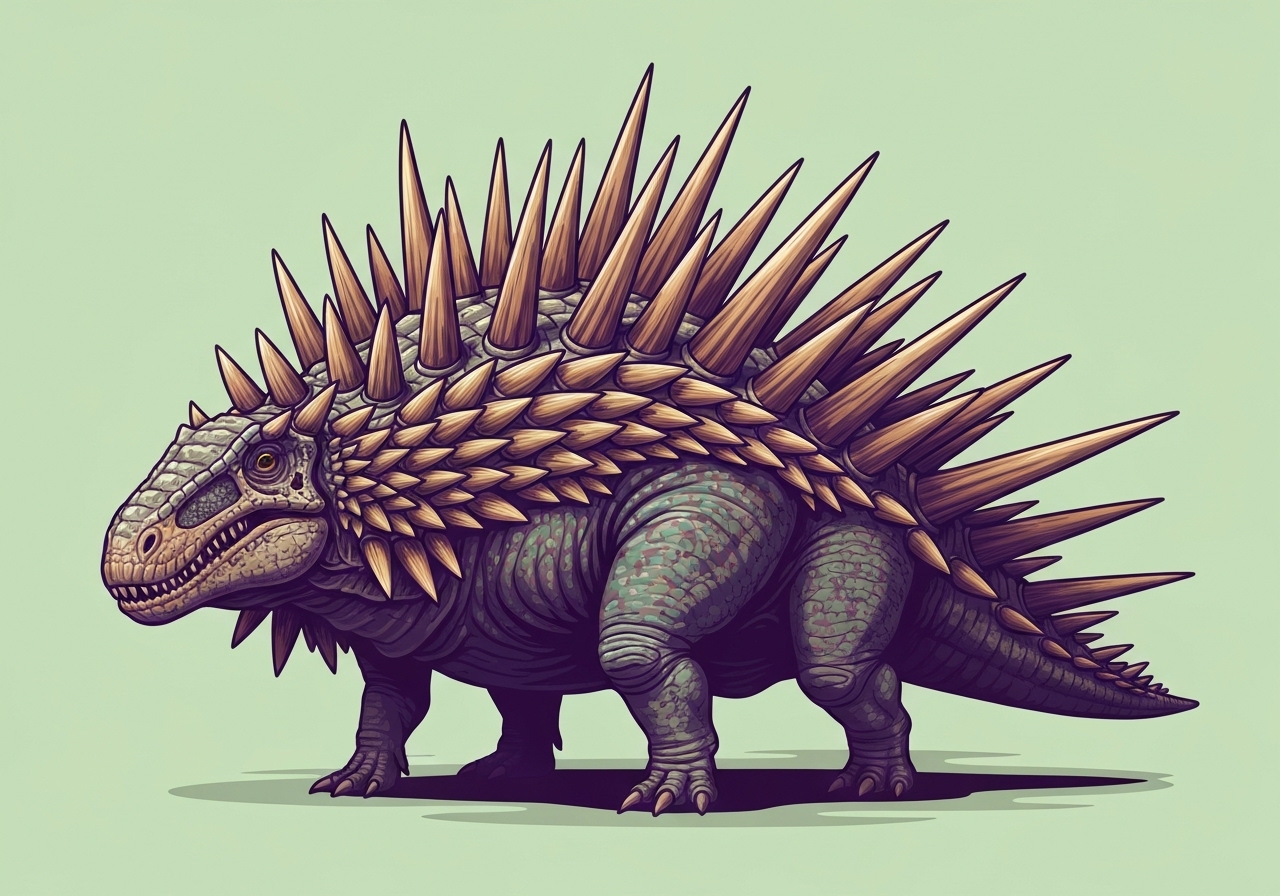
Researchers report that Spicomellus, a four-legged herbivore that lived in what is now Boulemane, Morocco more than 165 million years ago, carried elaborate spiked armor—metre-scale neck spikes, fused spiny ribs and an early tail ‘‘handle’’ likely linked to a club—features described in a Nature paper published in August 2025 that revise when and how ankylosaur armor evolved.
Key takeaways
- Spicomellus lived in present-day Morocco more than 165 million years ago and was roughly the size of a small car.
- New fossils show metre-long neck spikes, blade-like spikes over the hips and paired spike elements along the shoulders.
- Some ribs were fused to outward-projecting spikes—a unique condition not previously seen in any vertebrate.
- Fused vertebrae in the tail formed a rigid ‘‘handle,’’ suggesting a club-like weapon evolved earlier than once thought.
- Researchers propose the complex armor served both defensive and display functions, potentially for mate attraction or rival deterrence.
- Initial Spicomellus material was reported in 2021 from a single rib; the new specimens make its anatomy far better understood.
Verified facts
Spicomellus was first noted in 2021 from an unusual rib bone found near Boulemane. The recent study, published in Nature in August 2025, is based on additional remains that reveal a far more elaborate arrangement of osteoderms and spikes than the original single-bone report indicated.
The animal was a quadrupedal herbivore about the size of a small car. Its back and neck carried a range of bony elements: long, upward-pointing spikes over the hips, long neck spikes around one metre (about three feet) in length, paired blade-like spikes and plates over the shoulders.
Most strikingly, several ribs show fusion with long outward-projecting spikes. Authors note this rib-spike fusion has not been documented previously in any living or extinct vertebrate, making Spicomellus anatomically unique.
Vertebrae fused into a stiff section extending into the tail create what the authors call a ‘‘handle.’’ This morphology is consistent with an early form of a tail club, a feature previously believed to have evolved in ankylosaurs during the later Cretaceous period.
Researchers interpret the complex ornamentation as serving more than pure defense. The arrangement and variety of spikes suggest a role in visual display—either to attract mates or to intimidate rivals—while also providing protection against predators or competitors.
Context & impact
The find pushes back the emergence of some ankylosaur-like tail adaptations by tens of millions of years and indicates that experiments in armour design were underway in the Jurassic, not just the Cretaceous.
Because Spicomellus comes from Africa, the discovery highlights the importance of poorly sampled regions for filling gaps in early dinosaur evolution. It adds evidence that distinctive ankylosaur traits evolved in multiple forms across different continents.
Practical implications include revised timelines for the evolution of defensive and display structures in thyreophoran dinosaurs and encouragement for renewed fieldwork in North Africa to recover further specimens.
Official statements
We have never seen anything like this in any animal before.
Susannah Maidment, co-lead author, Natural History Museum, London
It was spine-tingling — we couldn’t believe how unlike any other dinosaur it looked.
Richard Butler, co-lead author, University of Birmingham
Unconfirmed
- The precise behavioral role of the spikes (sexual display versus strictly defensive use) cannot be proven from bones alone.
- Skin covering, coloration and soft-tissue structures associated with the spikes remain unknown.
Bottom line
Spicomellus presents a striking example of early experimentation with armour and weaponry in dinosaurs, combining unique rib fusion and large display spikes with a primitive tail handle long before such features were expected. The discovery changes timelines in ankylosaur evolution and underscores the scientific value of Moroccan fossil sites.