
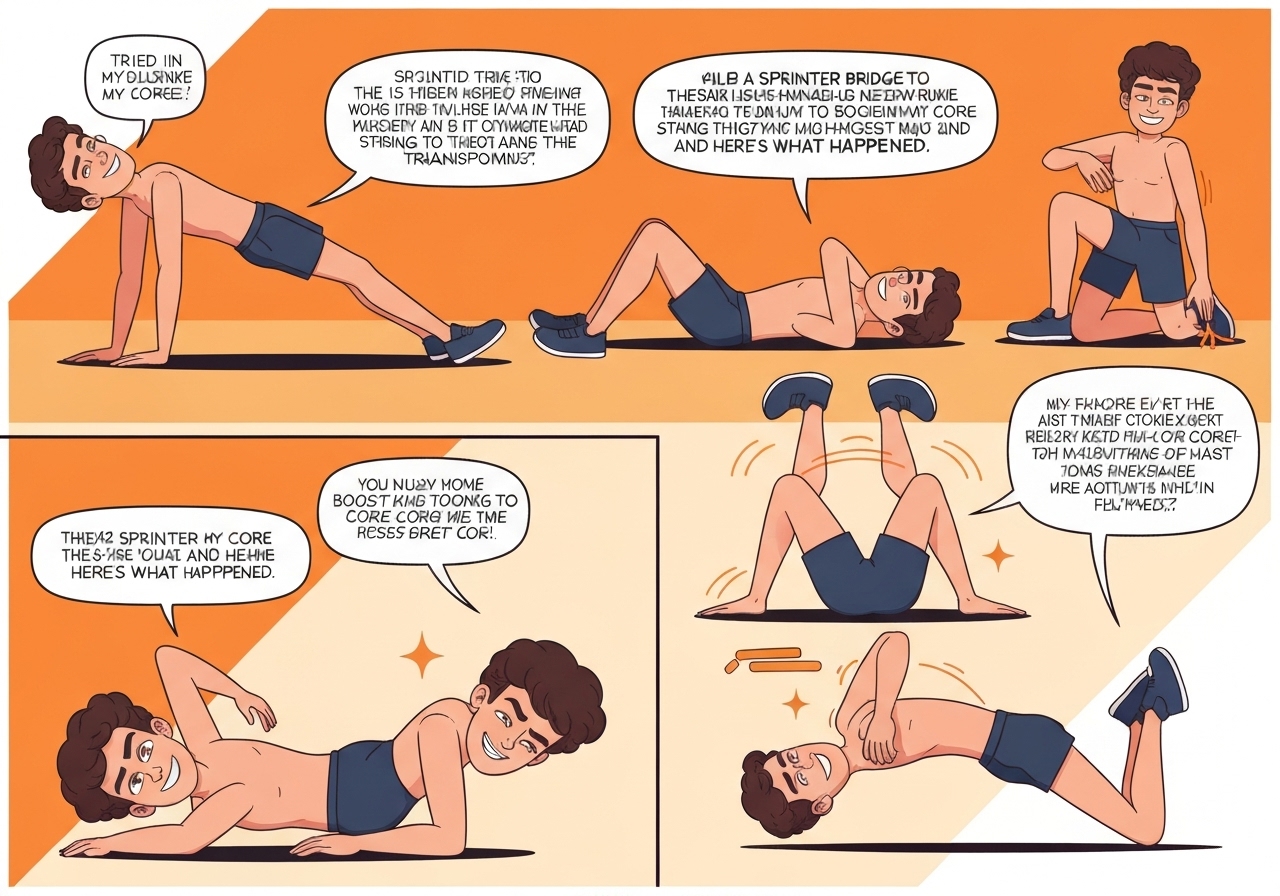
Tom’s Guide fitness writer Nick Harris-Fry recently tested the sprinter bridge after seeing the move flagged on social media by personal trainer Kyle Knapp. He performed the exercise on the floor and progressed to an exercise-ball variation to compare stability demands and muscle engagement. The experiment aimed to assess whether the sprinter bridge could offer a practical, time-efficient alternative to traditional core moves like sit-ups and planks. The author found the drill challenging, useful for unilateral strength testing, and an effective way to recruit glutes, hamstrings and deeper core muscles.
Key takeaways
- The sprinter bridge primarily targets the glutes, hamstrings and deep core muscles; it also challenges balance and hip extension mechanics.
- Done on the floor, the move is accessible to most exercisers; placing shoulders or feet on an elevated surface increases intensity.
- Using an exercise ball markedly increases instability, requiring greater core control and proprioceptive effort.
- The exercise highlights left-right strength differences because each repetition emphasizes one limb at a time.
- Shifting feet farther from the body increases hamstring demand, while a standard setup emphasizes glute activation.
- Trainer Kyle Knapp recommends starting with leg-only lifts on the ball before progressing to the opposite-arm, opposite-leg sprinter pattern.
- Author Nick Harris-Fry — a seasoned runner with a 2:25 marathon PB and 15:30 5K PB — found the move complementary to running-specific strength work.
Background
Core training routines often fall into repetitive patterns: sit-ups, planks and leg raises dominate many programs. That repetition can sap motivation and limit functional transfer to activities that require dynamic, unilateral control — such as running or single-leg sports. Trainers and physiotherapists increasingly promote variations that incorporate instability or unilateral loading to engage stabilizers and reveal imbalances.
The sprinter bridge is one such variation. It combines a hip-thrust/bridge position with alternating opposite-arm, opposite-leg lifts to mimic a sprinter’s posture while demanding pelvic stability. Social media has amplified interest in ball-assisted and elevated versions, and some coaches suggest these drills for runners because they load each leg independently and challenge the posterior chain.
Main event
To perform the basic sprinter bridge, start supine with knees bent and feet flat. Drive the hips upward so the torso, pelvis and thighs form a straight line, then raise the right leg and the left arm simultaneously to simulate a sprinter’s extension. Hold briefly, lower slowly, and repeat on the opposite side. That unilateral pattern forces the working side to produce hip extension while the contralateral side resists rotation.
Progressions include elevating the shoulders on a stable bench or placing the feet on a raised surface; both change the hip angle and increase load. The most advanced variant tested was with the upper back on an exercise ball: shoulders and upper thorax balanced on the ball while alternating limbs. The ball creates movement at the contact point, so tiny corrections from the deep core and hip stabilizers are required to keep the bridge position.
During testing, the author noticed an immediate difference in perceived effort between floor and ball versions. The floor version felt primarily like a strength test for the glute on the working side; the ball version added a persistent demand for fine control, particularly in the transverse plane. Repeating sets of 8–12 reps per side revealed subtle left-right asymmetry that can be addressed in subsequent training.
Analysis & implications
Biomechanically, the sprinter bridge combines hip extension strength with anti-rotation and anti-flexion elements. When one leg is elevated, the working gluteus maximus and hamstrings produce extension torque while the contralateral core and hip abductors stabilize the pelvis. That combination trains force transfer through the posterior chain in a way that traditional sit-ups do not.
For runners and athletes, unilateral hip-extension drills are particularly relevant. Running relies on single-leg support phases; strengthening side-specific extension and improving pelvic control can improve stride efficiency and reduce compensatory patterns that contribute to overuse injuries. The sprinter bridge’s capacity to display asymmetry makes it a useful screening tool in a practical training session.
From a programming standpoint, the move is adaptable: novices can start on the floor with shorter holds and fewer repetitions, progressing to elevated contacts and finally to an exercise ball for advanced stability challenge. However, it should complement — not replace — a balanced program that includes anti-extension planks, loaded hip thrusts and mobility work to maintain tissue resilience and movement variety.
Comparison & data
| Exercise | Primary targets | Stability demand | Use case |
|---|---|---|---|
| Sit-up | Rectus abdominis | Low | Basic anterior core; limited functional transfer |
| Plank | Anterior core, anti-extension | Moderate | Isometric core endurance, spinal support |
| Sprinter bridge (floor) | Glutes, hamstrings, deep core | Moderate | Unilateral strength, imbalance screening |
| Sprinter bridge (ball) | Glutes, hamstrings, deep core, stabilizers | High | Advanced stability and proprioception |
The table highlights how the sprinter bridge differs from traditional core staples: it shifts emphasis from anterior trunk muscles to posterior chain and unilateral stability. That shift explains why runners and athletes often find it more directly transferable to their sport-specific needs.
Reactions & quotes
“On the ball, the drill amplifies small stabilizing demands and forces the deep core to work harder than the floor version.”
Kyle Knapp, personal trainer
Knapp’s recommendation is consistent with exercise-science principles that link instability devices to increased neuromuscular control — though not always to greater strength gains in isolation. Practitioners often use instability for motor control and proprioception, then pair it with heavier, stable lifts for maximal strength.
“The exercise immediately exposed a subtle imbalance between my left and right sides, which I could target in follow-up sessions.”
Nick Harris-Fry, Tom’s Guide
The author used those observations to adjust subsequent sets and to include single-leg strength work in later training days.
Unconfirmed
- Long-term superiority of the sprinter bridge over traditional core routines for injury prevention remains unproven in large trials.
- Claims about the move dramatically improving running times or eliminating injuries lack direct clinical evidence.
- Exact magnitude of increased muscle activation on the exercise ball versus the floor varies by individual and has not been quantified here.
Bottom line
The sprinter bridge is a practical, adaptable exercise that shifts emphasis from anterior-core endurance to posterior-chain strength and unilateral stability. On the floor it offers a manageable way to test and strengthen one side at a time; on an exercise ball it becomes a high-skill drill demanding increased proprioception and deep-core control.
For runners and anyone wanting functional core improvements, the sprinter bridge is worth adding as part of a balanced program that includes mobility, loaded strength work and anti-extension exercises. Begin on the floor, monitor side-to-side differences, and only progress to unstable or heavily loaded versions once technique is consistent and pain-free.