
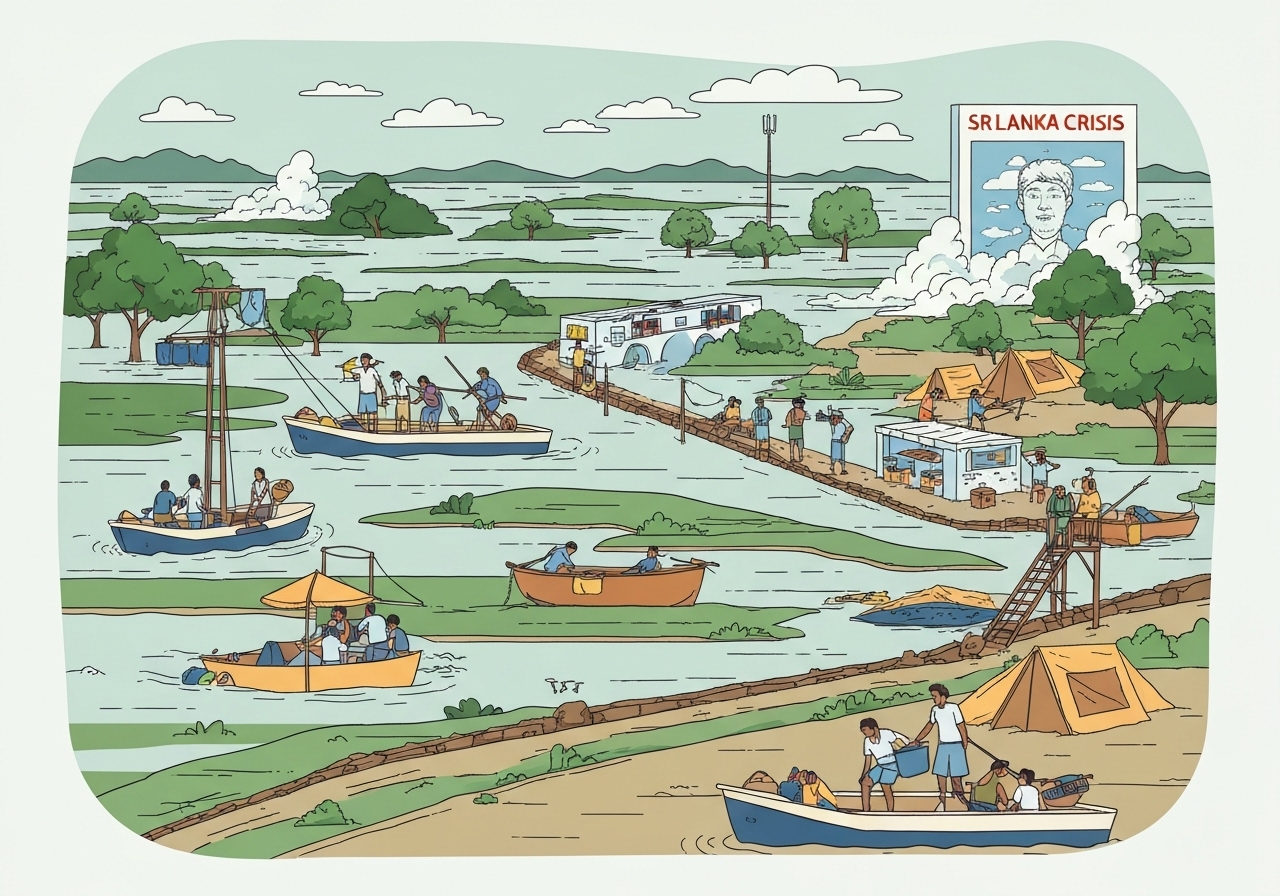
On Dec. 1, 2025, Sri Lanka faced nationwide flooding that President Anura Kumara Dissanayake characterized as the island’s ‘largest and most challenging natural disaster.’ Cyclone Ditwah has been linked to at least 355 deaths, 366 people reported missing and more than one million people affected as entire towns remain submerged. Rescue operations continued with assistance from neighbouring India, even as heavy rain and secondary flooding persisted in parts of the country. Officials warned that the death toll and damage estimates were likely to rise as access to remote areas remained limited.
Key Takeaways
- Confirmed deaths: 355, with 366 people listed as missing across the island.
- More than one million people affected; initial UN figures cite over 15,000 homes destroyed.
- Flooding and landslides reported in more than half of Sri Lanka’s 25 districts; evacuations ordered in over 20 districts.
- Critical infrastructure hit: at least 10 bridges damaged and over 200 major roads classified as impassable.
- Partial restoration of trains, electricity and telecommunications reported, but access to clean drinking water remains constrained.
- International aid: search and rescue teams and aircraft from India were deployed to assist operations.
- Population context: Sri Lanka has about 23 million residents, amplifying the scale of displacement and recovery needs.
Background
Sri Lanka has experienced a string of major shocks over recent decades, including a 2004 Indian Ocean tsunami and a 26-year civil war that ended in 2009. The country also faced terror attacks and a severe economic collapse in recent years. Those events weakened infrastructure and strained government resources, leaving many communities more vulnerable to extreme weather events.
Cyclone Ditwah formed over the Indian Ocean and moved across the region in late November and early December 2025. Forecasters warned of intense rainfall and coastal surges; by the time the system passed Sri Lanka, widespread flooding and numerous landslides had been reported. Local authorities, already stretched by limited budgets and recent crises, were forced into large-scale evacuations and emergency mobilization.
Main Event
Heavy rain associated with Cyclone Ditwah inundated urban and rural areas alike, with images showing streets, homes and fields under deep water. Officials confirmed fatalities and extensive damage across more than half of the country’s 25 districts, and rescue teams prioritized the most isolated and inundated communities. In many places, roads and bridges that connect towns were rendered unusable, complicating relief and assessment missions.
On Dec. 1, President Dissanayake addressed the nation, calling the flooding the ‘largest and most challenging natural disaster’ in Sri Lanka’s history and urging coordinated national and international effort. He acknowledged the scale of the response required and described attempts to reach stranded residents by boat and air. Indian crews and aircraft were reported to be assisting with flood rescues and logistics.
By the day after landfall, authorities reported partial restoration of rail lines, electricity and mobile services in several districts, but many areas remained without safe drinking water. The United Nations provided an early damage snapshot, estimating more than 15,000 houses destroyed in the initial assessment and flagging urgent needs for shelter, clean water and medical care.
Analysis & Implications
Humanitarian impact: With a population of roughly 23 million, Sri Lanka faces a large-scale displacement and public health challenge. Floodwaters increase the risk of waterborne disease and disrupt vaccination, maternal health and chronic care services. Overcrowded temporary shelters will complicate infection control and recovery efforts.
Economic and infrastructure effects: Damage to at least 10 bridges and more than 200 major roads will slow relief, trade and reconstruction. Agriculture, already under stress from prior economic difficulties, is likely to suffer immediate crop losses and longer-term erosion of livelihoods for smallholder farmers. The cost of rebuilding could further strain public finances and foreign exchange reserves.
Political and social consequences: The disaster puts pressure on the government to show rapid and effective response while balancing fiscal limits. Public trust may hinge on transparent distribution of aid and speed of recovery. The scale of the event also increases Sri Lanka’s dependence on external assistance and regional cooperation for emergency logistics and reconstruction financing.
Regional ripple effects: Cyclone Ditwah affected parts of southern India as well, and cross-border assistance underscores the importance of coordinated regional disaster response mechanisms. Multilateral agencies and donor governments will likely be called on for immediate relief funds and medium-term rebuilding support.
Comparison & Data
| Indicator | Current Event | Recent Benchmarks |
|---|---|---|
| Confirmed deaths | 355 | 2004 tsunami: ~30,000 in Sri Lanka (national) |
| Missing | 366 | — |
| People affected | 1,000,000+ | Typical major floods: hundreds of thousands |
| Homes destroyed | 15,000+ (UN initial) | Varies by event |
| Population | 23,000,000 | — |
The table above places the immediate human cost in context: while far smaller than the 2004 tsunami in absolute fatalities, the rapid spread across most districts and the number of people affected make Ditwah one of the most geographically extensive recent disasters in Sri Lanka. Damage to transport arteries and housing stock will shape the recovery timeline.
Reactions & Quotes
Officials and aid agencies issued public statements as rescue efforts continued and needs assessments were compiled.
“As a country, we are facing the largest and most challenging natural disaster in our history,”
President Anura Kumara Dissanayake
The president’s remark framed the official response and appeal for national unity. Government briefings emphasized mobilization of military and civilian resources, and a request for international assistance to reach cut-off communities.
“The estimated scale of destruction is severe,”
Government road development authority / official statement
That assessment highlighted transport and logistical bottlenecks, noting at least 10 bridges damaged and over 200 major roads impassable. International organizations signaled readiness to support shelter, water and medical aid.
Unconfirmed
- Final death and missing counts: field verification is ongoing and official tallies may change as rescuers reach isolated areas.
- Comprehensive damage estimates to agriculture and small businesses remain preliminary; detailed sectoral surveys are pending.
- Reports of localized security incidents or widespread civil unrest in affected zones are not confirmed by authorities at this time.
Bottom Line
Cyclone Ditwah has produced devastation across Sri Lanka, causing at least 355 deaths, hundreds missing and displacing or affecting over a million people. Immediate priorities are search and rescue, provision of safe drinking water, emergency shelter and rapid medical support in flooded and landslide-impacted districts.
Medium-term recovery will require substantial reconstruction of bridges, roads and housing, plus programs to restore livelihoods and public services. The scale of the event makes regional and international coordination — for logistics, funding and technical assistance — essential to speed relief and reduce secondary humanitarian harm.
For readers tracking developments, expect evolving casualty and damage figures over the coming days as access improves and assessment teams complete ground surveys.
Sources
- The New York Times — (News: initial reporting and on-the-ground coverage)
- United Nations — (International organization: early damage and humanitarian estimates)
- Reuters — (News agency: regional reporting and imagery)
- Office of the President of Sri Lanka — (Official: presidential address and government briefings)