
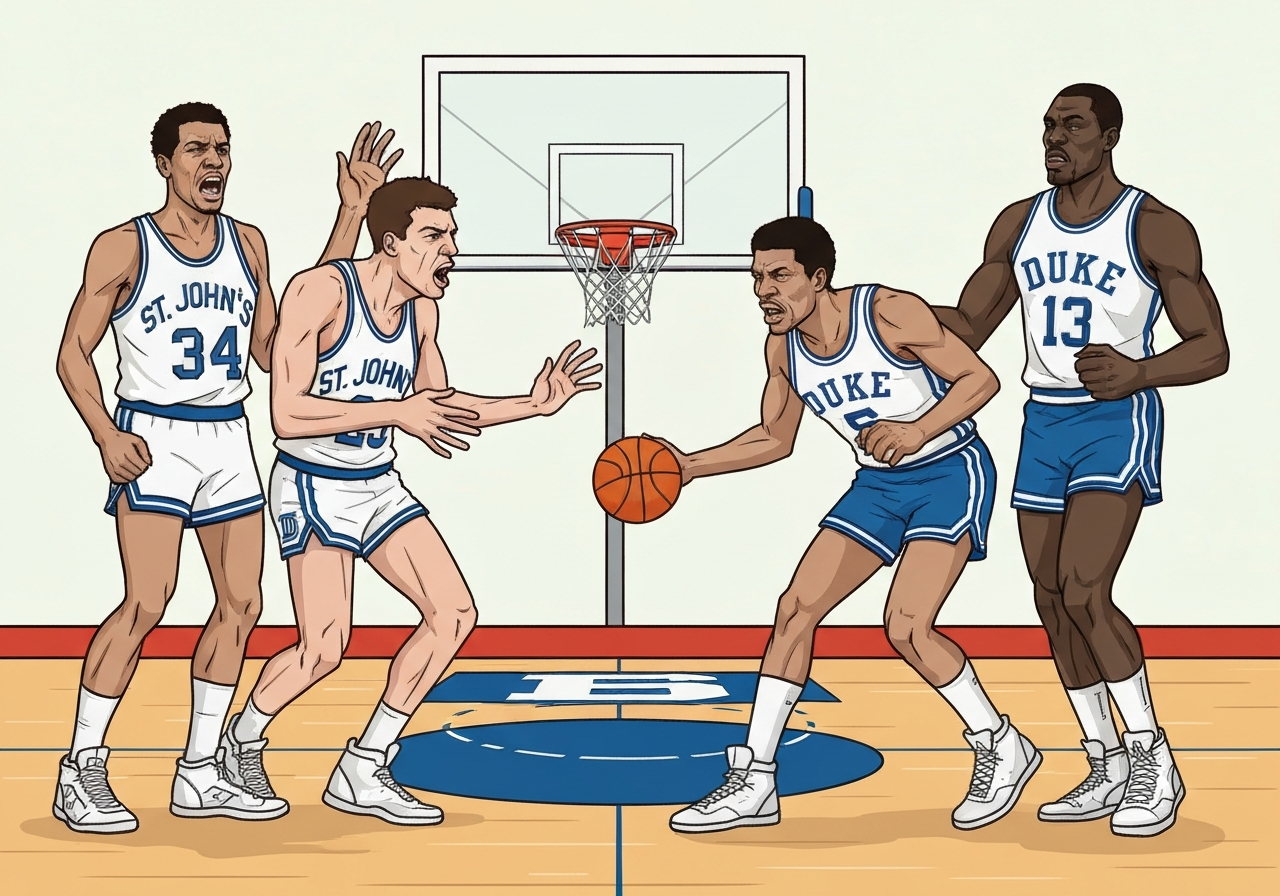
On March 27, 2026 at Capital One Arena in Washington, St. John’s saw a 30-win season end in a narrow 80-75 Sweet 16 defeat to No. 1 seed Duke. The Blue Devils closed the game behind late scoring from Isaiah Evans and Cameron Boozer, while St. John’s rallied behind a resilient effort that included Caleb Foster returning from a recent foot fracture. The Johnnies pushed the top seed to the limit but could not hold a late lead, leaving coach Rick Pitino and the program to reflect on a memorable run that fell just short.
Key takeaways
- Final score: Duke 80, St. John’s 75; game played March 27, 2026, at Capital One Arena in Washington, D.C.
- Records: St. John’s finished the season 30-7; Duke improved to 35-2 with the win.
- Late surge: Duke made 10 of its final 13 field-goal attempts and shot 57.1% in the second half.
- Star performances: Isaiah Evans scored 25 points; Cameron Boozer finished with 22, including 13 after halftime.
- St. John’s shooting: The Johnnies hit 13 three-pointers in the game and led by as many as 10 early in the second half.
- Caleb Foster’s return: Foster, 20 days after fracturing a bone in his right foot, scored 11 second-half points without a turnover.
- Key contributors for St. John’s: Zuby Ejiofor had 17 points, 8 rebounds and 6 assists; Bryce Hopkins added 15 points and 7 rebounds.
Background
St. John’s entered the 2025-26 postseason with momentum: the Red Storm won the Big East regular-season title outright for the second straight year and claimed the conference tournament crown over Connecticut. A rocky start to the season (9-5) gave way to a long winning stretch that culminated in the program’s first Sweet 16 appearance since 1999. Rick Pitino’s squad carried that narrative into March, fueled by a balanced roster that combined veterans and role players.
On the other side, Duke arrived as the overall No. 1 seed and a national title favorite, led by freshman star Cameron Boozer, who has emerged as a leading candidate for consensus National Player of the Year. Isaiah Evans provided late-game scoring and composure, helping Duke respond in tight moments. The matchup was therefore framed as a test between St. John’s momentum and Duke’s top-end talent and depth.
Main event
The game swung early in the second half when the Johnnies stretched a lead to 10 and showcased their hot perimeter touch, eventually hitting 13 triples. St. John’s led by two with 4:29 remaining after a sustained offensive sequence that looked to put pressure on Duke’s defense. The atmosphere at Capital One Arena reflected the stakes: an upset would have been program-defining for Pitino’s team.
Duke answered when it mattered most. Isaiah Evans buried a 3-pointer with 3:54 left to take the lead, and on the next possession Cameron Boozer converted a three-point play to extend the margin. Duke’s efficiency down the stretch — 10-for-13 on its final field-goal attempts — proved decisive and negated multiple St. John’s comeback attempts.
Caleb Foster’s comeback story was one of the night’s subplots: just 20 days removed from a fractured right foot, he logged 11 second-half points and handled pressure well, committing no turnovers while stabilizing St. John’s offense. Still, a late opportunity to tie fell short when Dylan Darling, fresh off a buzzer-winner against Kansas in the prior round, missed a potential game-tying 3 at the final horn.
The closing sequence left visible emotion: several Johnnies players were in tears during the postgame, and Zuby Ejiofor was notably overcome at his news conference, unable to finish his remarks. For many of the roster and their coaches, the 30-win season represented a significant achievement even as the Sweet 16 exit brought immediate disappointment.
Analysis & implications
From a program perspective, St. John’s validated its positioning as a national contender by logging back-to-back 30-win seasons and returning to the Sweet 16 for the first time in 27 years. That achievement should help Pitino and his staff in recruiting and in the transfer portal, where several rotation players are expected to test interest. Still, the loss underscores a gap in closing high-pressure late-game possessions against elite opponents.
For Duke, the victory reinforced the team’s title credentials: the Blue Devils combined perimeter scoring and late-game execution to overcome a determined opponent. Cameron Boozer’s second-half production and Isaiah Evans’ timely shooting illustrate why Duke remains the betting favorite to advance further; Boozer’s nightly impact strengthens his standing in National Player of the Year conversations, though the award is not yet final.
St. John’s roster construction will change next season regardless: while a core of contributors including Ruben Prey, Dylan Darling and Joson Sanon are expected to return, the program will be active in the transfer market to replace graduated pieces and add depth. Pitino’s continued tenure increases the likelihood of sustained competitiveness, but closing deficits in late-game scenarios will be a priority for coaching and player development staff.
Comparison & data
| Metric | Duke | St. John’s |
|---|---|---|
| Final score | 80 | 75 |
| Season record (after game) | 35-2 | 30-7 |
| Second-half FG% | 57.1% | — |
| 3-pointers made | Noted contributors | 13 |
The table highlights the decisive numbers: Duke’s 57.1% shooting in the second half and a 10-for-13 finish from the floor swung the outcome, while St. John’s 13 made 3-pointers fueled much of their comeback attempts. Historically, this marks St. John’s deepest NCAA run since 1999; for program momentum and fan engagement, this season is consequential despite the loss.
Reactions & quotes
Coach Rick Pitino reflected on his team’s effort and the margin for error late in March: he praised his players’ heart and attributed the defeat to execution in critical moments while acknowledging Duke’s quality.
“Our guys played with great heart. They made some defensive mistakes down the stretch, but that’s a credit to Duke.”
Rick Pitino, St. John’s head coach
Duke coach Jon Scheyer acknowledged St. John’s preparation and competitiveness, noting that the Red Storm made Duke earn the advancement. Scheyer’s comment emphasized respect for the opponent and the narrow nature of the victory.
“They gave us everything tonight. They were incredibly ready.”
Jon Scheyer, Duke head coach
Dillon Mitchell, a St. John’s starter, summed up the players’ reaction to the closing sequence and the finality of March elimination, highlighting how small execution errors altered the outcome.
“It cost us the game. It cost us our season.”
Dillon Mitchell, St. John’s guard
Unconfirmed
- Specific transfer moves and targets for St. John’s next offseason have not been announced; reports of portal activity are still emerging.
- Cameron Boozer’s expected standing as consensus National Player of the Year is not official; awards voting will determine the final outcome.
Bottom line
This game crystallized the margins between elite programs and rising contenders: St. John’s validated a return to national relevance with a 30-win season and a Sweet 16 berth, but a few late possessions swung the game in Duke’s favor. The Johnnies leave with tangible progress and recruiting momentum, even as immediate postseason goals went unmet.
Looking ahead, St. John’s should be expected to reload rather than rebuild — Pitino’s presence and returning contributors give the program a foundation to push back toward the Final Four conversation. For Duke, the win reinforces a path forward in the tournament where late-game efficiency and star-level performances will be decisive.
Sources
- New York Post (media—game report)
- Duke Athletics (official athletic department)
- St. John’s Athletics (official athletic department)