
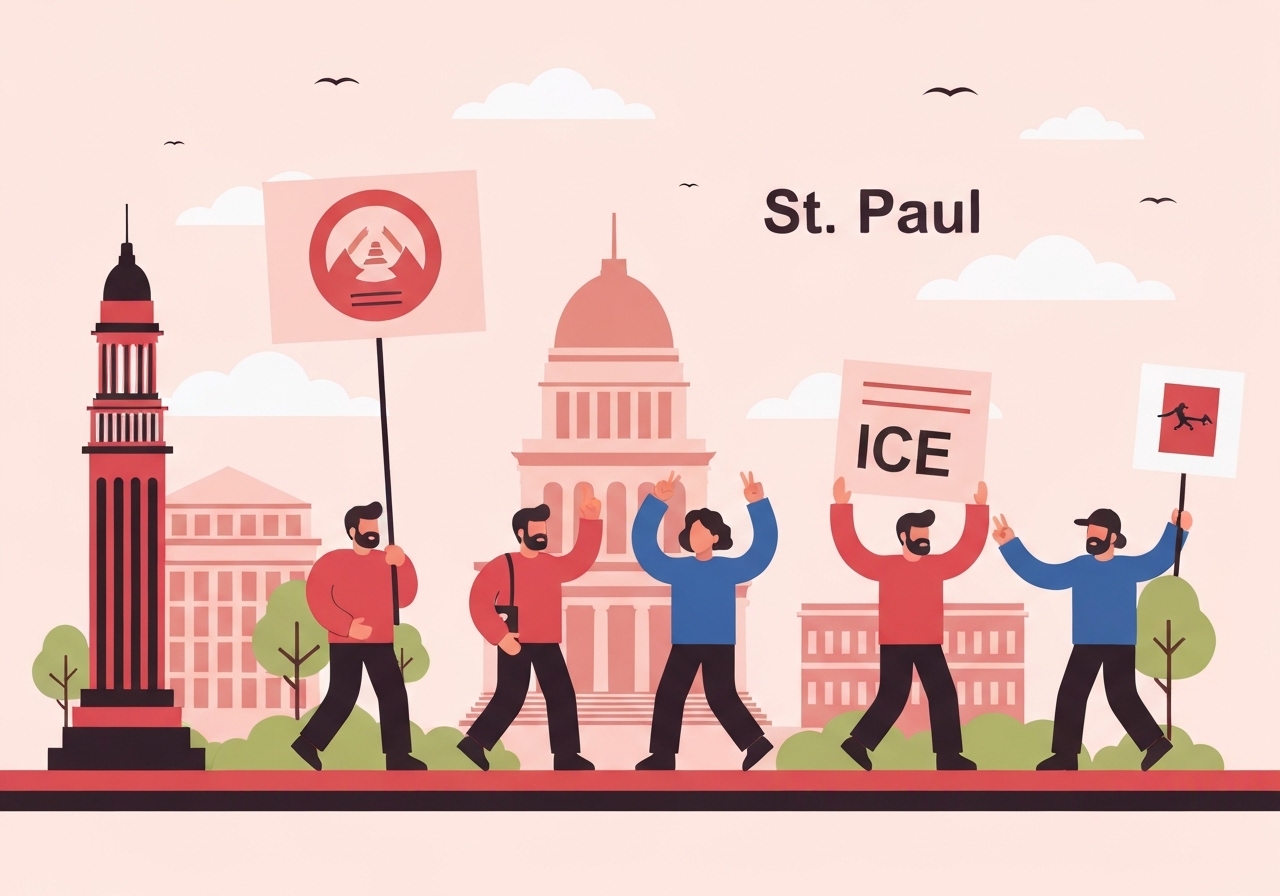
On Jan. 19, 2026, demonstrators disrupted a Sunday service at Cities Church in St. Paul to confront a church leader tied to Immigration and Customs Enforcement, stopping worship and prompting a federal review. Videos show protesters chanting “ICE out” as congregants moved toward the exits and worship music continued inside. The protest, organized by civil rights attorney Nekima Levy Armstrong, targeted David Easterwood, who appears to serve as acting director of ICE’s enforcement and removal operations in St. Paul and is named in litigation over aggressive enforcement. The Justice Department said it has opened an investigation, citing a 1994 law that bars force or threats to obstruct worship.
Key Takeaways
- On Jan. 19, 2026, protesters interrupted a Sunday service at Cities Church in St. Paul, Minnesota, chanting “ICE out” and causing congregants to leave.
- The action was organized by Nekima Levy Armstrong, a civil rights lawyer aiming to draw attention to a church leader linked to ICE enforcement.
- David Easterwood is identified in public records and reporting as the acting director of ICE field enforcement in St. Paul and is named in a lawsuit challenging enforcement tactics.
- The Justice Department announced an investigation and noted a 1994 statute that prohibits use or threats of force to interfere with worshippers.
- Attorney General Pam Bondi publicly framed the disruption as intimidation against Christians and said federal law will be enforced.
- Video of the event circulated on social media; it also followed heightened local tensions after an ICE agent shot and killed a woman in Minneapolis earlier this month.
Background
St. Paul and the neighboring Minneapolis area have been a focal point of national debate over immigration enforcement since a recent incident in which an immigration agent shot and killed a woman in Minneapolis. That confrontation intensified scrutiny of local ICE field offices and drew activists, faith leaders and legal advocates into public protests. Cities Church, a congregation in St. Paul, became the focus after public reporting tied one of its leaders to ICE enforcement roles; the intersection of religious institutions and government enforcement has been politically sensitive in the region.
Protest organizers have in recent years used direct action to highlight what they characterize as harmful enforcement practices; lawsuits and community campaigns challenging ICE tactics have also proliferated. Local leaders and civil rights attorneys, including Nekima Levy Armstrong, have repeatedly called for greater transparency and accountability from federal immigration authorities. At the same time, officials in the Justice Department and other federal offices have signaled willingness to intervene when protests intersect with protected religious activity.
Main Event
According to videos posted online, protesters gathered outside Cities Church during a Sunday service and chanted, temporarily halting worship. The footage shows attendees leaving pews while music continued inside the sanctuary; organizers said the objective was to confront a church figure with ties to ICE. It was not immediately clear whether the person targeted, identified in reporting as David Easterwood, was present in the building during the disruption.
The demonstration was planned by Nekima Levy Armstrong, who publicly described the action as an effort to call attention to what she and others describe as aggressive local enforcement. Protesters carried signs and used vocal chants, including “ICE out,” which were audible in the shared videos and amplified the confrontation between demonstrators and congregants. Jonathan Parnell, the lead pastor conducting the service, did not immediately respond to requests for comment posted by reporters on Sunday.
Federal authorities responded quickly: the Justice Department confirmed it is reviewing the incident and referenced federal protections for religious exercise that prohibit physical obstruction or threats at houses of worship. Separately, Attorney General Pam Bondi said she had spoken with a church pastor and framed the episode as an attack on law enforcement and an intimidation of Christians, pledging enforcement of federal statutes.
Analysis & Implications
The church disruption underscores how immigration enforcement has become a flashpoint that reaches into community institutions, including places of worship. When an individual associated with a congregation holds a federal enforcement role, it creates a dual set of expectations: congregants expect sanctuary and spiritual leadership, while community critics view such links as legitimizing contested enforcement tactics. That tension raises legal, ethical and pastoral questions that extend beyond this single protest.
A Justice Department inquiry focused on a 1994 statute signals that the federal response will hinge on whether protesters used force or credible threats to obstruct worship. If investigators find evidence of intimidation or physical obstruction, organizers could face federal charges; conversely, prosecutors must weigh First Amendment protections for protest and political speech. The legal calculus will shape how both activists and faith communities approach future demonstrations.
Politically, the episode feeds into broader national debates over immigration policy under the current administration. Localized clashes like this can amplify partisan narratives in Washington and among state officials, potentially affecting enforcement tactics, oversight demands and litigation strategies. For community cohesion in the Twin Cities, repeated confrontations risk deepening divisions between law enforcement proponents, immigrant-rights advocates and faith communities seeking to maintain congregational peace.
Comparison & Data
| Event | Date | Location |
|---|---|---|
| Church service protest | Jan. 19, 2026 | Cities Church, St. Paul, MN |
| Protest outside federal building (photo caption) | Jan. 19, 2026 | Bishop Henry Whipple Federal Building, near Minneapolis, MN |
The table situates the reported church incident alongside visuals of demonstrators near the Bishop Henry Whipple Federal Building, both dated Jan. 19, 2026. While the church action interrupted religious worship, other demonstrations that day took place outside federal facilities, suggesting coordinated local activism directed at ICE operations and related offices.
Reactions & Quotes
“Attacks against law enforcement and the intimidation of Christians are being met with the full force of federal law.”
Attorney General Pam Bondi (public statement)
“ICE out”
Protesters (video of the St. Paul service)
Federal officials framed the episode as potentially criminal under statutes protecting religious exercise, while protest footage and organizers described the action as targeted civil resistance. Church leaders had not issued a detailed public response by midday Monday, and local advocates emphasized that the protest was intended to spotlight litigation and enforcement practices rather than to harm worshippers.
Unconfirmed
- Whether David Easterwood was physically present at Cities Church during the Jan. 19 protest remains unconfirmed by independent reporting.
- The precise nature of Easterwood’s current employment status and job title with ICE—beyond public reporting that he appears to be acting director of field enforcement—has not been independently verified in available sources.
Bottom Line
The Jan. 19 protest at a St. Paul church crystallizes local anger over ICE enforcement and highlights the fraught overlap between faith communities and federal immigration operations. A Justice Department review centered on protections for religious exercise ensures the incident will be examined under both criminal and civil standards, and the outcome may influence how similar demonstrations are organized and policed.
Beyond immediate legal consequences, the episode is likely to intensify political debate in Minnesota and nationally. Activists, church leaders and federal authorities will watch the DOJ inquiry closely; its findings could shape litigation strategies and administrative oversight of field enforcement practices moving forward.