
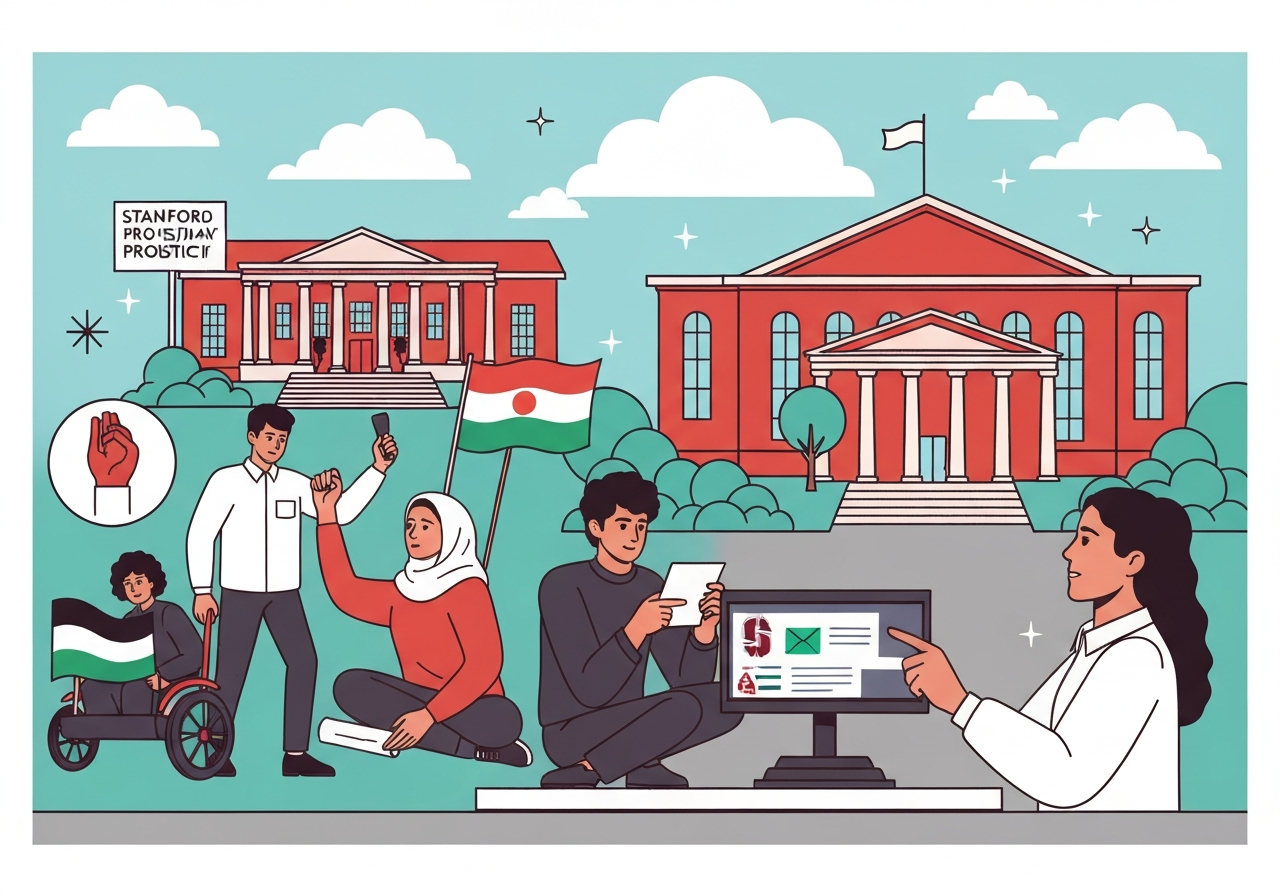
In a Santa Clara County courtroom on Friday, a jury deadlocked in the trial of five current and former Stanford University students accused of vandalism and conspiracy after a June 5, 2024 occupation of the president and provost executive offices. After five days of deliberations, jurors reported they could not reach unanimous decisions on two felony counts despite earlier votes of 9–3 and 8–4 in favor of conviction on those charges. The judge declared a mistrial on the two counts and dismissed the panel; prosecutors said they will seek a new trial. The episode highlights clashes over campus protest tactics and how courts handle demonstrations tied to the Israel–Hamas war.
Key Takeaways
- The trial centered on an incident on June 5, 2024, when demonstrators occupied Stanford’s president and provost executive offices for several hours.
- Jurors initially reported votes of 9–3 to convict on a felony vandalism charge and 8–4 to convict on a felony conspiracy to trespass charge, but ultimately could not reach a verdict after five days of deliberations.
- The judge declared a mistrial for counts one and two after jurors said additional deliberation would not resolve the impasse.
- Prosecutors accuse defendants of spray‑painting, breaking windows and furniture, disabling cameras and splashing a red liquid described as fake blood; defense attorneys argue the acts were protected speech and lacked intent to cause damage.
- If convicted, each defendant faced up to three years in prison and potential restitution exceeding $300,000; prosecutors plan to retry the case.
- Authorities initially arrested 12 people in the episode; one took a no‑contest deal and testified, six accepted pretrial deals or diversion, and five proceeded to a jury trial.
- The case is an uncommon instance of felony prosecutions stemming from the 2024 wave of campus protests related to the Israel–Hamas war, during which roughly 3,200 arrests were reported nationally.
Background
Campus unrest in 2024 followed the outbreak of the Israel–Hamas war, sparking pro‑Palestinian demonstrations at universities across the United States. Students at many institutions set up encampments and demanded changes in university investments and vendor relationships tied to Israel. Responses varied: some universities negotiated with protesters, others tolerated encampments for a period, and some campuses called police to clear sites, producing a mix of administrative and criminal outcomes.
At Stanford, the June 5 occupation targeted the executive offices and occurred on the last day of spring classes. Prosecutors framed the event as criminal conduct that damaged property and disrupted university operations. Defense teams countered that the demonstrators were exercising political speech and that protective gear and barricades reflected a concern for safety amid confrontations with authorities. The larger national context — thousands of arrests and mostly dismissed charges at some schools — set the case apart as one of relatively few to advance to felony jury trial.
Main Event
Prosecutors presented evidence that the defendants spray‑painted office surfaces, splintered furniture, broke windows, disabled security cameras and dispersed a red liquid described in court as fake blood across items in the offices. The government emphasized the monetary impact, citing more than $300,000 in estimated damages and loss requiring restitution if convictions were secured. Defense lawyers disputed the characterization of the acts as criminal intent to damage, saying protesters donned protective gear and barricaded themselves largely out of fear of forceful removal by police and campus security.
Jury proceedings lasted three weeks during which both sides debated whether the conduct was lawful dissent or criminal vandalism and conspiracy. After closing arguments the jury deliberated for five days but failed to reach unanimous verdicts on two felony counts; at earlier tallying stages jurors indicated split votes of 9–3 and 8–4 on the two charges. The presiding judge asked jurors whether more time might break the impasse; all responded no, prompting a mistrial declaration for counts one and two and dismissal of the jury.
Prosecutors signaled they will seek a new trial, with Santa Clara County District Attorney Jeff Rosen stating the office intends to retry the case and framing the matter as one of property destruction that caused substantial financial harm. Several defendants remain outside the courtroom process: of 12 initial arrestees, one accepted a no‑contest arrangement that led to sealed records after probation, and six resolved their cases with plea or diversion deals. The five who remained at trial pleaded not guilty and contested the charges before the jury.
Analysis & Implications
The mistrial underscores the difficulty of translating protest conduct into criminal convictions, particularly when jurors must weigh intent and the line between symbolic political expression and illegal property damage. The split juror votes illustrate a factual ambiguity juries commonly face in protest cases: spectators and participants often disagree on whether acts were meant as theatrical political speech or as purposeful destruction. That ambiguity complicates prosecutors’ efforts, especially in high‑profile campus contexts where public opinion and institutional pressures are palpable.
For universities, the case raises questions about how to manage sustained political demonstrations that occupy administrative spaces. Administrations must balance free‑speech protections, campus safety, and property preservation — decisions that can invite legal challenges or escalate to criminal charges. The Stanford matter may influence university policies and counsel strategies: administrators might refine protocols for both preventing and documenting damage to narrow evidentiary gaps should prosecutions follow.
Politically, the outcome and any retrial will be observed by activists and legal advocates on both sides of the free‑speech divide. A prosecution that culminates in convictions could set a precedent prompting more aggressive law enforcement responses to occupations; conversely, continued difficulty securing verdicts may discourage felony charges in similar demonstrations. The local prosecutorial choice to retry indicates a willingness to litigate these boundaries despite the broader trend of many campus protest charges being dismissed in 2024.
Comparison & Data
| Metric | Stanford case | National campus protests (2024) |
|---|---|---|
| Initial arrests tied to incident | 12 | ~3,200 nationwide |
| Defendants tried before jury | 5 | Few felony jury trials |
| Potential prison if convicted | Up to 3 years | Varied — many charges dismissed |
| Estimated restitution/damages | Over $300,000 | Case‑by‑case, often undisclosed |
The table places the Stanford proceeding in context: the campus wave produced thousands of arrests but comparatively few cases advanced to felony jury trials. Stanford’s matter is notable for the scale of alleged damage and the decision by prosecutors to pursue felony counts rather than handling the case through campus discipline or misdemeanor filings. That prosecutorial path, and the jury’s inability to convict, will be referenced in debates over how aggressively criminal systems should respond to political occupations on campus.
Reactions & Quotes
Prosecutors framed the outcome as a pause rather than an end to their pursuit; the district attorney’s office emphasized the financial and physical harm cited in filings. The DA’s public remarks reiterated an intent to retry the defendants and stressed accountability for property destruction.
“This case is about a group of people who destroyed someone else’s property and caused hundreds of thousands of dollars in damage,”
Jeff Rosen, Santa Clara County District Attorney (statement)
Defendants and supporters framed the case as political dissent and a campaign to defend Palestinian rights. One of the students who faced trial described the broader movement and vowed continued activism, coupling legal struggle with political commitment.
“No matter what happens, we will continue to fight tooth and nail…because at the end of the day, this is for Palestine,”
Germán González, defendant (phone interview)
The presiding judge summarized the jury’s position before declaring a mistrial, saying the panel was stalemated and could not reach unanimous verdicts on the central felony counts. Court officials then dismissed jurors and left the scheduling of any retrial to prosecutors and the court calendar.
“It appears that this jury is hopelessly deadlocked,”
Presiding judge (court statement)
Unconfirmed
- Whether forensic testing definitively identified the red liquid as imitation blood has not been publicly disclosed.
- The precise final calculation of restitution and whether the university will pursue separate civil recovery remains unresolved.
- No publicly announced calendar for a retrial date or its likely timing has been filed; prosecutors have stated intent to retry but formal scheduling is pending.
Bottom Line
The mistrial in the Stanford case highlights the legal and evidentiary difficulties in prosecuting politically charged campus occupations. While prosecutors cite tangible damage and seek accountability, jurors struggled with questions of intent and the intersection of protest and property harm — yielding a split panel and a formal mistrial.
Prosecutors’ decision to pursue a retrial means the legal chapter is not closed; the case will remain a test of how criminal courts adjudicate mass campus protests tied to international conflicts. Observers should watch for whether a retrial produces convictions, plea resolutions, or further dismissals, as the result will influence both campus policy and prosecutorial strategy in future demonstrations.
Sources
- Associated Press (news) — original reporting on the trial, jury process and statements cited.