
Lead
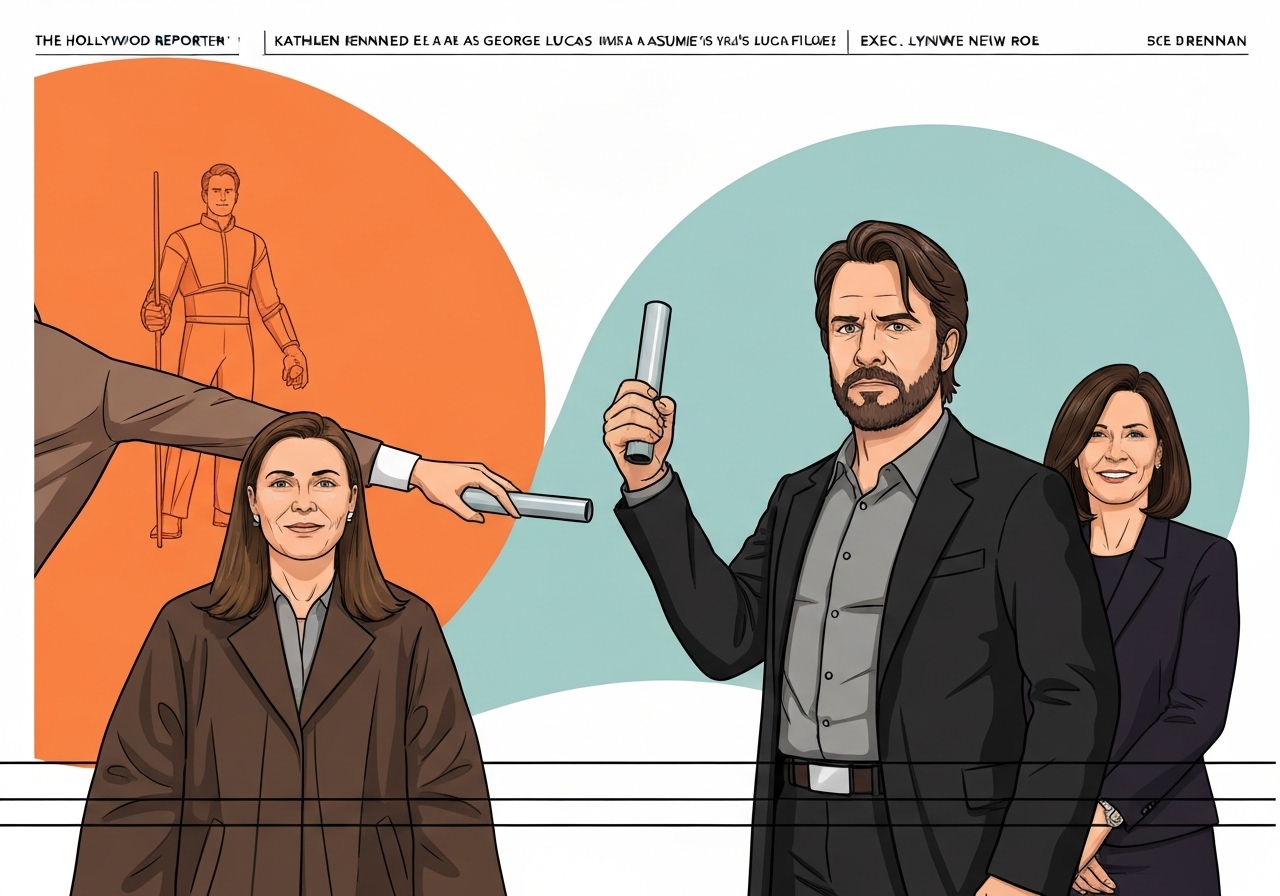
After 14 years steering the modern Star Wars era, Kathleen Kennedy is stepping down as president of Lucasfilm, an exit reported to be effective this week. Her departure has been anticipated inside the industry but still represents a major leadership change for one of Hollywood’s most valuable franchises. Dave Filoni, long viewed as George Lucas’s protégé and Lucasfilm’s chief creative voice, has been promoted to president and chief creative officer. Lynwen Brennan, who runs the company’s business operations, will assume a co-president role overseeing commercial and operational matters.
Key Takeaways
- Kathleen Kennedy is leaving Lucasfilm after 14 years at the helm; her exit is effective this week and she will remain as a producer on two upcoming Lucasfilm projects.
- Dave Filoni is promoted to president and chief creative officer of Lucasfilm; Lynwen Brennan becomes co-president responsible for business operations.
- Both Filoni and Brennan will report to Alan Bergman, co-chairman of Disney Entertainment, under a split creative/business leadership model.
- Kennedy joined Lucasfilm in 2012 after Disney purchased the company for $4 billion and became sole head months after the acquisition.
- Box-office context: Star Wars: The Force Awakens grossed approximately $2 billion worldwide and $936.6 million domestically; Rogue One and The Rise of Skywalker each reached roughly $1 billion worldwide; The Last Jedi grossed about $1.33 billion; Solo earned $392.9 million.
- Television impact: Kennedy helped launch live-action Star Wars on Disney+; The Mandalorian popularized Grogu, and Lucasfilm series have accumulated roughly 85 Emmy nominations, with Andor winning five Emmys (22 nominations).
- Two feature releases are scheduled: The Mandalorian and Grogu (opening May 22) and Shawn Levy’s Star Wars: Starfighter dated for May 28, 2027.
- Under Kennedy, several announced feature projects stalled or were delayed, including films tied to David Benioff & D.B. Weiss, Rian Johnson, Taika Waititi and a Daisy Ridley project still in development.
Background
Kathleen Kennedy arrived at Lucasfilm in 2012 after decades as a prolific producer on titles such as E.T., Indiana Jones, The Sixth Sense and Lincoln; she took leadership just after Disney’s $4 billion acquisition of Lucasfilm and George Lucas’s exit. Her appointment was meant to transition the franchise from its creator-led era into a large-scale, studio-driven slate across film and streaming. Kennedy quickly assembled high-profile filmmakers, most notably recruiting J.J. Abrams to direct Star Wars: The Force Awakens, which relaunched theatrical interest in the franchise in 2015.
Under Kennedy, Lucasfilm expanded aggressively into television for Disney+, with live-action series becoming a central strategy after The Mandalorian’s breakout success. The studio also pursued numerous feature projects that either succeeded (Rogue One) or faltered commercially (Solo) and critically (Rise of Skywalker provoked mixed responses). By the late 2010s and early 2020s, Disney acknowledged the studio had produced too many films too quickly, prompting a pause in the theatrical slate and a reset in development priorities.
Main Event
Kennedy’s departure is being handled as a phased exit: she will leave the president’s post effective this week but continue as a producer on two upcoming Lucasfilm titles—The Mandalorian and Grogu (coming May 22) and the tentatively scheduled 2027 release Star Wars: Starfighter. She has said she will pursue independent producing projects beyond Lucasfilm. The staggered handoff is intended to maintain continuity on active productions while enabling new leadership to set a fresh agenda.
Dave Filoni, who rose through Lucasfilm’s animation ranks and was mentored by George Lucas, will take responsibility for creative direction as president and chief creative officer. Filoni’s credits include The Clone Wars and collaborative live-action work with Jon Favreau on The Mandalorian and Ahsoka. Lynwen Brennan, a Lucasfilm executive since 1999 who led Industrial Light & Magic before becoming president & GM in 2015, will manage the business side as co-president.
The move formalizes a split leadership model common at Disney, where creative and business responsibilities are separated at other studios (for example, Pixar and Walt Disney Animation). Both Filoni and Brennan will report directly to Alan Bergman, co-chairman, Disney Entertainment, creating a clearer escalation path for strategic and operational decisions. Industry sources tell reporters the change could accelerate development after a period of relative quiet while Kennedy’s succession was settled.
Analysis & Implications
The promotion of Filoni signals an emphasis on franchise continuity and deep lore stewardship: his animation roots and long familiarity with Star Wars canon give him institutional knowledge that few others possess. That credibility matters for core fans and for projects that lean into established characters and long-form storytelling. However, Filoni’s strongest work has been in animation and serialized TV; questions remain about whether that skill set translates to managing a major feature pipeline and large-scale studio relationships.
Splitting creative and business oversight addresses recurring tensions at Lucasfilm between storytelling ambitions and commercial discipline. Brennan’s experience running ILM and the company’s business operations positions her to tighten budgets, schedules, and distribution plans—areas Disney leadership has signaled need refinement after mixed theatrical returns. The new structure could produce faster greenlighting decisions and clearer accountability, lowering the friction that contributed to earlier project delays.
For Disney, the leadership change is also reputational: restoring momentum on both film and streaming will be essential as subscriber economics for Disney+ evolve and theatrical windows are reassessed. Successful upcoming launches, particularly The Mandalorian and Grogu, will be an early barometer of whether the franchise can regain broad cultural momentum. Conversely, continued misfires could deepen questions about the long-term value of high-cost franchise management under a studio model.
Comparison & Data
| Title | Worldwide Gross (approx.) | Domestic Gross |
|---|---|---|
| Star Wars: The Force Awakens | $2.0 billion | $936.6 million |
| Rogue One: A Star Wars Story | $1.0 billion | — |
| Star Wars: The Last Jedi | $1.33 billion | — |
| Solo: A Star Wars Story | $392.9 million | — |
| Star Wars: The Rise of Skywalker | $1.0 billion | — |
The table above summarizes the commercial peaks and troughs of the modern theatrical slate under Kennedy. While several films cleared the billion-dollar mark, Solo underperformed and has been cited internally as the first major theatrical loss in the franchise’s recent era. These mixed box-office returns help explain Disney’s decision to pause and reassess the film pipeline ahead of a new leadership era.
Reactions & Quotes
“We produced too many movies too quickly,”
Bob Iger, Disney CEO (as reported)
Disney’s leadership acknowledged publicly that the studio’s prior pace contributed to a strategic pause; that assessment provided part of the rationale for an organizational reset at Lucasfilm. Industry observers say the appointment of Filoni and Brennan reflects a dual priority: restore creative trust with fans while imposing business discipline.
“With Kennedy’s exit, the company can move ahead with full force,”
Lucasfilm sources (as reported by The Hollywood Reporter)
Sources close to Lucasfilm told reporters they expect an acceleration in development now a succession has been finalized, though specifics on new projects and timelines were not disclosed at the time of reporting.
Unconfirmed
- Exact multi-year production slate changes under Filoni’s leadership are not publicly detailed and remain subject to confirmation.
- Whether Filoni will return to directing a live-action feature in the near term is not confirmed; plans reported earlier for a combined-character feature were put on hold.
- The long-term producing role Kathleen Kennedy may play beyond the two credited upcoming Lucasfilm titles has not been formally disclosed.
- The status and timeline of the Daisy Ridley-led movie remain described as stuck in development with no confirmed release date.
Bottom Line
Kathleen Kennedy’s departure closes a formative chapter in the modern Star Wars era and launches a governance model built around a proven creative steward and an experienced business operator. Dave Filoni brings deep franchise knowledge and TV/animation success; Lynwen Brennan brings institutional business experience and operational control. Together, their promotions reflect Disney’s attempt to balance lore-driven storytelling with tighter commercial oversight.
The immediate test will be execution: how quickly the new leadership can translate plans into released content that satisfies both core fans and a wider audience, beginning with The Mandalorian and Grogu’s release and continuing toward the 2027 Starfighter date. For observers and investors alike, the stakes are clear: the franchise must regain consistent creative momentum and predictable commercial returns under the new regime.
Sources
- The Hollywood Reporter — Entertainment trade reporting on Lucasfilm leadership change.