
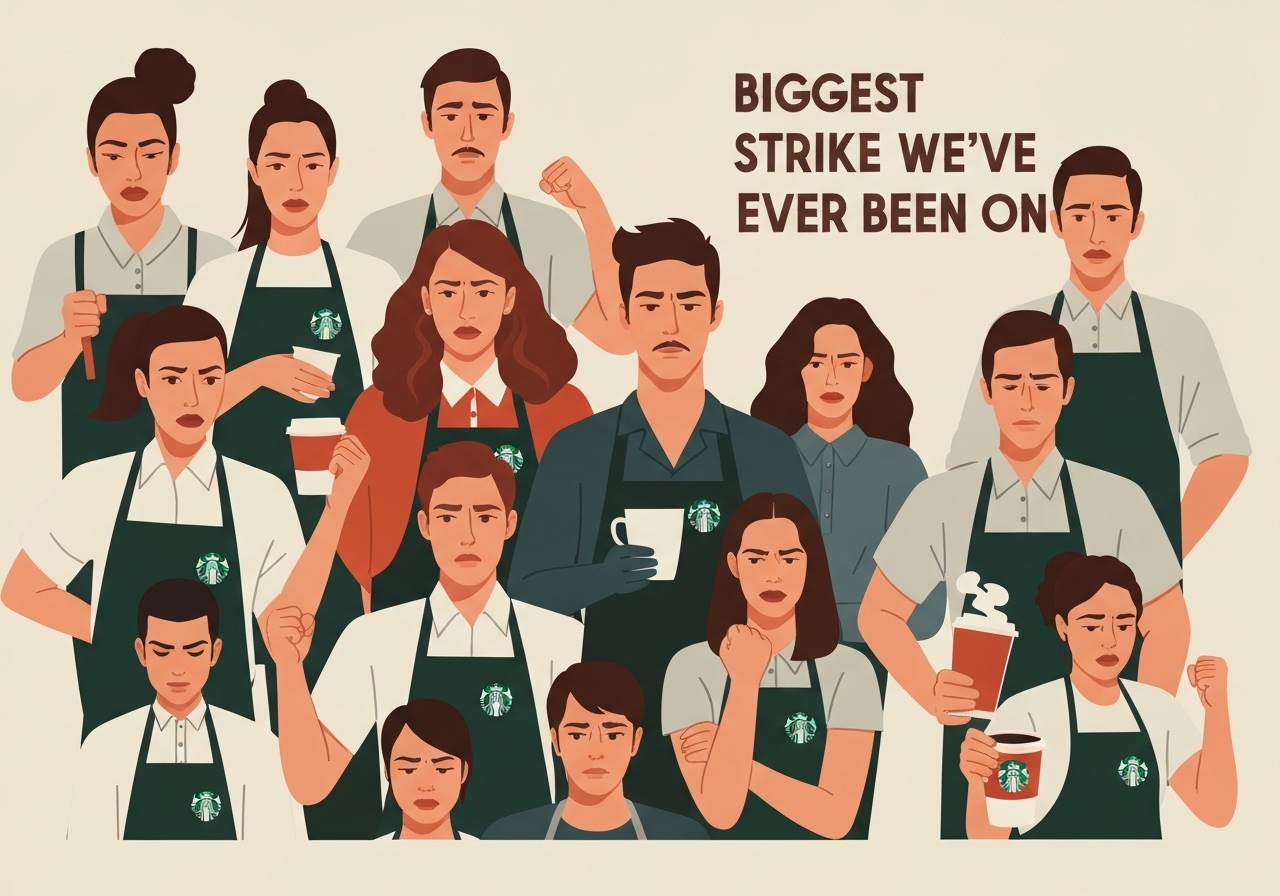
Lead: On November 5, 2025, unionized Starbucks baristas announced plans to stage strikes beginning November 13, targeting the company’s busy Red Cup Day across more than 25 U.S. cities. The action, organized by Starbucks Workers United — representing workers at about 550 of the roughly 10,000 company-run U.S. stores — follows years of intermittent contract talks and ongoing legal disputes. The union says members voted to authorize leadership to call work stoppages if bargaining stalls; the move aims to pressure Starbucks to finalize a first national contract. Organizers say the initial strikes could expand if negotiations or legal barriers are not resolved.
Key Takeaways
- Union vote: Starbucks Workers United reports members at roughly 550 company-run stores authorized leadership to call strikes at any time if demands remain unmet.
- Strike timing: Actions are scheduled to begin on November 13, 2025 — Red Cup Day — across more than 25 U.S. cities, a day the chain typically sees elevated traffic.
- Scope: The unionized locations represent about 5.5% of Starbucks’s roughly 10,000 company-operated U.S. stores.
- Primary goal: The union’s stated objective is to secure a binding contract after years of sporadic bargaining and unresolved legal claims.
- Escalation risk: Union leaders say the labor actions could widen beyond November 13 if there is insufficient progress toward a contract or settlement of legal disputes.
Background
Starbucks Workers United emerged in recent years as a focal point of broader retail and service-sector organizing, winning elections at hundreds of stores across the U.S. The movement has concentrated on company-run stores, where bargaining over wages, scheduling and labor protections has been contentious. Red Cup Day — the chain’s seasonal promotion — has previously been used by labor organizers as a rallying moment because of the high customer volume and media attention it draws.
Bargaining between Starbucks and unionized crews has been intermittent and, according to union statements, frequently stalled amid legal challenges and disputed bargaining practices. Starbucks operates roughly 10,000 company-owned stores in the U.S.; the 550 locations the union cites are a modest share of that total but include several high-visibility outlets. Both sides have signaled that negotiations remain unresolved, and the union frames the November action as leverage to close outstanding issues.
Main Event
On November 5, 2025, Starbucks Workers United announced that members had voted to empower union leadership to call for work stoppages. The union said the authorization allows for immediate action if talks do not produce a contract. Organizers set November 13 as the initial date for coordinated strikes, citing the holiday promotion as an opportunity to maximize pressure on corporate leadership.
Union statements accuse Starbucks of refusing to negotiate in good faith and of contributing to protracted bargaining and legal entanglements. The union says the authorization vote was cast by members at roughly 550 company-run U.S. stores and that plans include actions in more than 25 cities, with potential for additional dates if progress stalls. The union framed the step as a last-resort measure to achieve a binding, enforceable contract language for issues such as scheduling, pay and workplace protections.
Starbucks has not publicly accepted or finalized any new nationwide contract with the union as of the announcement. The company-run store count and the union’s figure for authorized locations were included in the union’s public statement and subsequent news reporting. The union also signaled readiness to pursue additional legal avenues and mobilizations if bargaining remains stalled.
Analysis & Implications
A coordinated strike on Red Cup Day targets an intensely commercial moment for Starbucks, potentially magnifying operational disruption and public visibility. Even localized walkouts in 25-plus cities can create headlines, disrupt staffing at high-traffic stores and complicate customer service during a seasonal peak. For a company with approximately 10,000 company-run U.S. stores, the direct operational impact depends on how many of the unionized 550 locations actually walk out and whether actions spread to noncompany or partner locations.
From a bargaining perspective, the union’s authorization vote increases leverage: the threat of stoppages on a major retail day raises the cost of continued stalemate for corporate leadership. Economically, lost sales on one or a few high-traffic days can be concentrated but are unlikely by themselves to determine a national contract; the greater pressure is reputational and the potential for protracted disruption if actions expand. Legal disputes — including outstanding unfair labor practice cases that unions frequently cite — will shape the timeline and limit or permit certain tactics.
Politically, the strike authorization fits into a broader trend of intensified labor activity in service industries since the early 2020s. A visible, successful campaign could encourage organizing elsewhere and influence public debate on worker protections and corporate bargaining practices. Conversely, an unsuccessful or narrowly contained action would temper momentum and could weaken negotiating posture if the company sustains operations with replacement staffing or other contingency plans.
Comparison & Data
| Metric | Figure |
|---|---|
| Company-run U.S. stores (approx.) | 10,000 |
| Unionized company-run stores cited | ~550 |
| Planned strike date | November 13, 2025 (Red Cup Day) |
| Initial cities targeted | More than 25 |
The table summarizes the core public figures reported by the union and in news coverage. While 550 locations represent a small share of Starbucks’s total U.S. company-run footprint, those stores can include high-visibility outlets where disruption matters disproportionately for customer experience and media attention. The durability and breadth of any campaign will determine its economic and bargaining consequences.
Reactions & Quotes
“This will be the biggest strike we’ve ever been on.”
Starbucks Workers United (union statement)
The union framed the November 13 action as deliberately timed for maximum visibility and leverage, emphasizing member authorization and readiness to act.
“Members voted to give leadership the ability to call for work stoppages if talks remain stalled.”
Starbucks Workers United (member announcement)
Union communications stressed the internal vote and the specific authorization mechanism as a tactical shift intended to shorten negotiation timelines.
“If sustained, targeted walkouts during peak promotional days can strengthen a union’s leverage at the bargaining table.”
Labor analyst (industry commentary)
Independent observers note that the combination of public visibility and tailored timing can raise the political and economic cost of protracted bargaining for employers, even when the absolute number of striking locations is a modest share of total stores.
Unconfirmed
- Whether every one of the roughly 550 authorized locations will participate in walkouts on November 13 is not confirmed and may vary by city and store.
- It is not yet confirmed how Starbucks corporate leadership will respond operationally or whether additional legal filings will be immediately lodged by either side.
Bottom Line
The November 13 action represents a calibrated escalation by Starbucks Workers United: limited in absolute scale but timed to amplify impact during a seasonally important retail day. The union’s authorization vote increases pressure on Starbucks by creating a credible threat of disruption and by signaling member frustration with the pace and outcomes of bargaining.
Outcomes will hinge on whether the strikes prompt renewed negotiations that produce a binding contract or whether they trigger legal and operational counters that blunt union leverage. Observers should watch both the geographic breadth of actual walkouts and any rapid shifts in bargaining posture or legal rulings that could change the dynamics in the days and weeks after November 13.
Sources
- Bloomberg (news) — initial report on union announcement and planned November 13 actions.