
Lead
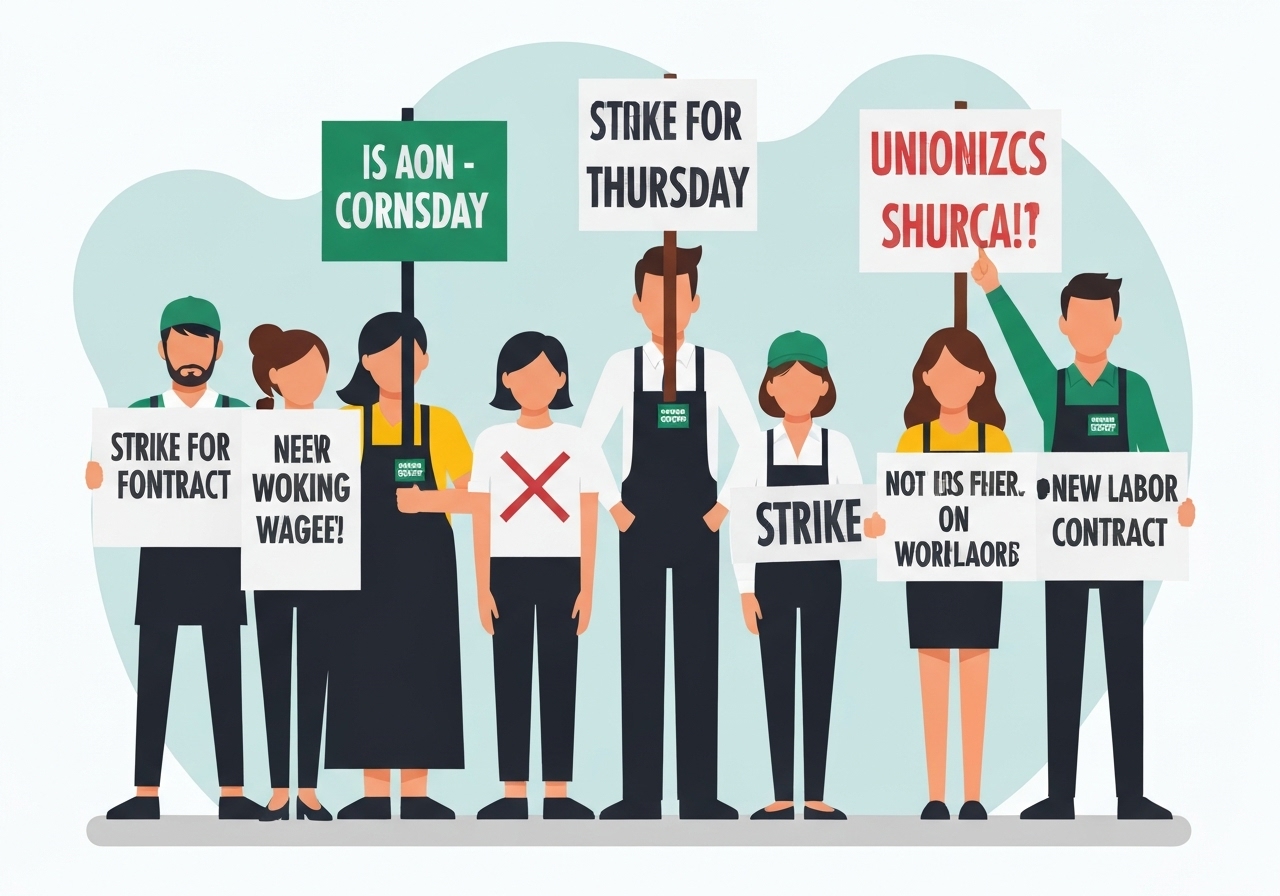
Unionized Starbucks baristas staged a coordinated walkout on Thursday, Nov. 13, 2025, pressing the company for a first collective bargaining agreement. The labor group ― Starbucks Workers United, representing more than 9,500 crew across roughly 550 cafes ― called the action the “red cup rebellion” to coincide with the chain’s Red Cup Day promotion. The strike began in more than 65 stores across over 40 U.S. cities and has no set end date; the union says it will escalate until a fair contract and resolution of unfair labor practice charges are secured. Starbucks reported minimal operational disruption on Thursday morning, saying fewer than 1% of its more than 17,000 U.S. stores were affected.
Key Takeaways
- Strike date: November 13, 2025; coincides with Starbucks’ Red Cup Day promotion.
- Scope: More than 65 stores in over 40 cities; Workers United represents ~9,500 workers at ~550 cafes.
- Union mandate: 92% of voting members authorized the strike after failing to secure a contract.
- Union demands: higher pay, increased staffing and resolution of unfair labor practice claims.
- Company response: Starbucks said impacts were minimal, affecting under 1% of its ~17,000 U.S. stores.
- Negotiations: Talks began in April 2024 and deteriorated in December; union reports 33 tentative agreements, most labeled noneconomic.
- Context: This is the third national union-led work stoppage in the past year, after actions in December 2024 and May 2025.
Background
The organizing drive at Starbucks has expanded since mid-2021, with Workers United winning recognition at numerous individual locations and pushing for companywide bargaining. Starbucks Workers United says it now represents more than 9,500 baristas in some 550 cafes; Starbucks counters that the union represents roughly 4% of its U.S. partners. The gap reflects the company’s scale—Starbucks operates over 17,000 stores in the United States—so localized wins coexist with limited overall union coverage.
Negotiations between Starbucks and Workers United began in April 2024 but collapsed in December of that year. The union says it has extracted 33 tentative agreements, primarily covering non-economic subjects, while parties remain far apart on wages, staffing levels and mechanisms for addressing alleged unfair labor practices. Over the past year the movement staged two prior national work stoppages: a December 2024 walkout and a May 2025 protest over a new company dress code.
Main Event
On Thursday, the union launched what it branded the “red cup rebellion,” timing the action with Red Cup Day to maximize visibility as customers visited stores for the seasonal giveaway. Workers United said the initial wave involved more than 65 stores in over 40 cities, spanning California, Colorado, Illinois, New York, Ohio, Oregon, Pennsylvania, Texas, Virginia, Washington and others. The union emphasized an open-ended timetable, saying the action would continue or expand until Starbucks agrees to a comprehensive, enforceable agreement.
Union spokesperson Michelle Eisen, a 15-year barista, framed the strike as a deliberate interruption of business: “No contract, no coffee is more than a tagline—it’s a pledge to interrupt operations and profits until a fair union contract and an end to unfair labor practices are won,” she said. The union also said it would escalate if the company continued what it termed stonewalling and union-busting. Organizers relied on coordinated local actions rather than a single nationwide shutdown.
Starbucks corporate spokespeople pushed back, calling the union a minority among partners and emphasizing willingness to negotiate. Jaci Anderson, a Starbucks spokesperson, told CBS News the company saw “minimal impacts” on Thursday morning and reiterated that fewer than 1% of U.S. stores were affected. CEO Brian Niccol, speaking in October 2025 on “CBS Mornings,” said Starbucks provides industry-leading wages and benefits and expressed openness to resume talks, while also calling some union demands unreasonable.
Analysis & Implications
The strike underscores a continuing tension between localized union victories and the difficulty of translating those wins into a companywide contract at a very large employer. With roughly 4% of partners represented by Workers United (by Starbucks’ estimate) but concentrated in key metropolitan markets, targeted actions can cause reputational and operational noise without immediately crippling nationwide operations. The union is betting that repeated, visible disruptions will raise the commercial and political stakes for Starbucks leadership.
Economically, the union is focusing on wages, staffing and enforceable dispute-resolution mechanisms. Starbucks has said its pay-plus-benefit package equates to about $30 per hour in total value; workers and organizers dispute whether that calculation reflects take-home pay or sufficient staffing levels that avoid chronic understaffing and mandatory overtime. If the union secures enforceable staffing ratios or wage bumps at union sites, it could set bargaining benchmarks that affect nonunion locations through labor market pressure.
Politically, the actions occur amid heightened public attention to corporate labor practices; timing the walkout with a high-profile promotional day increases media coverage and customer awareness. For Starbucks, repeated national actions raise the prospect of prolonged bargaining or regulatory attention if unfair labor practice charges accumulate. For investors and managers, the scale is still modest relative to total U.S. outlets, but persistence could elevate legal, operational and brand costs over time.
Comparison & Data
| Metric | Figure |
|---|---|
| Union-represented workers (Workers United) | ~9,500 |
| Unionized Starbucks cafes | ~550 |
| Stores participating in Thursday strike | 65+ |
| Total U.S. Starbucks stores | ~17,000+ |
| Company-reported impact on stores | <1% |
| Union authorization vote in favor | 92% |
| Union share of partners (company estimate) | ~4% |
The table shows the asymmetry between localized union strength and overall company scale. While 65+ stores across 40+ cities are enough to generate headlines and local disruption, they represent a small fraction of Starbucks’ U.S. estate. The 92% authorization vote indicates strong support among participating members, but the union’s leverage depends on sustaining coordination and public sympathy.
Reactions & Quotes
Starbucks Workers United framed the action as necessary leverage after stalled bargaining.
No contract, no coffee—it’s a pledge to interrupt operations and profits until a fair union contract and an end to unfair labor practices are won.
Michelle Eisen, Starbucks Workers United spokesperson
Starbucks emphasized limited operational effects and expressed willingness to resume talks.
We are disappointed that Workers United, who only represents around 4% of our partners, has voted to authorize a strike instead of returning to the bargaining table. When they’re ready to come back, we’re ready to talk.
Jaci Anderson, Starbucks spokesperson
Company leadership has defended its total compensation package while signaling openness to negotiation.
We offer what we believe are the best benefits and wages in the industry, and we remain willing to negotiate with partners.
Brian Niccol, Starbucks CEO (remarks Oct. 2025)
Unconfirmed
- Whether the company will offer new economic concessions specifically tied to this strike remains unreported by either party at the time of publication.
- Precise daily store-level operational impacts after Thursday morning were not independently verified across all affected cities.
Bottom Line
The Nov. 13, 2025 walkout illustrates how a relatively small but organized union membership can amplify leverage through timed, visible actions. With robust internal support (92% authorization) and a willingness to sustain pressure, Workers United aims to convert localized wins into binding contract terms that could influence broader labor standards at Starbucks.
For Starbucks, the immediate commercial fallout appeared limited on Thursday, but repeated national actions and continuing ULP allegations increase the prospect of protracted negotiations and higher costs—both regulatory and reputational—if no settlement is reached. Observers should watch whether talks resume and whether any tentative agreements include enforceable economic provisions that change bargaining dynamics going forward.