
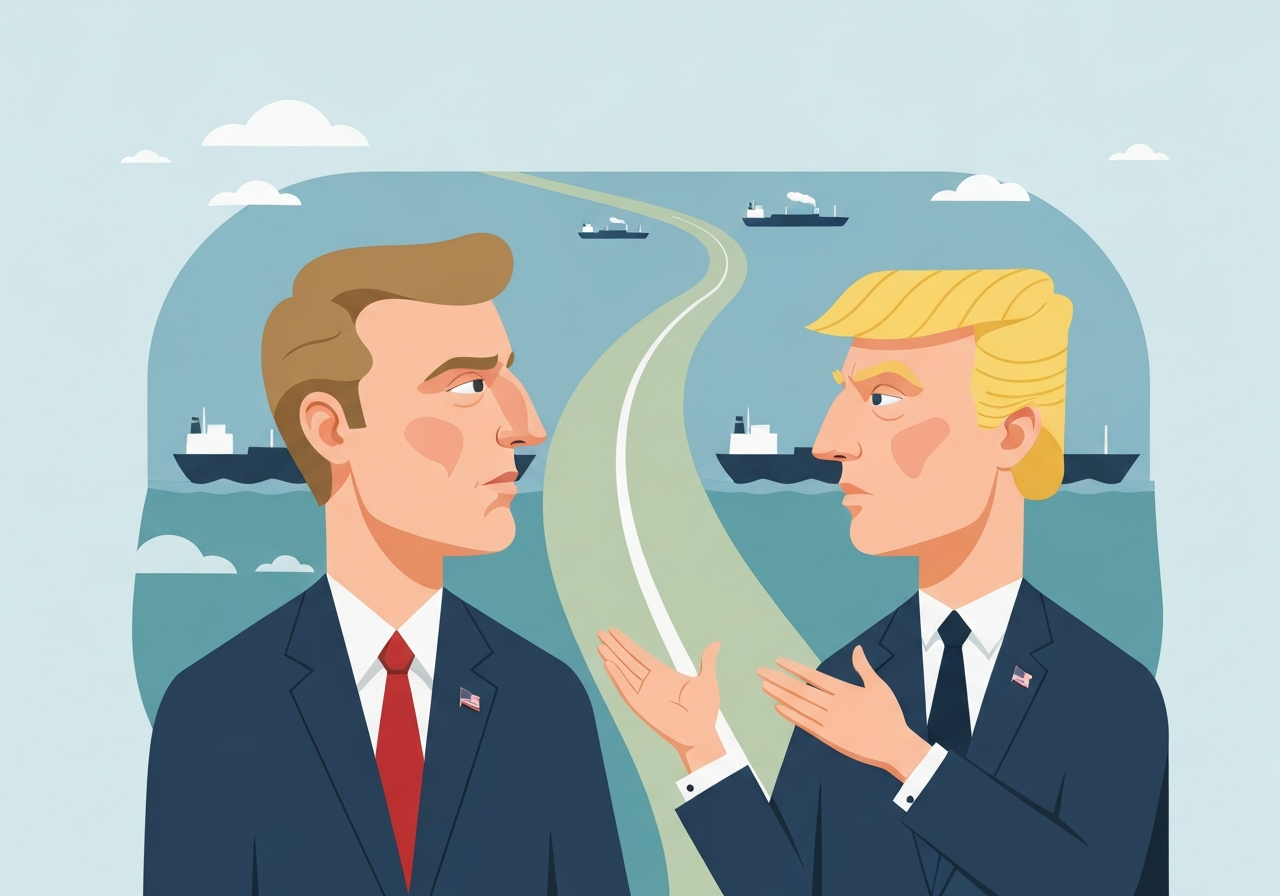
British Prime Minister Sir Keir Starmer and US President Donald Trump held a phone call on Sunday evening to discuss reopening the Strait of Hormuz amid the ongoing Middle East war that began on 28 February. Both leaders, according to a Downing Street spokesperson, said reopening the strait was essential to stabilise global energy markets as traffic through the waterway has fallen by about 95%. Sir Keir is due to chair a Cobra meeting on Monday — attended by the chancellor, foreign and energy secretaries and Bank of England governor Andrew Bailey — to assess the conflict’s impact on the cost of living. Downing Street said the two leaders agreed to speak again soon as ministers weigh economic and security responses.
- Leaders spoke Sunday evening; Downing Street said reopening the Strait of Hormuz is essential to stabilise energy markets.
- Shipping through the strait has slowed by roughly 95% since the Iran war began on 28 February, cutting a key route used by about 20% of the world’s oil and liquefied natural gas.
- Global crude oil has risen about 45% to $106 a barrel since hostilities began, amplifying cost-of-living pressure in the UK and beyond.
- The UK will hold a Cobra meeting on Monday including Chancellor, Foreign and Energy Secretaries and Bank of England Governor Andrew Bailey to discuss energy security and economic effects.
- The government announced a £53m package to help households facing higher heating oil bills; ministers will also examine business and supply-chain impacts.
- President Trump posted a social media ultimatum threatening to “obliterate” some Iranian power plants if the strait was not reopened in 48 hours; Tehran warned of targeting US-linked energy sites if strikes go ahead, per Iranian state media.
- UK officials said Iran has effectively blocked the strait since 28 February; the Israel Defense Forces said Tehran has weapons with ranges up to 4,000 km (2,485 miles).
- The government has authorised US use of British bases for strikes on Iranian sites linked to the Strait; those bases had previously been available only for defensive operations.
Background
The Strait of Hormuz is one of the world’s busiest chokepoints for maritime energy shipments; roughly 20% of global oil and liquefied natural gas transits the narrow waterway in normal times. On 28 February, the conflict that the UK government and other international actors describe as a war involving Iran and parties including the US and Israel began. Since then, commercial traffic through the strait has reportedly dropped sharply — Downing Street cites an approximate 95% slowdown — producing immediate effects on global fuel markets. Crude oil prices have responded strongly, rising about 45% to $106 a barrel, which in turn feeds through to higher energy bills and broader inflationary pressures in importing countries such as the UK.
Because of those economic effects, national security structures have moved into economic policy-making: Sir Keir will chair a Cobra meeting with senior ministers and Governor Andrew Bailey to co-ordinate fiscal, monetary and supply measures. The UK has also adjusted military permissions, allowing US forces to use British bases for strikes linked to reopening the strait; previously the bases were authorised principally for defensive actions. Domestic political actors, opposition parties and industry groups are pressing the government for clarity on contingency plans for energy supplies, commercial shipping and financial market interventions.
Main Event
The Sunday call between Sir Keir and President Trump focused on concerted action to reopen the Strait of Hormuz, Downing Street said. Officials described the conversation as centring on the link between maritime access and stability in global energy markets; both leaders agreed to stay in close contact and to speak again soon. The timing of the call precedes Monday’s Cobra meeting, where ministers will discuss direct economic measures including support for households facing higher heating oil costs and potential market interventions.
Parallel to diplomatic moves, the military situation has escalated. Iranian forces are reported to have effectively blocked the strait since 28 February; the Israel Defense Forces provided assessments of Iranian strike ranges of up to 4,000 km (2,485 miles), and UK ministers have said Iran launched ballistic missiles at the British-controlled Diego Garcia island — one missile reportedly failed and fell short while another was intercepted. Housing Secretary Steve Reed told the BBC the government is providing a £53m package to help households with heating oil costs and said there was no specific assessment that Iran was targeting the UK directly.
President Trump’s social media post on Saturday set a 48-hour ultimatum for opening the strait and warned of severe strikes on Iranian energy infrastructure if the route remained closed. Iranian state media responded by saying Tehran would target US-linked energy sites across the Gulf region if the US acted on the threat. Separately, ministers will also examine the impact on businesses and supply chains and coordinate an international diplomatic and military response.
Analysis & Implications
The near-total slowdown of traffic through Hormuz — if sustained — would sharply constrain global energy flows and raise systemic risk in energy-dependent supply chains. A roughly 45% rise in crude to $106 a barrel is already increasing inflationary pressure; for import-dependent economies this translates quickly into higher transport and heating costs and an erosion of real incomes. The UK’s £53m targeted assistance for heating oil users addresses a narrow but politically sensitive pocket of vulnerability, while the Cobra meeting signals cross-departmental coordination to manage both monetary and fiscal consequences.
Militarily, authorising US use of British bases for offensive strikes marks a tangible shift from a defensive posture to more active support for operations aimed at keeping the strait open. That decision carries legal, diplomatic and escalation risks: it ties UK facilities to potential strikes, which could broaden the geographic scope of confrontation and invite counterattacks. The reported Iranian missile capabilities — ranges up to 4,000 km — and incidents near Diego Garcia underscore the wider regional reach of the crisis and complicate risk assessments for overseas territories and allied bases.
Diplomatically, coordinated Anglo-American pressure to reopen Hormuz may prompt emergency negotiations with regional states and neutral shipping assurances, but it could also harden Iranian defences and reduce incentives for de-escalation. Markets are likely to remain jittery: even a partial reopening or an announced international convoy plan could calm prices temporarily, while renewed attacks on infrastructure or additional trade disruptions would push prices and insurance costs higher. For the UK, political consequences include scrutiny over the decision to allow offensive use of bases and questions about whether domestic support measures for households are sufficient.
| Metric | Before 28 Feb | Since 28 Feb |
|---|---|---|
| Commercial traffic through Hormuz | ~100% baseline | ~5% (reported 95% slowdown) |
| Share of world oil & LNG via Hormuz | ~20% | ~20% (route importance unchanged) |
| Brent crude price (approx.) | ~$73 per barrel | $106 per barrel (≈ +45%) |
| UK household heating oil support | — | £53m package announced |
These figures show the immediate market reaction (price) and the reported operational impact (traffic slowdown). The crude price comparison uses the BBC’s note that prices have risen about 45% to $106 a barrel; the earlier level implied is approximately $73 per barrel. The traffic slowdown figure is a Downing Street assessment reported to the BBC and is central to government urgency on reopening the strait.
Reactions & Quotes
“Agreed that reopening the Strait of Hormuz was essential to ensure stability in the global energy market.”
Downing Street spokesperson (official statement quoted to BBC)
“Obliterate” (threat to Iranian power plants if the strait was not opened within 48 hours).
Social media post attributed to President Donald Trump
“No specific assessment that the Iranians are targeting the UK — or even could if they wanted to.”
Housing Secretary Steve Reed (BBC interview)
Unconfirmed
- The precise operational extent and permanence of Iran’s alleged blockade of the strait — official reports describe it as “effectively blocked,” but independent real-time verification of total closure is limited.
- Specific targeting details and exact proximity of Iranian missiles to Diego Garcia remain withheld; ministers say operational details cannot be shared publicly.
- Reports that Tehran will definitely target specified US-linked energy sites if strikes occur are based on Iranian state media statements and are not independently verifiable.
Bottom Line
The Starmer–Trump phone call underlines how acute the intersection of military action and energy markets has become: a reported 95% slowdown through Hormuz and a roughly 45% jump in crude to $106 a barrel have made reopening the strait a priority for both economic and security reasons. London’s immediate response — a Cobra meeting, targeted household support and permission for US offensive use of UK bases — shows a blended political, economic and military strategy to limit market disruption and deter further escalation.
Risks remain high. Allowing offensive operations from British facilities raises diplomatic and escalation questions that will be scrutinised in Parliament and by international partners. For households and businesses, the coming days will reveal whether temporary market measures and diplomatic pressure can restore shipping access and stabilise prices, or whether protracted disruption will force larger fiscal and monetary responses.
Sources
- BBC News (UK broadcaster — news report summarising government and official statements)
- Downing Street / UK government (official statements and briefings)
- Israel Defense Forces (IDF) (official military statements)
- Iranian state media (IRNA) (state broadcaster reports cited by officials)