
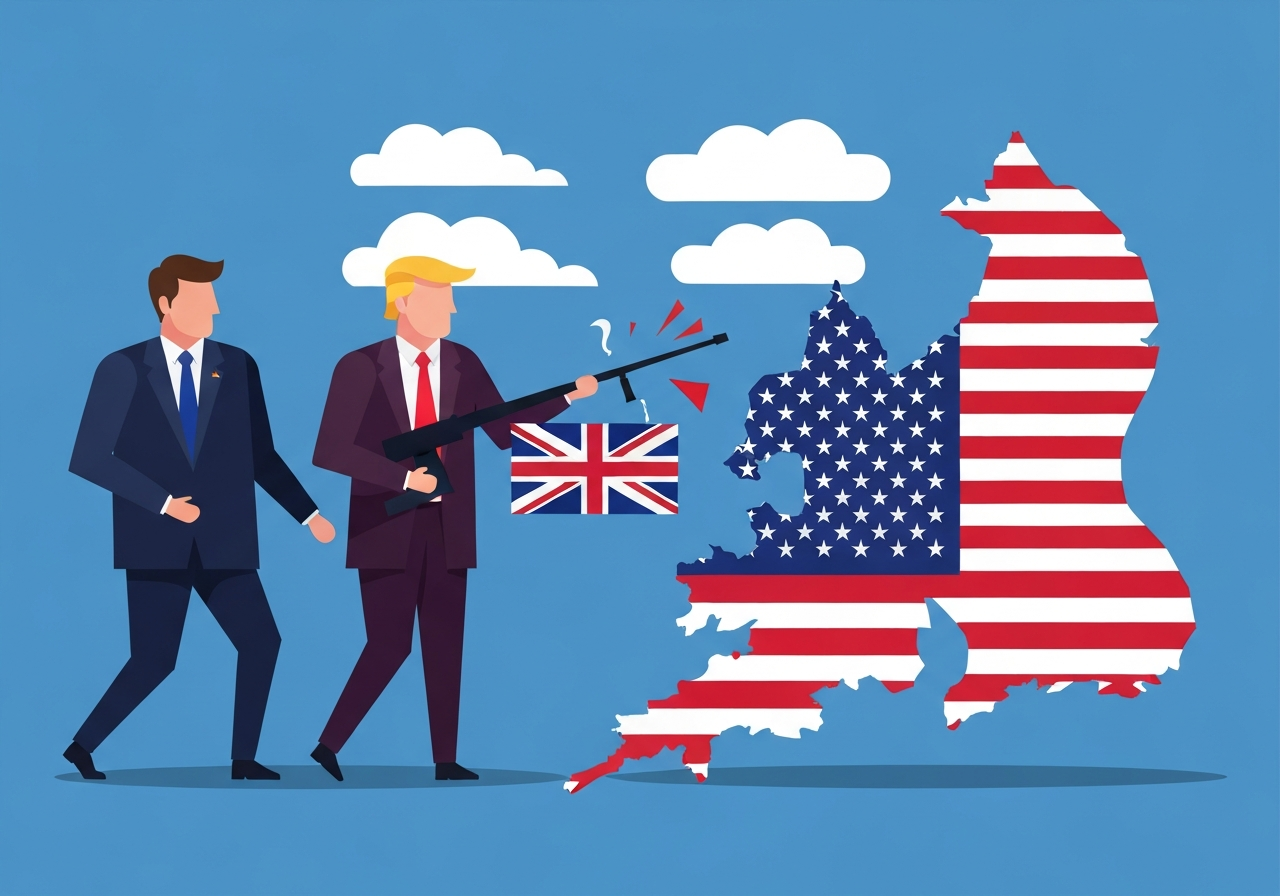
Lead: British Prime Minister Keir Starmer and U.S. President Donald Trump have publicly clashed this week after Starmer declined to join initial U.S.- and Israeli-led strikes on Iran, a dispute that has strained the long-standing U.K.–U.S. relationship. The disagreement centers on Britain’s decision-making about the use of British bases and the scope of any participation: Starmer initially blocked U.S. planes from U.K. facilities, then limited permission to strikes on ballistic missiles and storage sites from bases in England and Diego Garcia. The spat intensified after a British base at Akrotiri in Cyprus was struck by an Iran-made drone and after Trump criticized the prime minister in an interview with The Sun. The dispute is testing transatlantic ties that Starmer sought to strengthen since Trump’s 2025 return to the White House.
Key Takeaways
- Starmer initially denied U.S. aircraft access to British bases for the attacks on Iran that began Saturday; he later permitted use of bases in England and Diego Garcia strictly for strikes on ballistic missiles and their storage sites.
- Akrotiri, the U.K. base in Cyprus, was hit by an Iran-made drone over the weekend; the U.K. says it will not join offensive action following that incident.
- President Trump publicly rebuked Starmer in an interview with The Sun, saying the U.K. relationship is “much different” now and praising other European partners such as France.
- Starmer framed the U.K. stance around legality and planning: he told Parliament that any U.K. action must have a lawful basis and a thought-through plan, and that the government does not pursue “regime change from the skies.”
- Domestic reaction is split: polling indicates public skepticism about the U.S. justification for war, while right-leaning U.K. politicians — including Conservative leader Kemi Badenoch — urged support for U.S. action.
- Diplomatic friction has built over months, tied to past disputes including Trump’s Greenland comments and contention over the Chagos Islands/Diego Garcia handover to Mauritius.
- Senior figures have weighed in: a former U.K. foreign official warned of U.S. inconsistency on international law, while the U.K. Foreign Office minister defended the durability of the special relationship.
Background
The bilateral relationship between the United Kingdom and the United States has been through recurrent tensions since President Trump’s return to office in 2025, driven by an “America first” orientation and a transactional diplomatic style. Keir Starmer, who has worked to cultivate stable ties with Washington, welcomed aspects of Trump’s mediation efforts on others issues, including attempts — so far unsuccessful — to end the Russia–Ukraine war. Despite that outreach, recent policy disputes have exposed limits to cooperation when national legal standards and strategic judgements diverge.
Specific flashpoints predate the Iran strikes: earlier this year Starmer and other European leaders protested Trump’s suggestion about Greenland, and the U.K.–U.S. relationship was further strained by disagreements over the handover of the Chagos Islands and the status of Diego Garcia, a key British-held base in the Indian Ocean. Those disputes fed into a broader debate in London about aligning with U.S. military action versus preserving Britain’s obligations under international law.
Main Event
The immediate crisis began when the United States and Israel launched strikes on Iran on Saturday. The U.K. government first refused American requests to use British airfields in support of those strikes. Days later, after consultations, London consented to the limited use of bases in England and Diego Garcia — but explicitly restricted strikes to Iran’s ballistic missiles and storage sites, excluding broader targets.
During the same period, Akrotiri in Cyprus, a long-running U.K. base, was struck by a drone identified as Iran-made. Starmer responded by reiterating that the U.K. “will not join offensive action,” framing that choice as consistent with Britain’s legal obligations and strategic calculations rather than as a rebuke of the United States.
President Trump, speaking to The Sun, criticized the British response and publicly questioned whether the bilateral relationship is as close as before. His remarks singled out France as having been cooperative while saying “the U.K. has been much different.” Downstream, British opposition figures on the right pushed for closer alignment with the U.S., while ministers in Starmer’s government emphasized restraint and legal scrutiny.
Analysis & Implications
The dispute highlights a recurring tension in alliance management: solidarity on security can collide with domestic legal standards and political calculations. For Starmer, a former barrister and chief prosecutor, the legal framing of any military action is politically and politically salient; insisting on a lawful basis and a viable plan speaks to both legal constraints and an effort to maintain public legitimacy at home.
Strategically, the U.K.’s limited participation — allowing use of bases but restricting target sets — signals a calibrated approach intended to preserve operational cooperation with the U.S. while avoiding deeper escalation. That posture may reassure allies concerned about hasty escalation, but it risks alienating U.S. policymakers who expect close partners to match Washington’s choices in high-stakes moments.
Politically, the disagreement offers fodder to domestic rivals: Conservatives and right-leaning commentators have pressed Starmer to show greater solidarity with the U.S., while the Labour leader’s base and a skeptical public may reward restraint. Internationally, fractured European responses suggest the conflict could realign short-term coalitions around defensive versus offensive measures, complicating NATO coordination and regional security planning.
Comparison & Data
| Actor | Public Position on Strikes | Role/Action |
|---|---|---|
| United States (Trump) | Supports offensive strikes | Led strikes; sought allied basing |
| United Kingdom (Starmer) | Permitted limited basing; declined offensive participation | Allowed strikes on missiles/storage only |
| France & Germany | Not involved in strikes; supportive of defensive actions | Prepared to enable defensive measures |
| Spain (Sánchez) | Condemned the strikes | Called actions “unjustifiable” |
The table summarizes public stances as reported. These positions reflect a spectrum from backing robust offensive measures to calling for restraint and legal review. That divergence complicates coalition-building for any follow-on operations and suggests differing national thresholds for action.
Reactions & Quotes
Official and public reactions have been mixed, with sharp commentary from Washington and guarded defences from London. Below are selected statements with context.
“The U.K. has been much different from others.”
Donald Trump, U.S. President (interview with The Sun)
Trump’s comment to the tabloid framed his disappointment directly at Starmer, singling out perceived differences among European partners and signalling public displeasure that could influence bilateral posture forward.
“We will not join offensive action.”
Keir Starmer, U.K. Prime Minister (House of Commons)
Starmer used this declaration to draw a legal and moral line: the government insists on a lawful basis and a clear plan before committing British forces to offensive operations, a stance intended to reassure Parliament and the public.
“Under Trump, the Americans have effectively given up on any effort to be consistent with international law.”
Peter Ricketts, former head of the U.K. Foreign Office (The Observer)
The former senior diplomat framed the dispute as emblematic of deeper differences over international norms, adding a critical voice that amplifies concerns in parts of the U.K. foreign-policy establishment.
Unconfirmed
- Reports vary on the full legal assessments that guided the U.K. decision; the exact internal legal advice has not been published and remains unreleased to the public.
- Some media accounts attribute broader or different statements to NATO leadership and European officials; the alignment and language of those statements require cross-verification with primary transcripts or official releases.
Bottom Line
The standoff between Starmer and Trump underscores a deeper friction in modern alliance politics: shared security interests do not eliminate sovereign legal standards, domestic politics, or differing threat thresholds. Starmer’s cautious stance prioritizes legal justification and parliamentary accountability, while the U.S. administration has pushed for more immediate allied support for offensive operations.
Going forward, the dispute may cool if diplomatic channels produce clearer common objectives and operational boundaries; if not, the episode could leave a lingering chill in U.K.–U.S. cooperation, complicating joint planning on Iran and other theaters. For London, the immediate imperative is to balance alliance obligations with legal and political constraints at home.
Sources
- Associated Press (news report)
- The Sun (news outlet; published interview referenced)
- Financial Times (news analysis)
- The Observer (news; cited commentary)
- UK Parliament (House of Commons) (official record of statements)