
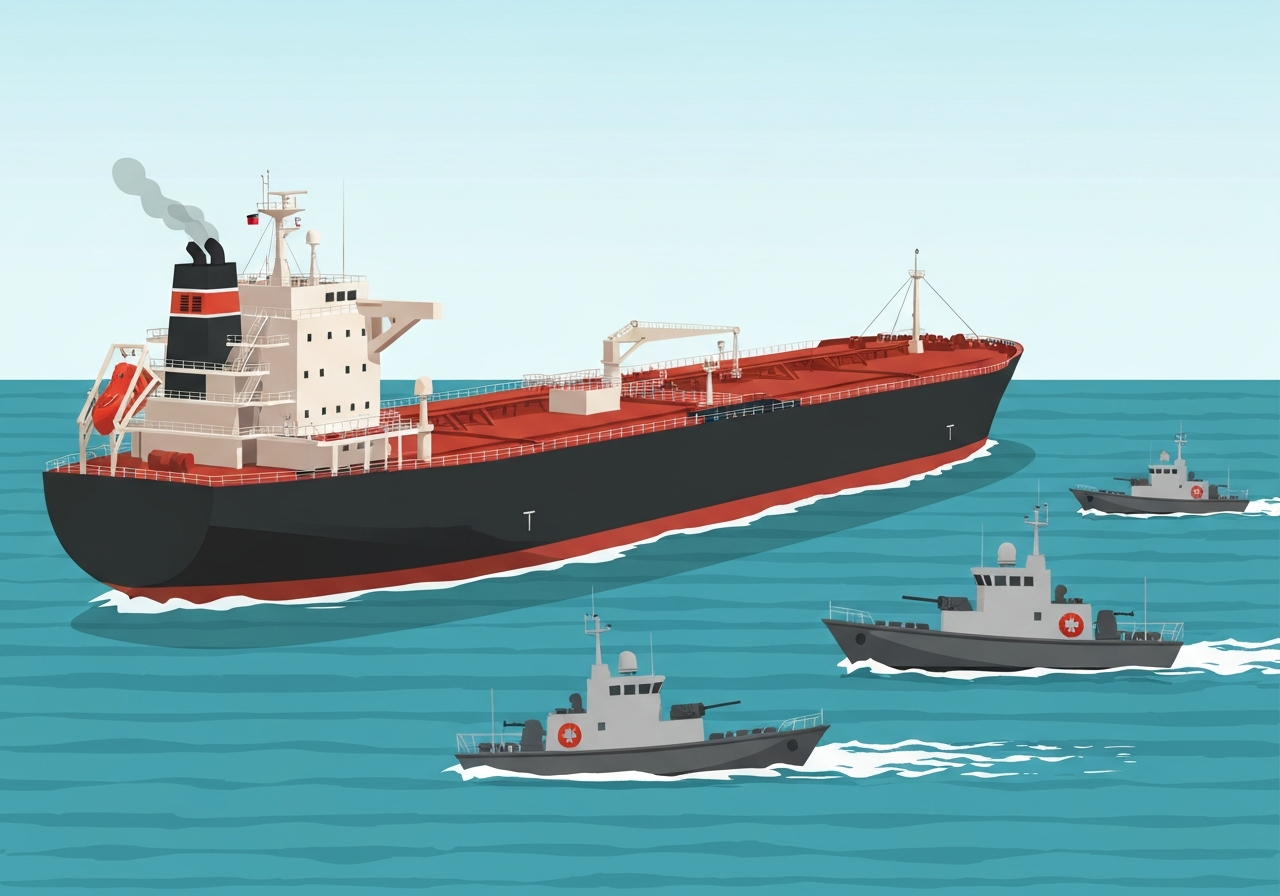
— A U.S.-flagged tanker, the Stena Imperative, was approached and ordered to stop by small armed boats identified by a maritime security company as belonging to Iran’s Islamic Revolutionary Guard Corps while transiting the Strait of Hormuz near Oman. The encounter occurred about 16 nautical miles north of Oman’s coast; the tanker did not change course, remained outside Iran’s territorial sea, and was later joined by a U.S. warship that escorted it toward Sitrah, Bahrain. Regional advisory authorities urged caution for vessels in the waterway as investigators sought to reconcile differing accounts from the security firm, the UK maritime reporting office and Iranian state media. The episode adds to already high tensions between Tehran and Washington just days before planned talks.
Key Takeaways
- Incident date and location: The approach occurred on Feb. 3, 2026, in the Strait of Hormuz roughly 16 nautical miles north of Oman’s coast.
- Vessel involved: The tanker was the U.S.-flagged Stena Imperative; MarineTraffic data showed it remained within Oman’s exclusive economic zone while transiting.
- Contacting parties: Vanguard Tech reported three pairs of small armed boats, which hailed the tanker and ordered it to stop and prepare for boarding.
- Response and escort: The ship maintained speed and course and, according to Vanguard Tech, was later escorted by a U.S. warship en route to Sitrah, Bahrain, with arrival scheduled on Feb. 5.
- Official advisories: UKMTO issued a safety notice saying a merchant vessel was hailed by numerous small armed vessels and continued on its planned route.
- Contradictory accounts: Iran’s Fars news agency, citing unnamed officials, denied the claim and said an interception followed an unauthorized entry into Iranian waters.
- Strategic context: The Strait of Hormuz remains a critical chokepoint for oil and LNG shipments and has been the focus of recent Iranian exercises and U.S. naval deployments.
Background
The Strait of Hormuz links the Persian Gulf and the Gulf of Oman and is one of the world’s most vital passages for crude oil and liquefied natural gas. Because of its strategic importance, incidents in the strait draw rapid attention from coastal states, commercial shipping operators and naval forces. In recent months tensions between the United States and Iran have risen, driven by reciprocal warnings, naval manoeuvres and political rhetoric in Washington and Tehran.
Maritime security companies and reporting centers such as UKMTO routinely monitor and publish alerts about suspicious activity in the region; those reports are used by commercial operators to adjust routing and by naval assets for situational awareness. Past events in the strait have included close approaches, seizures and the use of small fast boats in harassment or interdiction roles, creating a pattern that shapes how operators respond when vessels are hailed or shadowed.
Main Event
According to a statement from British security firm Vanguard Tech, the Stena Imperative was hailed on VHF by pairs of small, armed boats identified as belonging to the Islamic Revolutionary Guard Corps while transiting north of Oman. Vanguard Tech reported that the boats ordered the tanker’s captain “to stop the engines and prepare to be boarded,” but the ship increased speed and held course, and did not enter Iranian territorial waters.
UKMTO posted an advisory earlier that a vessel had been hailed by numerous small armed vessels and had ignored calls, continuing on its planned route; that advisory did not name the ship or the nationality of the boats. MarineTraffic tracking data cited by commercial sources showed the Stena Imperative positioned outside the 12-nautical-mile territorial limit, within Oman’s maritime economic zone.
Vanguard Tech said a U.S. warship subsequently began escorting the tanker toward Bahrain. Iran’s Fars news agency disputed Vanguard Tech’s account, asserting that a vessel had been interdicted after entering Iranian waters without permission; Fars cited unnamed officials in its denial. UKMTO and other maritime authorities warned vessels to exercise caution while transits in the strait continue.
Analysis & Implications
The incident highlights the asymmetric nature of maritime friction in the Gulf: small, fast craft can create diplomatic headaches and operational risk without matching the firepower of larger ships. Even short, non-contact episodes can escalate perceptions of threat, prompting naval escorts or changes to commercial routes that raise costs and increase insurance premiums for shippers.
Because the Stena Imperative reportedly stayed beyond the 12-nautical-mile territorial boundary, the encounter centers on questions of intent and maritime rules of navigation. If the vessel remained in Oman’s EEZ and international waters, actions short of seizure fall into a gray area where state claims and commercial freedom of navigation collide. That ambiguity complicates legal and diplomatic responses and often leaves verification to third-party tracking data and on-scene naval reports.
The timing — days before planned U.S.-Iran talks — increases the political stakes. Tehran’s denials and the differing public accounts make it difficult to assign responsibility conclusively; each side can use the episode to justify hardline positions or to rally domestic support. For regional actors and global energy markets, repeated episodes risk prompting rerouting or precautionary measures that would raise shipping times and insurance costs.
Comparison & Data
| Item | Detail |
|---|---|
| Reported ship position | ~16 nautical miles north of Oman’s coast (outside 12 nm territorial sea) |
| Territorial sea limit | 12 nautical miles from baseline (UNCLOS standard) |
| Scheduled ETA | Sitrah, Bahrain — Feb. 5, 2026 (MarineTraffic) |
The table summarises available positional detail and legal thresholds. Public track data showed the tanker did not cross the 12-nautical-mile territorial sea line; that places the encounter in international waters or an EEZ depending on exact coordinates. Commercial trackers and naval AIS feeds are commonly used to corroborate claims when state statements diverge.
Reactions & Quotes
“The vessel was hailed and ordered to stop the engines and prepare to be boarded,” Vanguard Tech said, describing the exchange and the subsequent U.S. escort.
Vanguard Tech (security firm statement)
This quote was issued as part of the security firm’s incident report and used by maritime advisories to inform shipping operators.
UKMTO said the merchant vessel was “hailed on VHF by numerous small armed vessels” and continued on its planned route.
UKMTO (maritime advisory)
UKMTO’s advisory intentionally omitted vessel nationality, a common practice designed to provide safety alerts without attributing blame pending verification.
Iranian state-linked media denied the Vanguard Tech account, saying an interception followed an unauthorized entry into Iranian waters.
Fars News Agency (state-linked media)
Fars cited unnamed officials; the agency’s account conflicts with independent tracking data indicating the ship remained outside the 12-nautical-mile limit.
Unconfirmed
- Whether the approaching boats intended to board the Stena Imperative or were attempting only to inspect it — motives have not been independently verified.
- The precise identity and affiliation of every small boat involved; Vanguard Tech identified them as IRGC craft but that attribution is contested by Iranian state media.
- The extent and timing of the U.S. naval presence relative to the approach — Vanguard Tech reported an escort, but public confirmation from U.S. military channels was not cited in initial reports.
Bottom Line
The Feb. 3 encounter involving the Stena Imperative underscores how quickly routine commercial transits in the Strait of Hormuz can become flashpoints. Available tracking data and independent advisories indicate the tanker remained outside Iran’s territorial sea and continued to Bahrain under reported U.S. escort, but competing narratives from security firms and Iranian state media leave aspects unresolved.
For mariners and policymakers, the episode reinforces the need for verified, shared situational awareness and clear communication channels to reduce the risk of miscalculation. As U.S. and Iranian officials prepare for talks later this week, monitoring agencies and naval forces will likely remain on heightened alert; further public statements or third-party confirmation will be needed to close outstanding questions.
Sources
- CBS News (news report quoting Vanguard Tech and others)
- Vanguard Tech (security firm statement)
- UKMTO (official maritime reporting/advisory)
- MarineTraffic (commercial vessel-tracking data)
- Fars News Agency (Iran state-linked media)