
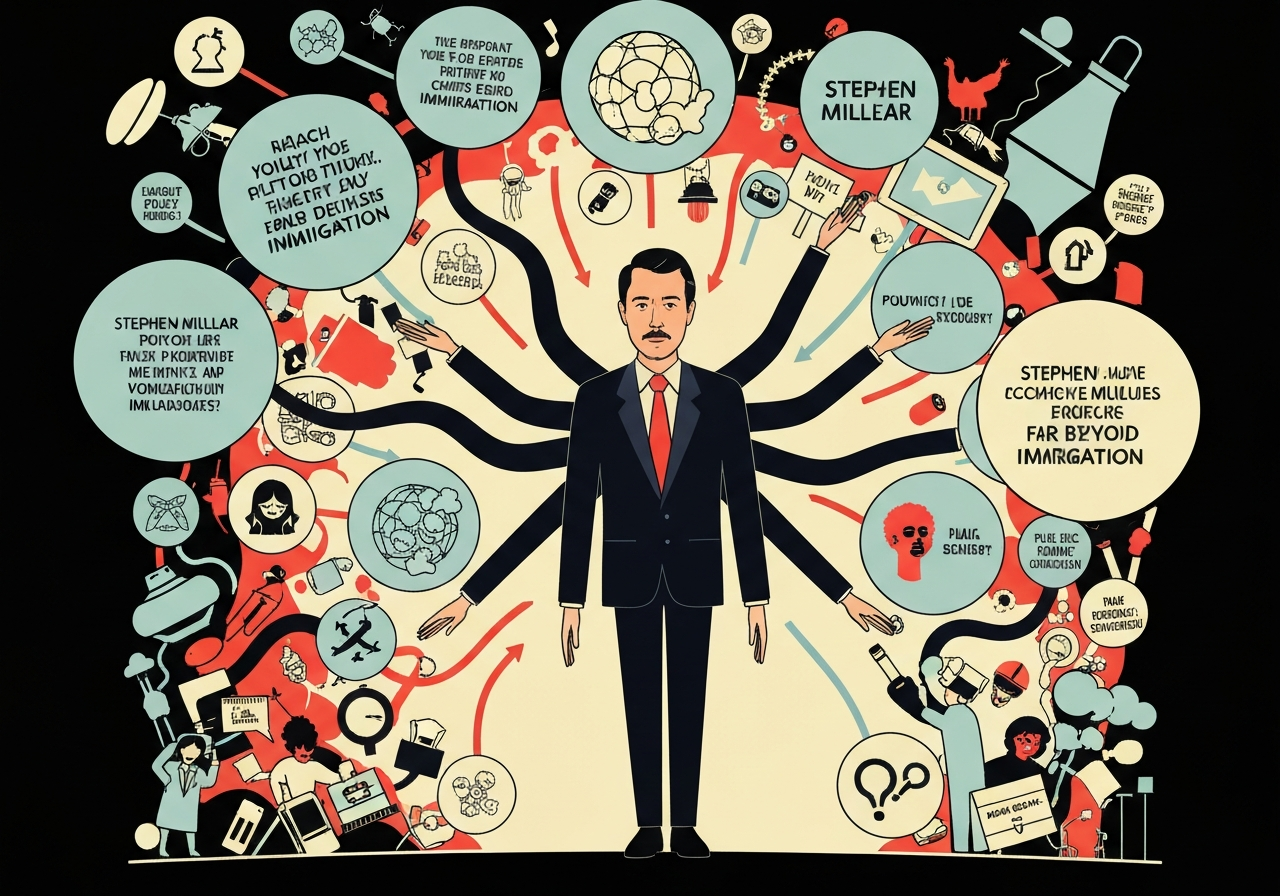
Stephen Miller has emerged as one of the most durable and wide-ranging operatives in the Trump White House, wielding influence across immigration, campus policy, city affairs and homeland security. Over more than a decade in Trump circles he has accumulated responsibilities that put him at the center of daily policy decisions, from daily 10:00 a.m. meetings to hands-on coordination with federal and city officials in Washington, D.C. His expanded portfolio has drawn both praise from allies and sharp criticism from opponents after high-profile incidents involving federal agents in Minnesota. The result is a powerful aide whose authority and methods are reshaping how the administration pursues the president’s agenda.
- Tenure and role: Miller has served in Trump’s orbit for roughly 11 years and currently holds dual roles as Deputy Chief of Staff for Policy and Homeland Security Adviser.
- Daily operations: He leads a regular 10:00 a.m. meeting with senior federal officials where topics have ranged from cartel disruptions to the fate of a suspicious vessel in the Caribbean.
- Campus pressure: Miller is driving the administration’s initiative to push elite universities on what the president describes as entrenched liberal or ‘woke’ influences, with institutions such as Harvard and Duke singled out for scrutiny.
- Local projects: He has taken charge of details in Washington, D.C., pressing officials on issues like malfunctioning fountains, broken security cameras and graffiti cleanup as part of a broader beautification and safety push.
- Controversy: The administration faced a national uproar after federal agents shot and killed two protesters in Minnesota, Renee Good and Alex Pretti, episodes that intensified scrutiny of policies Miller championed.
- Political backing: Some Republicans, including Sen. Ted Cruz, have publicly defended Miller, while retiring Sen. Thom Tillis and other critics have called for restraint or removal following contentious incidents.
- Operational style: Current and former officials describe Miller as relentless and detail-oriented, able to author and fast-track executive orders and to press agencies for rapid implementation.
Background
Stephen Miller rose to prominence on the 2016 Trump campaign and has been one of the few senior aides to remain continuously in the president’s inner circle. That continuity stands in contrast to many early campaign figures who have since departed or been sidelined, and it helps explain how Miller amassed authority across policy areas. His influence is rooted in the trust and ideological alignment he shares with President Trump, including a shared priority on immigration enforcement and cultural battles on college campuses.
The administration has explicitly sought to use the levers of federal power to reshape institutions it views as unsympathetic, from universities to urban management. Miller’s role combines policy design with operational pressure: he helps draft executive orders, coordinates cross-agency work, and presses local officials on visible problems in the capital. Those activities fit a broader MAGA-era pattern of prioritizing rapid, visible outcomes that appeal to the president’s base.
Main Event
Inside the White House, Miller’s daily rhythm includes convening senior officials for a morning session that can touch on disparate items, from counter-narcotics operations to municipal maintenance. The breadth of subjects reflects a long leash from the president that allows Miller to embed himself in both domestic and foreign priorities. Officials say Miller is directly involved in pushing university investigations and enforcement actions that align with the administration’s critique of ‘woke’ campus culture.
The aftermath of federal operations in Minnesota intensified attention on Miller because those enforcement actions were associated with policies he helped shape. A week after federal agents killed Renee Good in Minneapolis, Miller publicly defended agents’ authority; when another protester, Alex Pretti, was killed on Jan. 24, Miller described the individual in forceful terms on social media, language critics said outpaced the available evidence. A preliminary DHS review sent to Congress on Jan. 27 did not corroborate claims that Pretti attacked officers or brandished a weapon.
Miller’s portfolio also reaches municipal concerns inside Washington, D.C., where he has led meetings about public safety, sanitation and the city’s aesthetics. Officials described discussions that ranged from crime statistics and murder clearance rates to fixing dry fountains and removing graffiti, framed as part of making the capital both safer and more visually appealing. These local interventions underscore how Miller’s remit extends beyond conventional homeland-security tools into quality-of-life matters.
Despite periodic calls from lawmakers for his resignation and recurrent media speculation that he might be sidelined, Miller remains in place. Support from influential allies, and the president’s apparent appreciation for his relentlessness, have helped him withstand controversies that felled other officials in past administrations.
Analysis & Implications
Miller’s consolidation of roles signals a choice by the administration to centralize policy direction in a trusted adviser rather than diffuse responsibilities across multiple offices. That model increases speed and coherence for priorities the president cares about, but it also concentrates political risk. If a high-profile enforcement action or policy push triggers a public backlash, the political fallout is more readily traced to a small group of visible actors.
Operationally, Miller’s approach favors executive orders and rapid issuance of directives that can be implemented before legislative or judicial checks take hold. Former and current officials describe a capacity to draft and push executive orders on short timelines, an attribute that suits an administration conscious of electoral calendars: the president has less than three years remaining of the current term, and a change in congressional control following the November midterms could impede the agenda.
The administration’s campus-focused strategy illustrates how cultural issues are being folded into federal enforcement and funding levers. By pressing universities over speech, antisemitism, and federal dollars, the White House is attempting to translate ideological priorities into administrative oversight; this raises constitutional and institutional questions about academic freedom and federal authority that are likely to be litigated or contested in public debate.
Internationally and domestically, a centralizing aide like Miller can speed decisions in crises but may also limit input from regional or subject-matter experts. Several officials described after-hours calls and tight timetables that can pressure agencies to act quickly, which may produce policy seams or unintended consequences if not all perspectives are considered.
Comparison & Data
| Figure | Example |
|---|---|
| Tenure | Approximately 11 years in Trump political orbit |
| Daily role | Leads 10:00 a.m. senior official meeting covering varied topics |
| Policy reach | Immigration enforcement, campus oversight, D.C. beautification, homeland security coordination |
| Political contrast | Other aides have held multiple titles (e.g., Marco Rubio had four titles at one point) but few match Miller’s combination of policy and operational control |
This table summarizes the attributes that differentiate Miller from many contemporaries: long service, a fixed daily convening role, and a portfolio that blends policy drafting with operational pressure. Those features help explain his resilience amid controversies and why allies describe him as indispensable to executing the president’s agenda.
Reactions & Quotes
He wants to focus on it.
Sen. Lindsey Graham
Graham used that phrase to describe Miller’s interest in reshaping universities, noting direct conversations with Miller about the administration’s education priorities.
Stephen Miller is a great American.
Sen. Ted Cruz
Sen. Cruz offered public praise on social media as critics called for scrutiny; his post represents a segment of GOP backing that has helped shield Miller from removal.
intelligent, hardworking, and loyal
Karoline Leavitt, White House Press Secretary
The White House press office defended Miller’s record and described his role as bringing coordination across corners of government to implement policy rapidly.
Unconfirmed
- Claims that Alex Pretti attacked or brandished a weapon during the Jan. 24 incident are not supported in the preliminary DHS review shared with Congress.
- Media speculation that Stephen Miller is on the verge of removal from his posts remains unverified; no official change has been announced.
Bottom Line
Stephen Miller has transformed from a campaign speechwriter into a central operator whose remit spans immigration, campus policy, local urban issues and homeland security coordination. That breadth is a function of long-term trust with the president, an appetite for rapid execution, and a willingness to press agencies and local officials for visible outcomes.
His position offers the administration both advantages and vulnerabilities: centralization speeds implementation of priorities but concentrates political exposure when policy decisions produce controversy. In the months ahead, legal challenges, congressional oversight and the November midterm dynamics will shape how much of Miller’s agenda endures and which parts are altered or reversed.
Sources
- NBC News (original reporting, media)