
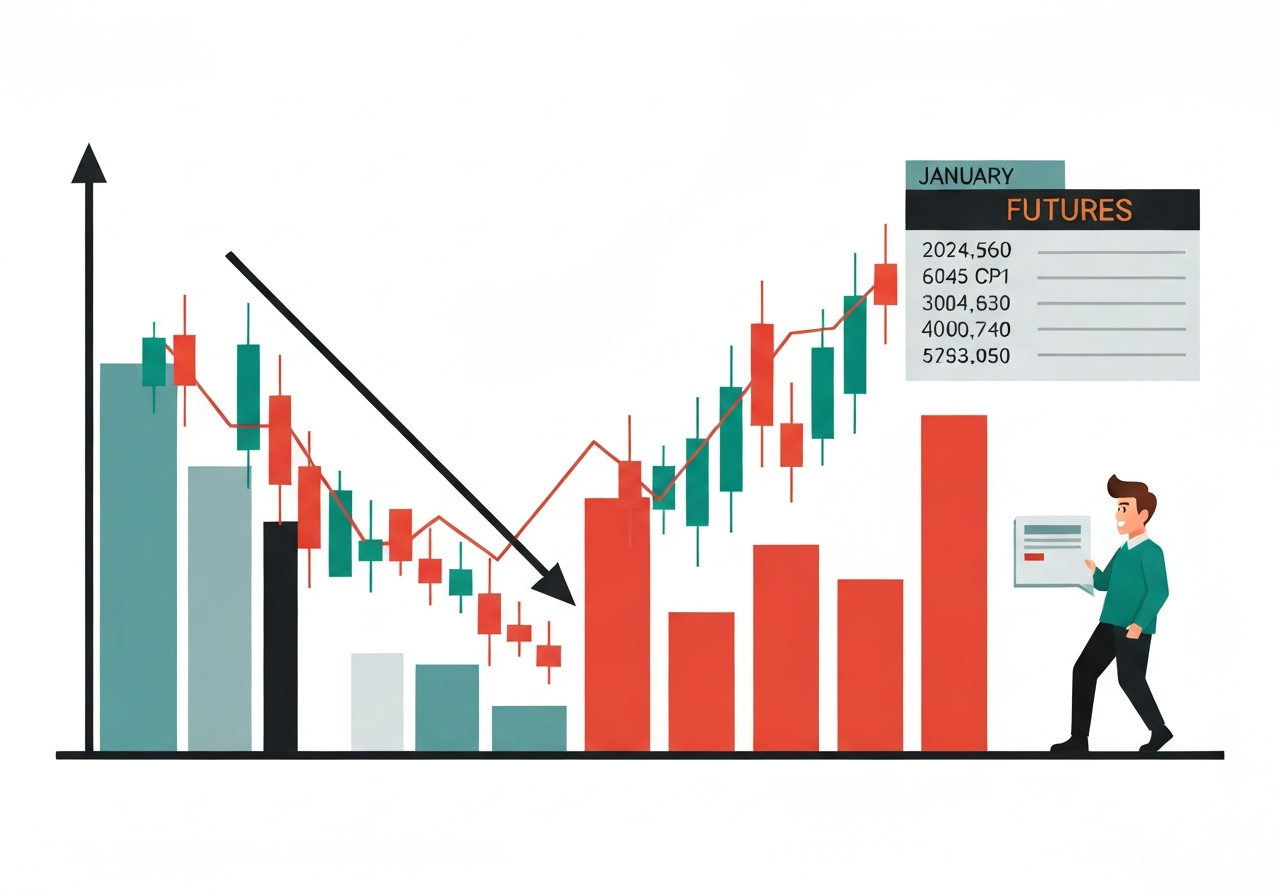
U.S. stock-index futures drifted lower on Friday as traders prepared for the release of January’s consumer price index (CPI), a report expected to shape near-term market direction. S&P 500 and Nasdaq 100 futures were each down about 0.2%, while Dow futures fell roughly 109 points (0.2%). The move followed a broad Thursday sell-off that hit technology and other cyclical sectors, even as several individual stocks rallied after earnings and guidance updates.
Key Takeaways
- S&P 500 futures fell about 0.2%; Nasdaq 100 futures down 0.2%; Dow futures slipped ~109 points (0.2%).
- Applied Materials jumped about 11% in early trading after reporting adjusted EPS of $2.38 on $7.01 billion in revenue, beating LSEG estimates of $2.20 and $6.87 billion.
- Airbnb shares rose near 6% on confident guidance; Pinterest shares tumbled roughly 20% after a Q4 miss and weak outlook.
- Major U.S. averages dropped on Thursday: S&P 500 ~1.6%, Nasdaq Composite ~2.0%, Dow Jones Industrial Average ~670 points (1.3%).
- Cisco slid about 12% on disappointing guidance; Apple fell roughly 5%, its largest one-day loss since April 2025.
- Economists polled by Dow Jones expected January CPI to show a 2.5% year-over-year rise and a 0.3% month-over-month increase.
- The three major averages were set for weekly losses through Thursday: S&P 500 and Dow down more than 1%; Nasdaq on track for a ~1.9% weekly decline.
Background
Markets entered Friday coming off a broad equity pullback driven in part by renewed doubts about winners in the artificial intelligence (AI) investment theme. Recent earnings and guidance from large-cap tech companies have prompted investors to sort high-conviction positions from names that may face tougher competition or slower growth.
The wider context includes resilient labor-market data earlier in the week and lingering questions about inflation’s path after tariff changes and other policy moves in 2025. Headline CPI was 2.7% in December and core CPI (excluding food and energy) was 2.6%—benchmarks that markets watch closely for implications on Federal Reserve policy.
Main Event
On Friday morning, futures markets showed modest downside as participants awaited the Bureau of Labor Statistics’ January CPI print. Traders were pricing the possibility that a weaker-than-expected inflation read could relieve near-term rate-hike fears, while a hotter print could revive concerns about more restrictive policy.
Company-specific news added intra-day dispersion. Semiconductor-equipment maker Applied Materials surged roughly 11% after beating adjusted earnings expectations and issuing upbeat commentary. Airbnb’s shares climbed about 6% on forward-looking guidance, while Pinterest slumped near 20% after missing Q4 revenue and lowering near-term outlooks.
Following Thursday’s rout, every member of the so-called Magnificent Seven closed lower, amplifying sectoral weakness. Cisco’s approximately 12% decline, triggered by weaker guidance, was a notable negative for market breadth. Apple endured an around 5% drop—the firm’s sharpest daily fall since April 2025—contributing materially to the Dow’s roughly 670-point slide on Thursday.
After-hours and other corporate updates further colored sentiment: Coinbase reported 2025 trading volume of $5.2 trillion (up 156% year-over-year) and higher subscription and services revenue; Rivian projected 2026 deliveries of 62,000–67,000 units, implying a 47%–59% increase from 2025, and posted Q4 results that beat certain loss and revenue expectations.
Analysis & Implications
January’s CPI reading is positioned to be the immediate market catalyst. A 2.5% year-over-year headline print—the Dow Jones median call—would mark a step down from December’s 2.7% but still leave inflation above the Fed’s 2% target. Investors will focus on whether the downtrend continues and whether core inflation shows sustained moderation.
If inflation cools as expected, markets may interpret it as reducing the odds of further Fed tightening, which would likely support equities, particularly rate-sensitive sectors such as real estate and utilities. Conversely, a hotter-than-expected print could revive rate-risk pricing, weigh on growth stocks and intensify sector rotations away from long-duration tech names.
The divergent corporate earnings picture complicates the outlook. Strong results and guidance from capex beneficiaries such as semicap suppliers and hyperscaler-related vendors suggest pockets of durable demand. At the same time, guidance misses and sharp equity moves in some software and consumer-adjacent names highlight how quickly market leadership can shift amid uncertain macro signals.
On a policy horizon, a persistent core CPI above 2% would keep markets vigilant for additional Fed communication or policy actions. International investors will also watch U.S. inflation versus counterparts as currency and safe-haven flows could adjust if dollar or Treasury yields move materially on the CPI surprise.
Comparison & Data
| Series | Prior Move | Futures/Change (FRI AM) |
|---|---|---|
| S&P 500 (Thu) | -1.6% | Futures -0.2% |
| Nasdaq Composite (Thu) | -2.0% | Futures -0.2% |
| Dow Jones (Thu) | -670 pts (-1.3%) | Futures -109 pts (-0.2%) |
| Applied Materials (after-hours) | — | +11% (beat EPS $2.38; revenue $7.01B) |
| Pinned CPI consensus | Dec headline 2.7% / core 2.6% | Jan estimate: 2.5% YoY / 0.3% MoM |
The table highlights the scale of Thursday’s declines vs. Friday morning futures positioning and shows where corporate beats and misses are concentrating. Traders will be watching the CPI print against recent readings that have trended down from the September 2025 peak near 3%.
Reactions & Quotes
Market strategists and participants gave varied takes on the recent sell-off and what to expect from the CPI release.
“There’s some steam coming out of certain names as the market determines winners and losers, but this is not an AI bubble — overall markets are holding up reasonably well,”
Brian Levitt, Global Market Strategist, Invesco
Levitt’s comment framed the pullback as selective rather than systemic; investors interpreted it as a rotation in convictions rather than a broad collapse. That view helps explain why pockets of earnings-driven strength, such as Applied Materials, can coexist with sharp declines in other names.
“Hyperscalers are treating early capex as a competitive advantage and are unlikely to announce big pullbacks mid-year,”
Paul Meeks, Head of Technology Research, Freedom Capital Markets
Meeks’ observation underscores why some investors remain constructive on tech-related capital spending despite headline volatility. Market participants see the capex cycle as a multi-year structural story that may sustain demand for certain suppliers.
Unconfirmed
- Causality between specific tariff changes in 2025 and near-term January price moves remains debated; some economists link them to earlier price shifts but direct attribution for January is not yet substantiated.
- Reports that major hyperscalers will materially increase or cut 2026 capex mid-year are speculative until companies issue formal guidance updates.
- Short-term correlations between AI sentiment and declines in real estate or trucking require further data to establish a sustained causal relationship.
Bottom Line
Friday’s trading left markets in a holding pattern ahead of a key inflation reading that could influence Fed expectations and the mix of winners and losers in the equity market. The immediate risk-reward hinges on whether January CPI confirms the recent downtrend from the September 2025 peak.
Corporate earnings continue to drive idiosyncratic moves—some firms beat and rallied sharply while others disappointed and saw deep sell-offs—so investors should expect heightened dispersion across sectors. Over the coming weeks, focus will center on CPI details, Fed communications and whether capex plans from large tech players translate into sustained demand for suppliers.
Sources
- CNBC — Market live updates (media)
- U.S. Bureau of Labor Statistics — CPI release and methodology (official)
- Applied Materials Investor Relations — Company press releases and filings (company IR)
- Rivian Investor Relations — Earnings & guidance (company IR)
- Coinbase Investor Relations — Financial results (company IR)