
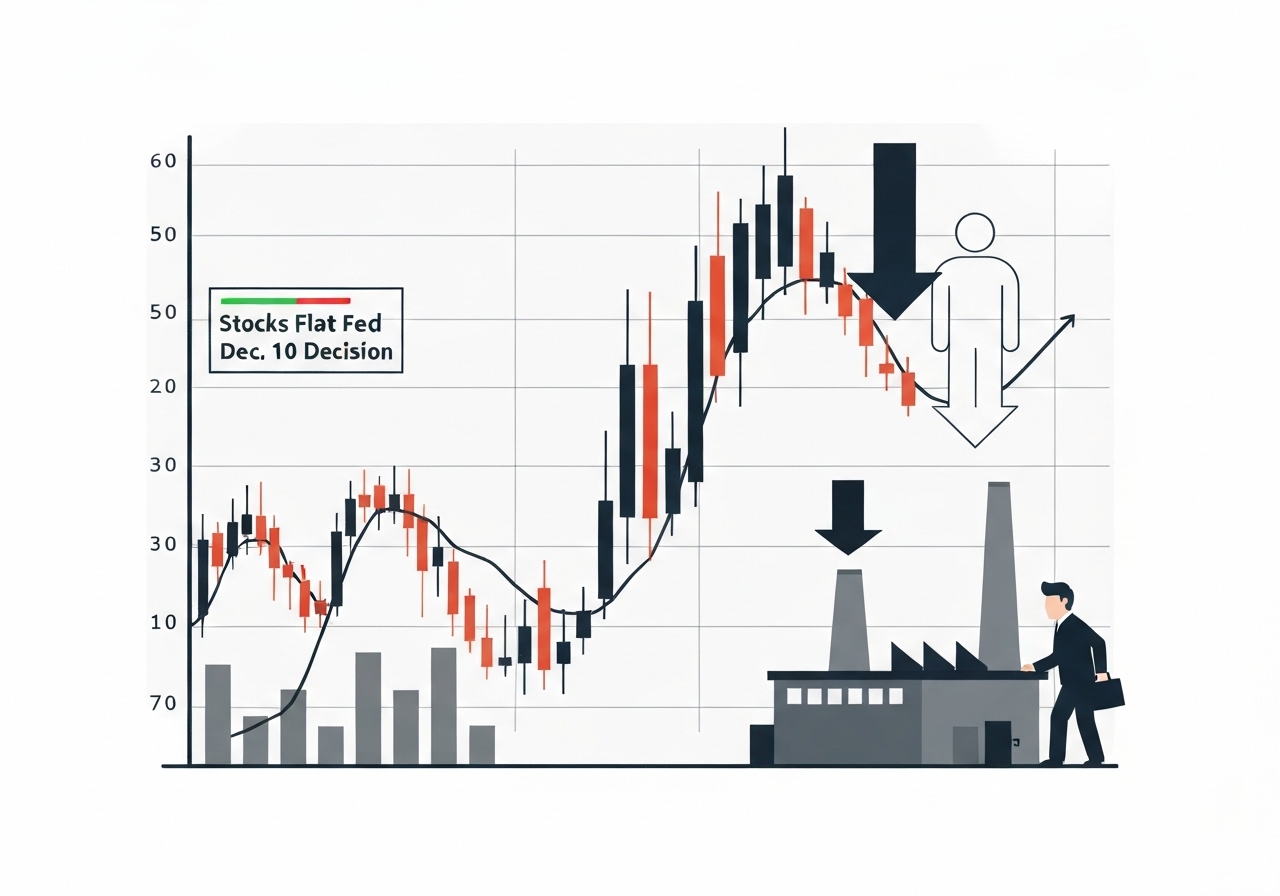
U.S. equity markets were largely unchanged on Thursday, Dec. 3, 2025, as investors positioned for the Federal Reserve’s Dec. 10 policy decision and digested fresh labor-market data. Traders continued to price a high probability of a 25 basis-point cut at the Fed’s final meeting of the year while corporate layoff announcements pushed the 2025 total to 1.17 million. Major averages hovered near record levels even as tech names showed signs of weakness and several companies issued mixed guidance. Economic releases scheduled for Friday, including delayed September consumer spending and the Fed’s preferred inflation gauge, the PCE index, are expected to influence the Fed outlook.
Key Takeaways
- Major indexes were little changed on Dec. 3, 2025, with the Dow and S&P around the flatline and the Nasdaq down about 0.1% intraday.
- Investors price an ~89% chance of a 25 bp Fed cut at the Dec. 10 meeting, per the CME FedWatch tool.
- Challenger, Gray & Christmas reported 71,321 announced job cuts in November, bringing the 2025 total to 1.17 million, up 54% from the prior year.
- Initial jobless claims for the week ending Nov. 29 fell to a seasonally adjusted 191,000, the lowest level since Sept. 24, 2022; continuing claims were about 1.94 million.
- Corporate movers: Salesforce issued stronger-than-expected Q4 revenue guidance; Five Below reported earnings well above estimates; Snowflake cut product revenue-growth guidance and fell sharply.
- Tech leadership showed strain: Microsoft closed roughly 2.5% lower on a report it trimmed AI-related software targets; Nvidia and Broadcom added to sector pressure.
- Markets await Friday’s delayed Commerce Dept. reports on consumer spending/incomes and the PCE price index plus the University of Michigan December consumer survey.
Background
The market narrative entering the first week of December centers on whether weakening labor-market signals and softer hiring will allow the Fed to ease policy before year-end. A sequence of data — including a surprising ADP private payroll slowdown earlier in the week and the Challenger report showing elevated layoff announcements — has shifted investor expectations toward monetary easing. Historically, sudden shifts in the labor market have been a primary driver of Fed timing decisions, and traders often react rapidly when signals suggest cooling.
Corporate restructuring and technology-driven consolidation have been cited as key drivers of 2025 job-cut announcements, alongside trade policy uncertainty. At the same time, many major indices are trading close to record highs after recent gains, so the current market is balancing stretched valuations against data that could justify lower policy rates. The interplay between economic indicators, central-bank guidance and earnings season results is shaping a cautious but opportunistic investor stance.
Main Event
Trading on Dec. 3 opened with modest gains for the major averages but later settled near unchanged territory as investors weighed mixed headlines. The S&P 500 and Dow began the session up about 0.2% before momentum faded; the Nasdaq underperformed and slipped roughly 0.1% as tech names cooled. Market attention concentrated on labor-market datapoints and corporate updates that may inform Fed deliberations.
Labor-market releases were a focal point. The Labor Department reported initial jobless claims for the week ending Nov. 29 at a seasonally adjusted 191,000, down 27,000 from the prior week and below the 220,000 consensus. Meanwhile, Challenger, Gray & Christmas tabulated 71,321 announced layoffs in November, bringing their 2025 tally to 1.17 million, a level not seen since 2020. These readings pulled in different directions for the policy outlook: claims fell, but cumulative layoff announcements remain elevated.
On the corporate front, Salesforce raised its fourth-quarter revenue outlook, sending shares higher in premarket trading, while Five Below posted third-quarter adjusted EPS of $0.68 versus an expected $0.24 and reported $1.04 billion in revenue, beating consensus. By contrast, Snowflake cut product revenue-growth guidance for the January quarter and fell about 8% premarket. Microsoft closed about 2.5% lower following a report that it reduced AI-related software sales targets; the company publicly disputed that report and the stock recovered some losses by the close.
Policy and trade headlines also affected markets. Treasury Secretary Scott Bessent said the administration could pursue tariff measures under sections of the 1962 Trade Act, comments that kept tariff risk on the radar for firms exposed to global supply chains. Separately, Nvidia CEO Jensen Huang’s comments to reporters after a meeting with President Trump drew attention as lawmakers debate export controls and potential provisions such as the proposed GAIN AI Act.
Analysis & Implications
Markets now trade with the expectation that the Fed will cut rates by 25 basis points at the Dec. 10 meeting. That pricing reflects a string of softer labor signals and the possibility that inflation momentum will moderate after upcoming PCE readings. If the PCE index confirms cooling inflation, the Fed will have stronger cover for easing, but a hot print would complicate that path and likely push markets to reprice the timing and magnitude of cuts.
The divergence between headline jobless claims and cumulative layoff announcements complicates the narrative. A drop in weekly claims to 191,000 suggests ongoing labor resilience, but the elevated 1.17 million announced job cuts through November highlights structural adjustments in certain sectors, particularly tech and retail. Policymakers will need to weigh whether layoffs are concentrated and cyclical or signal a broader softening that justifies a policy pivot.
Sector implications are uneven. Technology, which has driven much of 2025’s equity gains, looked vulnerable during this session, with Microsoft, Nvidia and Broadcom among the underperformers. Defensive and cyclical sectors have seen rotation flows as investors reduce exposure to richly valued growth stocks. Meanwhile, Citi’s initiation of U.S. airlines at buy suggests analysts see room for cyclical rebound in 2026, highlighting pockets of opportunity even as overall sentiment becomes more cautious.
Comparison & Data
| Metric | Value | Context |
|---|---|---|
| Initial jobless claims (week ending Nov. 29) | 191,000 | Lowest since Sept. 24, 2022; below 220,000 consensus |
| Continuing claims | 1.94 million | One-week lagging series |
| November announced layoffs (Challenger) | 71,321 | 2025 total: 1.17 million (up 54% y/y) |
| CME FedWatch implied chance of 25 bp cut (Dec. 10) | ~89% | Market-implied probability |
| Notable stock moves (pre/early session) | Salesforce +1.6%, Snowflake -8.2%, Dollar General +6.5% | Company-specific guidance and earnings drove moves |
The table above summarizes core datapoints investors referenced on Dec. 3. Taken together, the data show a mixed labor picture and strong market odds for an imminent Fed easing, but upcoming PCE and consumer data will be decisive for policymakers and asset prices.
Reactions & Quotes
Market strategists and corporate leaders offered immediate reactions that framed the day’s trading. Analysts noted that rotation out of tech into defensive areas signals a tentative risk-off posture after months of leadership by big tech.
“Rotation is often called the lifeblood of a bull market; recent movement away from tech toward defensive areas marks the first notable sign of risk aversion since April’s rebound.”
Adam Turnquist, Chief Technical Strategist, LPL Financial
Company and policy voices also weighed in on AI and trade topics that affect supply chains and chipmakers.
“We support export controls that ensure U.S. companies have the best and first access to advanced chips, while balancing national-security concerns.”
Jensen Huang, CEO, Nvidia
On trade policy and tariffs, Treasury commentary kept potential policy shifts in focus.
“The administration has tools under the 1962 Trade Act to recreate parts of its tariff agenda if necessary.”
Scott Bessent, U.S. Treasury Secretary
Unconfirmed
- The inclusion of the GAIN AI Act in the final National Defense Authorization Act package remains unconfirmed; reports conflict and the matter is still under legislative negotiation.
- Claims that Microsoft formally reduced AI-related sales targets were reported by a third party and were publicly disputed by the company; the precise internal sales assumptions are not independently verified.
Bottom Line
Markets entered the Dec. 10 Fed meeting pricing a high probability of a 25 basis-point cut, reflecting a mix of softer labor signals and hopes for easing inflation. However, the juxtaposition of low weekly jobless claims and elevated cumulative layoff announcements means policymakers and investors must parse sector-specific disruption versus broad weakening.
Upcoming data releases — notably the delayed September consumer spending/incomes reports and the PCE price index, plus the University of Michigan consumer survey — will be the immediate catalysts to confirm or challenge current market pricing. Until those prints arrive, expect muted market action punctuated by stock-specific volatility tied to earnings and guidance.